

wayground logo

Free Printable Worksheets

Font size

S
M
L
XL
Worksheets

Great Depression

Total questions: 76

Worksheet time: 46mins
Name
Class
Date
1.
Month and Day that Stock Market Crashed
a)
October 28, 1929
b)
October 29, 1928
c)
October 29, 1929
d)
October 29, 1939
2.
Which was NOT a LONG-TERM cause of the Great Depression?
a)
Buying stock on margin
b)
Stock market crash (Black Tuesday)
c)
too much production and consumer spending
d)
Laisezz-faire economic policies
3.
The Great Depression began in
a)
1925
b)
1929
c)
1932
d)
1940
4.
What effect did the Dust Bowl storms have on the Great Depression?
a)
Many farmers were forced to leave the Great Plains.
b)
Unemployment decreased gradually.
c)
Many homes long the Mississippi River were flooded.
d)
Hoover was re-elected as president.
5.
In the 1930's, people would line up at ____________ to get food.  These were normally run by charities.
a)
churches
b)
businesses
c)
soup kitchens
d)
work
6.
Who was president at the time of the Stock Market Crash of 1929?
a)
Abraham Lincoln
b)
Franklin D. Roosevelt
c)
Theodore Roosevelt
d)
Herbert Hoover
7.
After the Stock Market Crash, many people lost their life savings because _______________.
a)
banks closed
b)
banks gave away their money
c)
they couldn't remember where they put it
d)
someone stole it
8.
What were the villages full of shacks located in cities filled with unemployed Americans called?
a)
Hoovervilles
b)
Okies
c)
Bonus Army Bases
d)
Rooseveltowns
9.
Which economic factor contributed most directly to the start of the Great Depression?
a)
low worker productivity
b)
high income taxes
c)
decreasing tariff rates
d)
buying stocks on margin
10.
Which of the following was NOT an effect of the Great Depression?
a)
homelessness
b)
bank failures
c)
high tariffs
d)
struggling farmers
11.
What natural disaster of the 1930s added insult to injury?
a)
Flooding along the Mississippi River
b)
The Dust Bowl
c)
Tornadoes called the Helen Hunt Twisters
d)
Hurricanes along the Gulf Coast
12.
Pick the best answer.  Over-production of what led to the Great Depression?
a)
farm goods
b)
consumer goods
c)
farm and consumer goods
d)
iPhones
13.
What tool - passed during the Hoover Administration -  designed to protect American manufacturers actually ended up creating a worldwide depression?
a)
Reconstruction Finance Committee
b)
Hawley-Smoot Tariff
c)
New Deal
d)
Second New Deal
14.
The Bonus Army incident in 1932 best illustrates the idea that
a)
F.D.R.'
s relief programs were unsuccessful.
b)
many felt that Herbert Hoover was not handling the Depression well.
c)
protests by veterans during the Depression were effective.
d)
the U.S. Army had increased in size and power during the Depression.
15.

Which of the following is NOT a cause of the Great Depression?

a)

Overproduction and underconsumption

b)

High tariffs restricting trade

c)

buying stocks on the margin

d)

high income taxes

16.

What was President Herbert Hoover's response to the Great Depression?

a)

He believed "rugged individualism" would solve the economy

b)

He created mass welfare

c)

He increased infrastructure to create jobs

d)

He violated his policy of laissez-faire

17.

Money loaned to banks, insurance companies & businesses to jumpstart the economy by Hoover

a)

Reconstruction Finance Corporation (RFC)

b)

Civilian Conservation Corps (CCC)

c)

Works Progress Administration (WPA)

d)

Securities & Exchange Commission (SEC)

18.

Migrant farmers from Oklahoma

a)

Hooverville

b)

Okies

c)

Economy

d)

Soup Kitchens

e)

Dust Bowl

19.
Farmers contributed to the problems that led to the Dust Bowl by
a)
putting down new layers of topsoil.
b)
moving off of the plains to find new farmland.
c)
damming western rivers and using irrigation techniques.
d)
using intensive farming practices that removed protective grasses.
20.

Roots of the Depression included overproduction, high tariffs, and

a)

uneven distribution of wealth

b)

inadequate money supply

c)

over-spending by government

d)

excessive reliance on export sales

21.

Which is a reason Americans preferred movies, radio, and entertainment during the Great Depression?

a)

Focused on the homeless and unemployed

b)

Evoked indignation at social injustice

c)

Provided a release from the daily worries

d)

Created thrills with new special effects

22.

Which of the following BEST describes farmers during the Great Depression

a)

Many farmers found success through out the depression selling their items to other countries

b)

Many farmers found success through out the depression selling their items to hungry Americans

c)

a drought and low prices forced many farmers into poverty and foreclosures

23.

After President Hoover failed to help the public, who ran for election on the slogan a New Deal for Americans?

a)

Franklin D Roosevelt

b)

Harry S Truman

c)

Calvin Coolidge

d)

Herbert Hoover

24.

The New Deal is BEST described as

a)

fixing and ending the Great Depression giving millions a steady job and a regular paycheck moving forward into the 1940s

b)

being the same thing President Hoover did just setting up a system of empty promises given to the people

c)

temporary help and relief to some Americans, but could not sustain or end the Great Depression

25.

FDR wanted to be able to control all parts of the government including the Supreme court, he tried doing this by attempting to...

a)

Abolish the Supreme court

b)

Take away judges

c)

Give more power to the courts

d)

Pack the Supreme Court with his judges

26.
When was the depression?
a)
1929-1941
b)
1950-1957
c)
1910-1914
d)
1945-1949
27.
What is disposable income?
a)
Garbage money
b)
Money left over after paying bills
c)
Money spent on garbage items
d)
Recycled money
28.
When an owner cannot pay their mortgage and the bank repossesses their property and sells it.
a)
Installment Buying
b)
Buying on credit
c)
Fraud
d)
Foreclosure
29.
Unemployment got how high during The Depression?
a)
25%
b)
50%
c)
10%
d)
20%
30.
What was FDR's program for ending the Great Depression called?
a)
Money Deal
b)
New Plan
c)
New Deal
d)
Working Deal
31.
What ultimately ended the Great Depression?
a)
WWI
b)
FDR
c)
WWII
d)
JFK
32.
Which of the following was a major cause of the Great Depression?
a)
overproduction and underconsumption
b)
a decrease in the supply of consumer goods
c)
an increase in demand for imported products
d)
an increase in the price of wheat on the world market
33.
How did "bank runs" impact the American people during the Great Depression?
a)
Banks eventually ran out of money to loan, and people's life savings were gone.
b)
Banks made loans throughout the Great Depression, helping people pays bills until they could find work.
c)
Banks were able to people's deposits safe, but they could not loan out any more money.
d)
Banks were not at all involved in the Great Depression because people did not use them.
34.
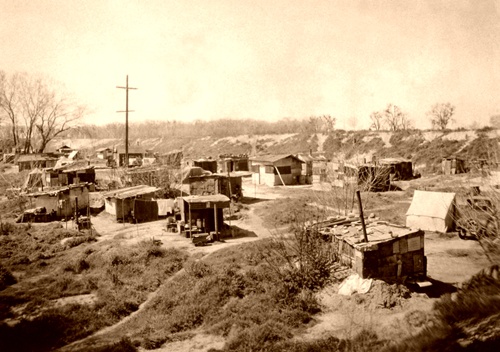
What was the main reason for the emergence of “Hoovervilles” like the one shown in the photograph?
a)
Many Americans had lost jobs during the Great Depression.
b)
Thousands of homes had been destroyed by the effects of the Dust Bowl.
c)
Housing projects could not keep up with the demand for homes needed by the poor.
d)
Preparations for World War I had created a shortage of building materials.
35.
During the early 1930s, the main goal of the Bonus Army was to pressure the Hoover administration to
a)
strengthen the nation’s defenses
b)
end the military draft
c)
bring American troops home from overseas
d)
support the early payment of money promised to veterans
36.
Which of these statements is true of the 1932 presidential election?
a)
Franklin Roosevelt won in a landslide.
b)
Hoover lost by a narrow margin.
c)
Huey Long ran a strong third-party campaign.
d)
Roosevelt won a third term.
37.
A major difference between the philosophies of President Herbert Hoover and President Franklin D. Roosevelt in responding to the Great Depression is that Roosevelt
a)
wanted to rely on private charities to provide assistance
b)
stressed the need for individual rugged individualism
c)
supported direct relief to people out of work
d)
thought the government should not be involved in economic reform
38.
FDR addressed the American public in weekly broadcasts known as:
a)
FDR Hour
b)
Hangin' With Franklin
c)
Fireside Chats
d)
Around the Fire
39.
What was a guiding principle of the New Deal economic policies?
a)
Pro-business tax breaks would solve the problems associated with urban poverty.
b)
Antitrust legislation would destroy the free market economy of the United States.
c)
Rugged individualism must be allowed to solve social inequality.
d)
Government must assume more responsibility for helping the poor.
40.
As part of the New Deal, the Securities and Exchange Commission (SEC) and the Federal Deposit Insurance Corporation (FDIC) were created to
a)
allow for a quick recovery of stock prices
b)
provide direct loans to businesses
c)
protect individual investors from stock fraud and bank failure
d)
allow banks and companies to invest in the stock market
41.
The Civilian Conservation Corps (CCC) and the Works Progress Administration (WPA) were both New Deal programs developed to address the problem of
a)
excessive stock market speculation
b)
high unemployment
c)
increased use of credit
d)
limited income of senior citizens
42.
The TVA is significant because it hired people to 
a)
deliver food to the poverty-stricken Dust Bowl residents
b)
build dams and generators that provided electricity
c)
work on farms to help stabilize agriculture
d)
publish important facts about businesses
43.
An advocate of President Franklin D. Roosevelt’s farm policy would have likely supported which economic strategy?
a)
Reducing agricultural output to increase product values
b)
Utilizing minimum wage laws to stimulate farm productivity
c)
Allowing market forces to operate freely to achieve stabilization
d)
Increasing agricultural production to ensure an affordable food supply
44.
How would an African American during the Great Depression most likely have felt about the New Deal?
a)
Disappointed, because the TVA failed to bring power to African American farmers in its Rural Electrification Program.
b)
Outraged, because African Americans were ineligible for any benefits under New Deal programs.
c)
Frustrated, because the CCC and other work programs discriminated against African Americans.
d)
Angry, because President Franklin D. Roosevelt did not attempt to restrain his racially insensitive views.
45.
The Fair Labor Standards Act of addressed what labor issue?
a)
Workplace safety
b)
Health insurance
c)
Collective bargaining
d)
Minimum wage
46.
A major reason that President Franklin D. Roosevelt proposed adding Justices to the Supreme Court in 1937 was to
a)
make the Court processes more democratic
b)
end corruption and favoritism in handling cases
c)
influence Court decisions related to New Deal programs
d)
ensure the appointment of members of minority groups
47.
Passage of the Social Security Act (1935) helped American workers by 
a)
creating jobs for the unemployed
b)
guaranteeing a minimum wage
c)
legalizing the right to join labor unions
d)
providing financial assistance after retirement
48.
Senator Huey Long, Dr. Francis Townsend, and Father Charles Coughlin are best known as
a)
members of President Franklin D. Roosevelt’s cabinet
b)
outspoken critics of President Franklin D. Roosevelt’s New Deal
c)
supporters of President Franklin D. Roosevelt’s reelection campaign in 1940
d)
members of the Supreme Court nominated by President Franklin D. Roosevelt
49.
A major result of the New Deal was that it
a)
eliminated poverty in the US
b)
extended the merit system in the civil service
c)
destroyed the private enterprise system
d)
greatly increased the size and power of the Federal Government
50.
Which of the following was a cause of the Depression?
a)
Overproduction 
b)
Easy Credit 
c)
Unequal Distribution of Wealth
d)
All of the above 
51.
Which President thought the government should not get involved in economic affairs?
a)
Hoover
b)
Roosevelt 
52.
Which of the following is NOT an effect of the Dust Bowl?
a)
Large migration from the Great Plains to the West Coast
b)
Stock prices fell 
c)
Massive Clean Ups
d)
Bank Foreclosures 
53.
Roosevelt passed a record number of bills in what we call his...
a)
Political Reform 
b)
Fireside Chat 
c)
First Hundred Days
d)
Inaugural Speech 
54.
Buying on margin means you are buying _____ with borrowed money. 
a)
Cars
b)
Homes
c)
Stocks
d)
Food
55.
The term for when those who invest in the stock market take great risk, buying stocks and bonds in hopes of earning a quick profit:
a)
Brokers
b)
Speculation 
c)
Bear Market 
d)
Buying on Margin 
56.
 A bull market is a downward trend it stock prices.
a)
True
b)
False 
57.
Which of these pull factors drew Okies to California?
a)
promises of steady farmwork
b)
a mild climate near the ocean
c)
cheap homes on large plots of land
d)
the prospect of plentiful factory jobs
58.
Did the New Deal end the Great Depression? 
a)
Yes
b)
No
59.
October 29th, 1929
a)
Black Monday
b)
Black Tuesday
c)
Black Wednesday
d)
Black Friday
60.
The Dust Bowl devastated what part of the U.S. during the Great Depression?
a)
West Coast
b)
New England
c)
Deep South
d)
Great Plains
61.
Which of the following DID NOT cause the Dust Bowl?
a)
overproduction
b)
windstorms
c)
drought
d)
tornadoes
62.
Who are these people?
a)
hoboes
b)
immigrants
c)
tourists
d)
carpet baggers
63.
When people went to the bank to withdraw their money and the banks had no money was known as the 
a)
Bank Crisis 
b)
Black Tuesday
c)
Stock Market Crash
d)
New Deal 
64.
What is a good title for this list?
a)
Culture of the 1920s
b)
The Great Migration
c)
Impact of the Great Depression
d)
Features of the New Deal
65.
All of the following were causes of the Great Depression except - 
a)
Prohibition
b)
Overspeculation on stocks
c)
failing banks
d)
high tariffs
66.

How did installment plans make the economy appear healthy during the 1920s

a)

Most people did not experience bankrupcies

b)

Agricultural sales went down

c)

It caused banking closings

d)

Credit allowed people to buy luxury goods

67.

What was the purpose of the Works Progress Administration (WPA)

a)

To Track cost in Medicare

b)

To close banks until approved to operate

c)

To help farmers with loans and crop prices

d)

To provide jobs to the unemployed

68.

Based on the cartoon, how did FDR plan to fix the Great Depression

a)

By expand the role of government

b)

By expanding the role of the treasury department

c)

By limiting the amount of money in the top 1%

d)

By creating programs to lower poverty levels

69.

What is relative to an economic boom?

a)

Economic prosperity

b)

Bank Failures

c)

Stock Market Crash

d)

The Great Depression

70.

What was the main goal of programs like the TVA, CCC, WPA, and AAA?

a)

To aid in civil right

b)

To aid with WWI war debt

c)

Aid people in buying credit

d)

To provide jobs for the unemployed

71.

How did the introduction of agencies show the government's involvement during the New Deal?

a)

Government must get involved the economy

b)

the government is not to be involved with the economy

c)

The government should assist people in cities only

d)

The government should not modify programs for the rich

72.

What happened during the bank Holiday?

a)

All banks were closed, reformed and restored

b)

All banks closed due to bankrupcy

c)

The banking system collapsed

d)

Banks were allowed to take weekends off

73.

What does the image represent?

a)

Buying on margin

b)

stock market

c)

installment plans

d)

speculation

74.

The FDIC was part of which R of the New Deal

a)

It was part of Relief because it gave jobs to the unemployed

b)

It was part of Recovery because it was a program to encourage spending

c)

It was part of Reform because it reformed commerical banks and protected peoples monies

75.

True or False: Some people felt the New Deal would be too controlling?

a)

True

b)

False

76.

How did the New Deal combat depression

a)

It allowed the US to borrow money from other countries

b)

It aided farmers ONLY

c)

It increased government spending to help create jobs

d)

It established welfare.
