
 Worksheets
AP World History Review
Total questions: 120
Worksheet time: 1hrs 13mins

Number 1 region on the AP World map is?
North America
South America
USA
Latin America

Number 2 region on the AP World map is....
North America
Asia
South America
Latin America

Number 3 region on the AP World map is...
West Africa
Central Asia
East Africa
South Asia

Number 4 region on the AP World map is....
South Asia
the Caribbean
East Africa
Southern Africa

Number 5 region on the AP World map is....
America
Mexico
the Caribbean
Oceania

Number 6 region on the AP World map is...
Oceania
Caribbean
Middle East
Southeast Asia

Number 7 region on the AP World map is...
West Africa
Central Africa
Middle East
South Asia

Number 8 region on the AP World map is...
Mexico
Central America
Central Africa
West Africa

Number 9 region on the AP World map is...
North America
North Asia
North Africa
Europe

Number 10 region on the AP World map is...
North America
Middle East
South Asia
Oceania

Number 11 region on the AP World map is...
Europe
Middle East
North America
Mexico

Number 12 region on the AP World map is...
Central Africa
Central Asia
Middle East
East Asia

Number 13 region on the AP World map is...
North America
South Asia
East Asia
Middle East

Number 14 region on the AP World map is...
Central Asia
Middle East
North Africa
South Asia

Number 15 region on the AP World map is...
East Asia
Southeast Asia
South Asia
Oceania

Number 16 region on the AP World map is...
Southeast Asia
Oceania
South Asia
South America
Early Russia grew out of a principality centered in the city of
Minsk
Kiev
St. Petersburg
Novgorod
What do Vietnam, Japan, and Korea have in common?
They all have languages that stem from the same linguistic family.
China left a lasting cultural and religious imprint on them.
All were once colonies of the Mongols.
All were conquered by the Sung dynasty.
What commonalities can be seen between European and Japanese feudalism?
Centralized kingdoms dominated the political scene.
Literature flourished during long periods of peace.
Land formed the basis for power, with lords controlling fiefdoms.
Weak emperors were controlled by religious leaders.
Which of the following was an outcome for peasants in Europe after the Black Death c. 1340?
More land was available and wages increased.
Wages plummeted as demand decreased.
Social unrest decreased.
About 10% of the peasant population died.

Practiced in Song China: the responsibility of children to respect, obey, and care for their parents...
Mandate of Heaven
filial piety
Legalism
Dao
What country was NOT overrun by Chinese armies to become a tributary state?
Vietnam
Korea
Tibet
Japan
A canal linking northern and southern China improved during the song dynasty
Suez Canal
Panama Canal
Grand Canal
Suzhou Canal
The Song Dynasty is strongly associated with the invention of which weapons technology?
Gunpowder
Grenades
Landmines
Huge warships
What is the most significant impact of the introduction of champa rice in China?
New agricultural technology
Increased trade with tributary states
New forms of labor
Urbanization and population growth
Under the major Chinese Dynasties, candidates for government jobs had to pass official exams that places a large focus or emphasis on . . .
Buddhist teachings
Confucianism
Mathematics and engineering
Sea navigation and survival
What was the importance of the camel?
The camel was able to eat a lot of food often
The camel had many offspring
The camel allowed people to cross the Sahara desert due to its endurance
The camel was faster than the horse
Malian Emperor Mansa Musa’s pilgrimage to Mecca in 1324 can best be understood in the context of which of the following?
The expansion of Islam throughout Afro-Eurasia
The development of new transportation technologies
The diffusion of African culture to the Middle East
The territorial expansion of West African empires
Ibn Battuta traveled widely across the Middle East, South Asia, Southeast Asia, and Africa in the fourteenth century. His travels serve as evidence for the
unifying influence of Islam
excellent condition of roads in Africa and Asia
political unity of Africa and Asia
widespread use of paper money

The map shows which of the following empires at its greatest extent?
The empire of Alexander the Great
The Mongol Empire
The Russian Empire
The Byzantine Empire
During the thirteenth and fourteenth centuries, territories under Mongol control benefited from which of the following?
Widespread adoption of Confucian family hierarchies
Trade that facilitated the spread of Christianity throughout the Indian Ocean region
Trade that tied several distinct regional networks together
Widespread adoption of Buddhist religious practices

Which of the following caused feudalism in Europe to decline?
Black Plague
Muslim invaders
Revival of Learning
Rebellions for more freedom

Select which parts of Africa had an Islamic influence.
West Africa
East Africa
Southern Africa
Northern Africa

What two religions spread peaceful on trade routes in Asia in 1200 - 1450 CE?
Islam and Buddhism
Sikhism and Judaism
Hinduism and Animism
Christianity and Judaism

What political system form due to the collapse of the Roman empire in Europe?
Feudalism
Communism
Republic
Confucianism

What did the revival of Confucian ideas in Song Dynasty do to women?
They had more restrictions
Their status rose to great heights
They were allowed to work in government
Their status was never changed

What region built canals and irrigation for agriculture, trade, and political control around Hindu temples?
Southeast Asia
East Asia
South Asia
Europe

What American civilization near the Mississippi river valley built what is in the picture?
Cahokia
Cherokee
Navajo
Apache

Select the technology that was developed in the Song Dynasty.
Increased stability of the compass
Gunpowder being used in warfare
Developed drought-resistant rice
Continuation of the woodblock printing


What is the name of the movement that promotes the interests of a particular nation due to intense pride?
A revolution
Protestantism
Enlightenment
Nationalism
Which nation was the first to industrialize?
Britain
France
Germany
Japan
All of the following helped countries to industrialize EXCEPT
Access to waterways
Natural resources like coal
Access to foreign resources and markets
Being colonies of other nations
Select ALL of the following that characterized the Second Industrial Revolution.
Oil
Electricity
Steam
Steel
After Britain industrialized, all of these nations followed suit EXCEPT
Japan
United States
Russia
India
Select ALL of the accurate social effects of the Industrial Revolution.
Poor working and living conditions for the lower class
Increased standard of living for middle and upper classes
Lower class families working closer together in their homes
More accessible and cheaper goods
As countries embraced Adam Smith's capitalism laissez-faire policies, what new forms of business were promoted? Select ALL that apply.
corporations
monopolies
socialism
transnational businesses
Mexico was liberated from
the United States
the Spanish
the Portuguese
the Brazilians

Bolivar envisioned
a Grand Colombia, which united all the liberated South American states
a united Portugal and Spain
a Spanish takeover of Portuguese Brazil
a loosely knit confederation of South American States
Toussant L'Ouverture
was a member of the Committee of Public Safety under Robespierre
rose to the rank of General under Napoleon
was a complete revolutionary failure
helped free slaves in Haiti
Which of the following scientific concepts had the greatest role in providing a justification for imperialism in the late 19th and early 20th centuries?
Louis Pasteur's germ theory of disease
Charles Darwin's theory of evolution
Albert Einstein's theory of relativity
Marie Curie's theory of radio activity


Under the Tokugawa Japan was
a major trading nation
rapidly industrializing
bankrupt
isolated

Commander Perry is connected to
the opening of Japan for trade
the attack on China during the Opium wars
Russia's rapid growth as a power
the defeat of the Napoleon
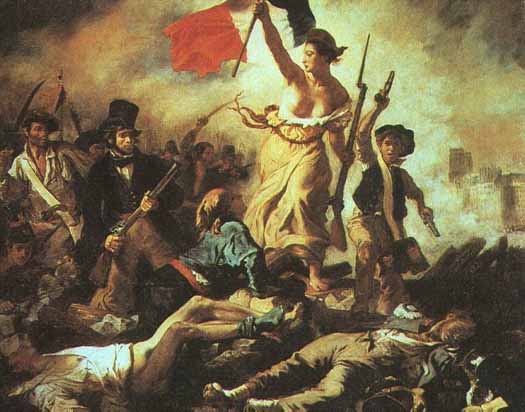
The Haitian Revolution was influenced mainly by which revolution?
French
American
Spanish American
Russian
Which of the following wars helped to inspire the French Revolution?
The American Civil War
The French and Indian War
American Revolution
The Seven Years War
Which document articulated the progressive demands of the National Assembly? ________________The National Assembly consulted with ________________ when writing it.
Declaration of the Rights of Man and the Citizen , Thomas Jefferson
Declaration of the Rights of Man and the Citizen , John Locke
Constitution of the French Republic , Thomas Jefferson
Constitution of the French Republic , John Locke


Which of the following would best describe a "nationalist"?
A citizen who always votes
An employee of the federal government
A person who fights to establish an independent government for their nation
A person who wants to preserve a strong economy for their country

Which country had the largest sphere of influence in Latin America during the Age of Imperialism?
United States
Spain
Mexico
England

The economic system that prevailed from c. 1750-1900 was
Capitalism
Communism
Socialism
Mercantilism

What caused the Taiping and Boxer rebellions?
Foreign economic involvement in China
British selling opium to China
Indians refusing to touch the gunpowder pouches
Americans moving into West North America

What was Japan's response to foreign interference in the nineteenth century?
Adapt to Western politics and culture (Meiji Restoration)
Isolate themselves further by resisting and fighting
Became allies with the Chinese to become the dominant power in the region
Adapt to the ideas of the islanders and tribal people to resist
Which of the following was not a motive of imperialism?
Economic Gain
Cultural Superiority
Democratic Governments
Feelings of Nationalism
Which of the following is NOT one of the reasons why so many people died during World War II?
Weapons became much more deadly such as tanks, airplanes, and the atomic bomb.
Deadly trench warfare
Total War tactics
The bombing of enemy cities with bombs dropped from airplanes
Which of the following had the most influence on the United States' decision to enter World War I?
The entry of the Ottoman Empire
The capture of Paris by the Germans
Unrestricted submarine warfare by the Germans leading to the sinking of the U.S.S. Lusitania
Mexico's insinuation that it would ally itself with Germany
Which country/region was doing the "best" during the 1200s?
Song Dynasty China
Medieval Europe
The Dar -Al -Islam
Sub Saharan Africa
What areas saw a rise of Dictator after WWI because of the Depression?
USSR, Germany and Italy
Russia, Germany and Japan
Japan , Germany and Austria
US, Germany and USSR
What happened to the Ottoman territory after WWI?
It was divided up as part of the Mandate system
All of the states became independent
Suffered control by neighboring conquerors
Nothing, the Ottoman empire stayed in power.

What political ideology is associated with this country during the Interwar period?
Fascism
Militarism
Nazism
Communism

What leader developed the Five Year Plan depicted in this chart?
Vladimir Lenin
Benito Mussolini
Joseph Stalin
Adolf Hitler

Which leader is associated with this newspaper headline?
Nicholas II
Joseph Stalin
Vladimir Lenin
Peter the Great

What leader is associated with this image?
Benito Mussolini
Joseph Stalin
Adolf Hitler
Hideki Tojo

What was the "New Deal" of the 1930s?
a government program that gave free land to homesteaders
a government program that helped women get the vote
a government program that spread civil rights throughout the country
a government program designed to help people during the depression

