

wayground logo

Free Printable Worksheets

Font size

S
M
L
XL
Worksheets

Unit 13 Test - States of Matter

Total questions: 50

Worksheet time: 1hrs 2mins

Name
Class
Date
1.
Which of the following statements is NOT true of all different types of matter?
a)
They are made of atoms and molecules
b)
The particles are always in motion
c)
The particles always move at the same speed
d)
They are made of particles that are too small to see
2.

The change of state from a liquid to a solid (a)  

Choose from the below words
freezing
melting
evaporation
boiling
3.

What is the change of state from a gas to a liquid called? (a)  

Choose from the below words
deposition
sublimation
evaporation
condensation
4.

Change of state from a solid directly to a gas is called (a)  

Choose from the below words
deposition
melting
evaporation
sublimation
5.
How is a gas defined?
a)
no shape, no volume
b)
Definite shape, definite volume
c)
Found in stars
d)
Definite volume, no shape
6.

What term describes a solid changing to a gas? (a)  

Choose from the below words
Melting
Sublimation
Evaporation
Freezing
7.
Particles of a liquid
a)
are tightly packed together and vibrate in place
b)
have no viscosity.
c)
collide with one another
d)
vibrate and slide past each other
8.
Define a liquid
a)
no shape, no volume
b)
Definite shape, definite volume
c)
Found in stars
d)
Definite volume, no shape
9.

What happens when my glass of water is sitting in the sun and disappears into a gas? (a)  
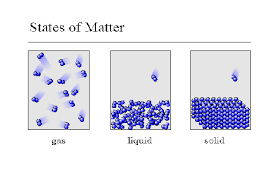
Choose from the below words
evaporation
burning
melting
freezing
10.
At higher temperatures
a)
particles in an object have less energy
b)
particles in an object move faster
c)
a gas contracts
11.
As pressure decreases, boiling point___
a)
decreases
b)
increases
c)
decreases then increases
d)
increases then decreases
12.

The weaker the intermolecular forces of a substance the _____________ the boiling point

a)

higher

b)

lower

13.
When the atmospheric pressure equals the equilibrium vapor pressure ___ occurs.
a)
freezing
b)
melting
c)
boiling
d)
sublimation
14.

Which model represents a LOWER Vapor Pressure? (a)  

Choose from the below words
A
B
15.

The (a)   is a measure of the average speed of the particles in a substance.
Choose from the below words
temperature
density
volume
mass
16.

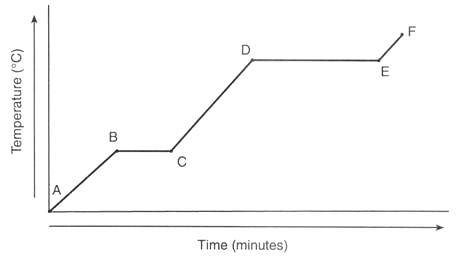
Describe the substance between letters C and D.  (a)  

Choose from the below words
Gas
Liquid
Melting
Evaporating
17.

The melting point of the sample is (a)  

Choose from the below words
-60 ºC
-100 ºC
60 ºC
100 ºC
18.

Given the heating curve of a solid being heated at a constant rate, what is the boiling point of this substance? (a)  

Choose from the below words
20°C
50°C
110°C
170°C
19.

What is the freezing point of the substance? (a)  

Choose from the below words
0oC
60oC
120oC
180oC
20.

Given the heating curve of a solid being heated at a constant rate, what is the boiling point of this substance? (a)  

Choose from the below words
20°C
50°C
110°C
170°C
21.

Which segment of the graph represents both vaporization and condensation? (a)  
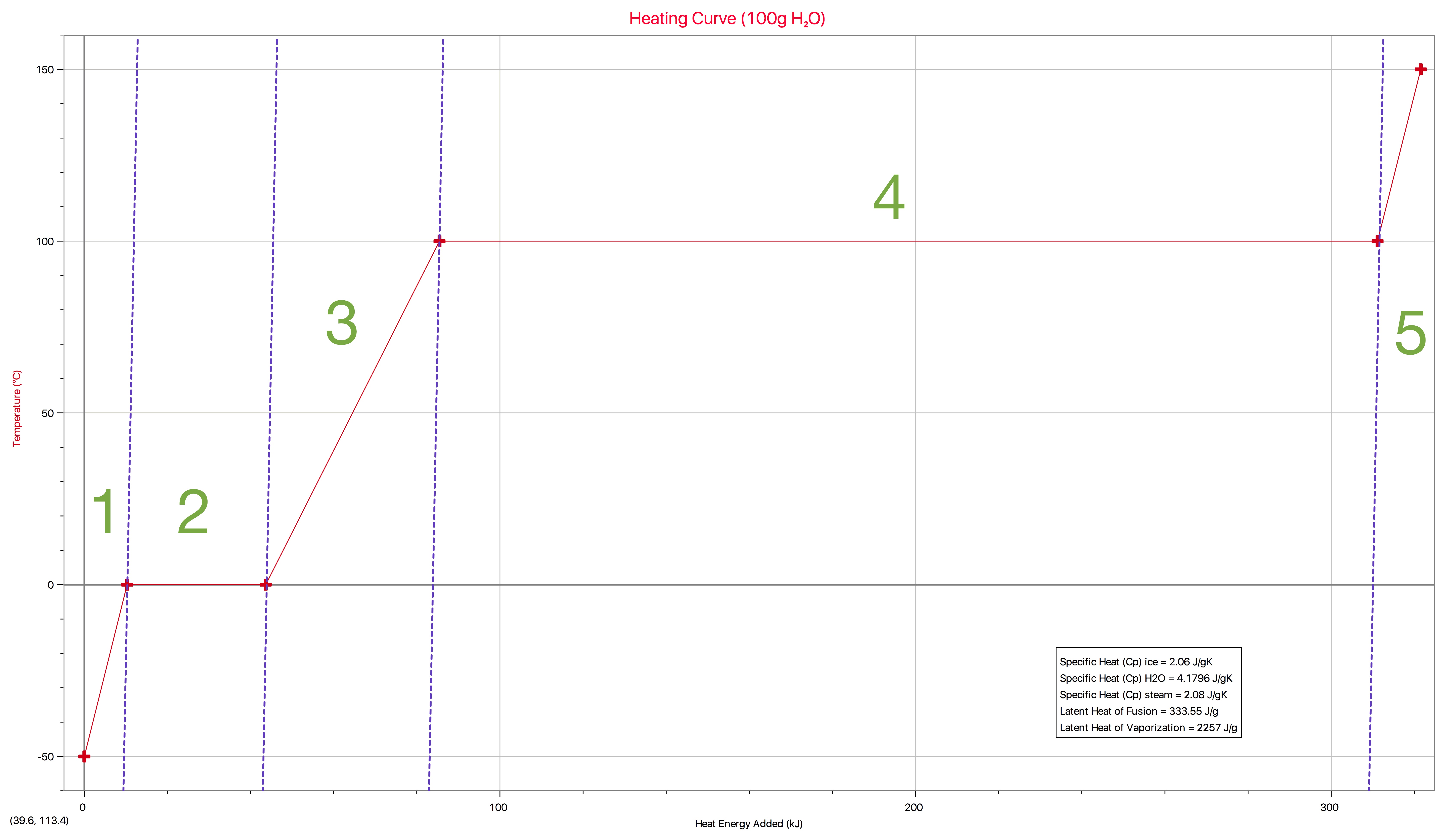
Choose from the below words
AB
BC
DE
EF
22.
In which region(s) of the graph would the substance be a solid only?
a)
Region 1
b)
Region 2
c)
Region 3
d)
Region 4
23.
What state of matter is X?
a)
solid 
b)
liquid
c)
gas
d)
supercritical fluid
24.

What change occurs from E to C? (a)  

Choose from the below words
sublimation
freezing
melting
boiling
25.
Water exists as a _____________ at 700 mmHg and 50 °C.
a)
solid
b)
liquid
c)
gas
d)
supercritical fluid
26.

What letter on the diagram represents the triple point?

a)

A

b)

B

c)

C

d)

D

27.

What change occurs from F to E? (a)  

Choose from the below words
sublimation
deposition
melting
condensation
28.

What is the normal melting point for this substance?

a)

55°C55\degree C  

b)

60°C60\degree C  

c)

80°C80\degree C  

d)

100°C100\degree C  

29.

What is the normal boiling point for this substance?

a)

55°C55\degree C  

b)

60°C60\degree C  

c)

80°C80\degree C  

d)

100°C100\degree C  

30.

If the substance is at 50°C at 1.8 atm, what state of matter will the substance be? (a)  

Choose from the below words
Solid
Liquid
 Gas
Plasma 
31.

Which state of matter has particles arranged like this? (a)  

Choose from the below words
solid
liquid
gas
32.

Which state of matter has particles arranged like this? (a)  
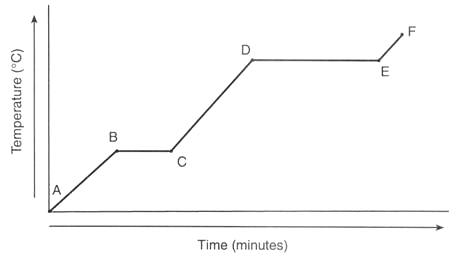
Choose from the below words
solid
liquid
gas
33.
How is a gas defined?
a)
Indefinite shape, indefinite volume
b)
Definite shape, definite volume
c)
Found in stars
d)
Definite volume, indefinite shape
34.

What state/phase is the object likely from points A to B? (a)  

Choose from the below words
Solid
Liquid
Gas
Plasma
35.
During a phase change what happens to temperature?
a)
it increases
b)
it decreases
c)
depends; if being heated it increases, if being cooled it decreases
d)
stays constant
36.
What happens to particles when they are heated?
a)
They speed up and spread out
b)
They slow down and compress
c)
They stop moving
d)
They move closer together and speed up
37.

The intermolecular forces between particles in a solid are

a)

weaker than those in a gas.

b)

stronger than those in a liquid.

c)

of different types than those in a liquid.

d)

too weak to hold the particles in fixed positions.

38.
Water will boil at temperatures above 100 °C at pressures __________ 760 mmHg.
a)
below
b)
above
c)
equal to
d)
significantly below
39.

According to the kinetic molecular theory, a gas consists of molecules in constant fixed motion.

a)

True

b)

False

40.

The kinetic molecular theory states that

a)

particles of matter are in constant motion

b)

particles of matter are in extremely slow motion

c)

particles of matter are never in motion

41.

Which best describes the movement of particles in a solid?

a)

free to flow, constant volume

b)

free to flow, volume changes

c)

vibrates in place,

volume changes

d)

vibrates in place, constant volume

42.

Which of the following is NOT a part of the kinetic molecular theory of gases?

a)

Gases move in random, constant, straight-line motion

b)

Gases are separared by great distances

c)

Gases are attracted to each other

d)

Gases transfer energy when they collide

43.

According to the Kinetic Molecular Theory a liquid's (SELECT ALL THAT APPLY)

a)

particles are held close together by intermolecular forces

b)

particles are in constant motion

c)

particles are vibrating in place and closely packed

d)

particles are not moving

44.
Question Image

Match the following phase change terms with their description

a)

fusion

1.

solid to liquid

b)

solidification

2.

liquid to solid

c)

vaporization

3.

liquid to gas

d)

condensation

4.

gas to liquid

e)

sublimation

5.

solid to gas

45.

The heat absorbed by melting a solid is known as

a)

heat of fusion

b)

heat of solid

c)

heat of liquid

d)

heat of vaporization

46.

The amount of heat needed to change 1 gram of a substance from the liquid phase to the gas phase is (a)  
Choose from the below words
Heat of Vaporization
Boiling point
Heat Energy
Phase change
47.

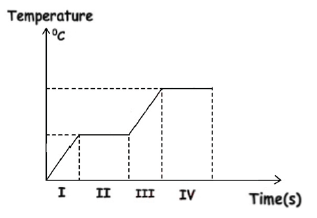
Consider the following temperature-time graph when a solid is heated. which part of the graph involves latent heat of vaporization? (a)  

Choose from the below words
Part I
Part II
Part III
Part IV
48.

Consider the following temperature-time graph when a solid is heated. which part of the graph involves latent heat of fusion? (a)  

Choose from the below words
Part I
Part II
Part III
Part IV
49.
As pressure decreases, boiling point___
a)
decreases
b)
increases
c)
decreases then increases
d)
increases then decreases
50.

Which substance has the weakest intermolecular forces?

a)

Substance A, boiling point of 75 °C

b)

Substance B, boiling point of 105 °C

c)

Substance C, boiling point of 25 °C

d)

Substance d, boiling point of 45 °C
