Worksheets
LENS REFRACTION
Total questions: 15
Worksheet time: 30mins



The above image is an example of a ____________. They happen because cool and hot air have a different ___________________________.
Mirage; angle of incidence
Optical fibre; refractive index
Lateral inversion; angle of reflection
Mirage; refractive index

The focal length of this lens is _______.
negative because it can form real images
positive because it can form real images
negative because it can form virtual images
could be positive or negative depending on the image formed

A person standing in front of a lens creates an image that is both smaller than the original and closer to the lens. Classify the image formed in this scenario.
real, inverted
real, upright
virtual, inverted
virtual, upright

Students often use a hand lens to make small objects appear larger. A hand lens makes objects appear larger because the lens-
increases the light’s strength
changes the color of the light
bends light passing through it
converts light energy to heat
A concave lens has focal length of 20 cm. At what distance from the lens a 5 cm tall object be placed so that it forms an image at 15 cm from the lens? Also calculate the size of the image formed.
u=-60; h' =(5/4)
u=-60; h' =(4/5)
u= +60; h' =(5/4)
u=+60; h' =(4/5)
You are given three media A, B and C of refractive index 1.33, 1.65 and 1.46. The medium in which the light will travel fastest is
A
B
C
Equal in all media
Which of the following statements is/are true?
A convex lens has 4 dioptre power having a focal length 0.25 m
A convex lens has -4 dioptre power having a focal length 0.25 m
A concave lens has 4 dioptre power having a focal length 0.25 m
A concave lens has – 4 dioptre having a focal 0.25 m
A point object is placed at a distance of 20 cm from a convex mirror of focal length 20 cm. The image will form at:
at infinity
at focus
at pole
behind the mirror.
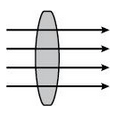
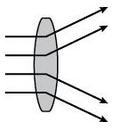
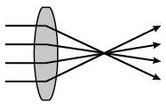
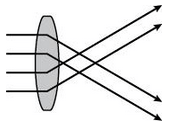
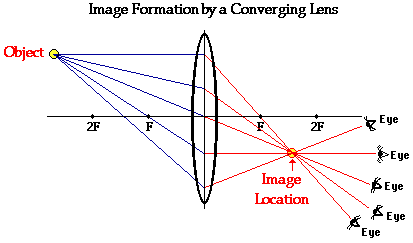
Which figure represents the path light takes through a converging lens?