
 Worksheets
Unit 5: Earth science Review
Total questions: 55
Worksheet time: 55mins

Pangaea is a theory where all continents began as
one big country
one big continent

This is a __________ boundary.
Convergent: Subduction
Divergent
Transform
Convergent: Collision

This is a ________ boundary.
Convergent
Divergent
Transform

This is a _______ boundary.
Convergent
Divergent
Transform
The process by which one plate is forced under another
Radiation
Convection
Conduction
Subduction

When one plate forces it's way under another plate.
convection
boundary
subduction

Tectonic Plate movement is caused by ______________.
the rotation of the Earth
ocean tides
convection currents in the mantle
the moon's gravity

The San Andreas Fault is a classic example of a ___________ boundary.
convergent
divergent
transform
normal

Describe the most likely relationship between these mountains and nearby tectonic plates.
The mountains are probably formed by earthquakes
The mountains are probably formed by the movement of glaciers
The mountains are probably located near the edge of 2 tectonic plates.
The mountains are probably formed by running water.

Is there a pattern to the locations of earthquakes and volcanoes around the globe?
No, earthquakes and volcanoes are random.
Yes, earthquakes and volcanoes usually occur near the boundaries of tectonic plates.
yes, earthquakes and volcanoes usually occur in the middle of tectonic plates.
No, earthquakes and volcanoes usually occur under water.

The Ring of Fire is an area where a large number of earthquakes and volcanic eruptions occur. What claim can be made about the Ring of Fire from this information?
It is the only place on Earth where earthquakes can happen.
The edges of the tectonic plates are moving in this area.
It represents the areas where tectonic plates are the thickest.
It has been getting larger since Earth first formed.

Tectonic plates float on top of the ________
Crust
Mantle
Inner Core
Outer Core
Huge pieces of lithosphere that slowly move on the asthenosphere and consist of the crust and the rigid, uppermost part of the mantle
tectonic plates
North American Plate
Eurasian Plate
African Plate
the place where two different plates have contact.
Pacific Plate
Mountains
Earthquakes
Plate Boundaries
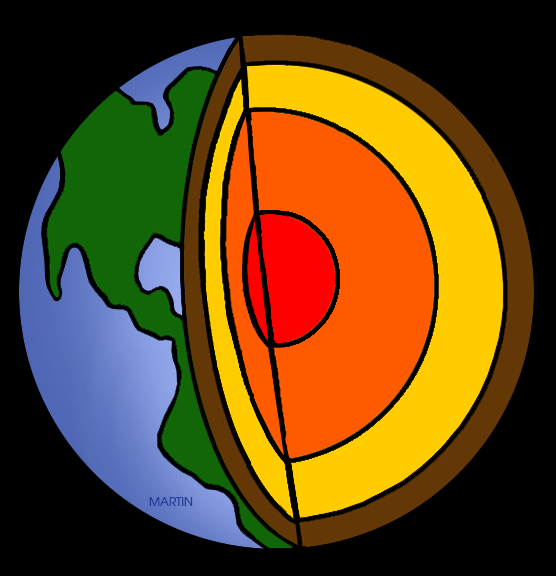
Which layer is shown in red?
crust
mantle
outer core
inner core
Which layer is shown in orange?
crust
mantle
outer core
inner core
Which layer is shown in yellow?
crust
mantle
outer core
inner core
Which layer is shown in brown?
crust
mantle
outer core
inner core

Which shows the order of the layers from COOLEST to HOTTEST?
crust, mantle, outer core, inner core
inner core, outer core, mantle, crust
crust, outer core, inner core, mantle
Trick question! All of the layers are the same temperature!

Which layer is made of "flowing" solid rock (think clay or pudding)?
crust
mantle
outer core
inner core
Which layer is made (mostly) of LIQUID iron and nickel?
crust
mantle
outer core
inner core

Which layer is made (mostly) of SOLID iron and nickel?
crust
mantle
outer core
inner core

Which layer of the Earth is the THINNEST?
crust
mantle
outer core
inner core

Which layer of the Earth is the THICKEST?
crust
mantle
outer core
inner core
Which layer is the hottest?
crust
mantle
outer core
inner core
Which layer is the coolest?
crust
mantle
outer core
inner core
Scientists think that the continents once formed a giant landmass that broke apart, and then slowly drifted apart. What is the name given to this hypothesis?
sea-floor Spreading
plate tectonics
continental drift
Pangaea
Most geologist think that the movement of Earth's tectonic plates is caused by
the rotation of the Earth.
the Earth's magnetic field.
subduction.
convection currents.
Most tectonic plates have both oceanic and continental crust. How are they different?
Oceanic is thinner and less dense than continental.
Continental is thinner than more dense than oceanic.
Continental is thicker and less dense than oceanic.
Oceanic is thicker and more dense than continental.
Alfred Wegener thought South America and Africa have similar coastlines because...
the mesosaurus fossils were found on both continents
He noticed that similar rocks were found on both continents
he thought that the continents used be be joined together
Pangaea was 250 million years ago
What are two pieces of evidence used to support the theory of continental drift?
Fossils and Pangaea
South America and Rocks
Rocks and Fossils
Fossils and Africa
Study of plates, their movement, and Earth’s features that they affect
Plate boundaries
Plate Tectonics
Major mountains
What was Alfred Wegenerś Continental Drift theory?
The continents used to be joined together to form a supercontinent.
The continents have since drifted apart to their current location
Pangaea was formed around 250 million years ago
All of the above

What is the force that moves the continents?
Conduction
Convection Currents
Radiation
Conveyor belts

Where did Wegener find plant fossils that today would not be able to survive on that type of land?
North America
Antarctica
China
India
Convection currents, the force that moves tectonic plates, happens in the
lithosphere
asthenosphere
outer core
inner core
Tectonic plates are on what layer?
top of the crust
lithosphere; the bottom of crust and top of the mantle
asthenosphere; the middle of the mantle
outer core

A convergent: Collision boundary would result in WHAT landform?
volcano
earthquake
rift valley
mountain

