wayground logo

Free Printable Worksheets

NEW

Font size

S
M
L
XL
Worksheets

Ecology Pre-Test

Total questions: 36

Worksheet time: 36mins

Name
Class
Date
1.
All of the living and nonliving things in an area that interact with each other are called a/an ______.
a)
community
b)
habitat
c)
population
d)
ecosystem
2.
An area where an organism finds food, shelter and water in a specific arrangement
a)
niche
b)
biosphere
c)
biome
d)
habitat
3.
The living part of an ecosystem
a)
Biotic
b)
Abiotic
c)
Mother Earth
d)
Flowers
4.
The non-living part of an ecosystem
a)
Ocean
b)
Lava Flow
c)
Birds
d)
Abiotic
5.
The study of how living things interact with one another and with their environment.
a)
Biology
b)
Lithology
c)
Ecology
d)
Farmacology
6.
Organisms that look similar and can produce fertile offspring
a)
Species
b)
Fish
c)
Community
d)
Trees
7.
Two or more members of a particular species living and interacting in the same area
a)
Community
b)
Population
c)
Organisms
d)
Biosphere
8.
Different populations living and interacting with each other in the same area
a)
Biome
b)
Ecosystem
c)
Community
d)
Niche
9.
The area between the highest mountain and the deepest ocean where life can be found
a)
Biosphere
b)
Biome
c)
Farm
d)
Ecosystem
10.

What is the correct order for this food chain?

a)

Owl, Mouse, Grasshopper, Grass

b)

Grass, Mouse, Owl, Grasshopper

c)

Grass, Owl, Grasshopper, Mouse

d)

Grass, Grasshopper, Mouse, Owl

11.

Which of these organisms is the secondary consumer?

a)

Owl

b)

Mouse

c)

Grass

d)

Grasshopper

12.

Which of these organisms is the producer?

a)

Owl

b)

Mouse

c)

Grasshopper

d)

Grass

13.

What do herbivores eat?

a)

Animals

b)

Plants and Animals

c)

Plants

d)

Dead Animals

14.

What do omnivores eat?

a)

Animals

b)

Plants and Animals

c)

Plants

d)

Dead Animals

15.

Place the levels of environment in the correct order.

a)

biome, biosphere, population, organism, ecosystem,community

b)

organism, ecosystem, biosphere, population, community, biome

c)

organism, population, community, ecosystem, biome, biosphere

d)

population, community, organism, biome, ecosystem, biosphere

16.

What is the hawk in the food web?

a)

Producer

b)

Primary consumer

c)

Secondary consumer

d)

Tertiary consumer

17.

Which of these is an aquatic biome?

a)

Savanna

b)

Tropical Rainforest

c)

Marine

d)

Tundra

18.

How much energy is transferred between trophic levels?

a)

25%

b)

20%

c)

10%

d)

90%

19.

Which of these is the main source of energy on Earth?

a)

The Sun

b)

Producers/Plants

c)

Consumers/Animals

d)

Decomposers/Fungi

20.

Which species will have the largest population?

a)

Hawks

b)

Snakes

c)

Rabbits

d)

Grass

21.

Which species is the 2nd level consumer?

a)

Sharks

b)

Mackerel

c)

Herring

d)

Crustaceans

22.

Which of these are ways that animals will use to conserve energy during the winter?

a)

Grow more fur

b)

Hibernate

c)

Take a long trip to find food (migrate)

d)

Find a cabin with a fire place

23.

When a honeybee pollinates flowers, the bee gets access to nectar, while the flowers gain the chance to reproduce. This is an example of:

a)

Amensalism

b)

Commensalism

c)

Parasitism

d)

Mutualism

24.

Which of the following is an example of a parasite?

a)

A flea

b)

An orchid

c)

An Egyptian plover

d)

The bacteria that live in human intestines

25.

Remoras are fish that swim alongside sharks, eating scraps that the sharks leave behind. This is an example of:

a)

Amensalism

b)

Commensalism

c)

Parasitism

d)

Mutualism

26.

Mistletoe is a plant that grows in the branches of other plants. It grows by taking nutrients and water from these plants. This is an example of:

a)

Mutualism

b)

Commensalism

c)

Parasitism

d)

Amensalism

27.

Both species benefit

a)

symbiosis

b)

parasitism

c)

mutualism

d)

commensalism

28.

This is any close relationship between any two different species in an ecosystem

a)

symbiosis

b)

parasitism

c)

mutualism

d)

commensalism

29.

One species benefits, the other is unaffected

a)

symbiosis

b)

parasitism

c)

mutualism

d)

commensalism

30.

One species benefits, the other species is harmed

a)

symbiosis

b)

parasitism

c)

mutualism

d)

commensalism

31.
If the number of births in a population is the same as the number of deaths in a population, what will happen to the growth of the population?
a)
It will increase.
b)
It will decrease.
c)
It will stay the same.
d)
It will fluctuate.
32.
If the number of births is greater than the number of deaths in a population, what will happen to the growth of the population?
a)
It will increase.
b)
It will decrease.
c)
It will stay the same.
d)
It will fluctuate.
33.
Largest number of individuals of a population that the environment can support...  
a)
carrying capacity
b)
population crash
c)
lag phase
d)
mutualism
34.
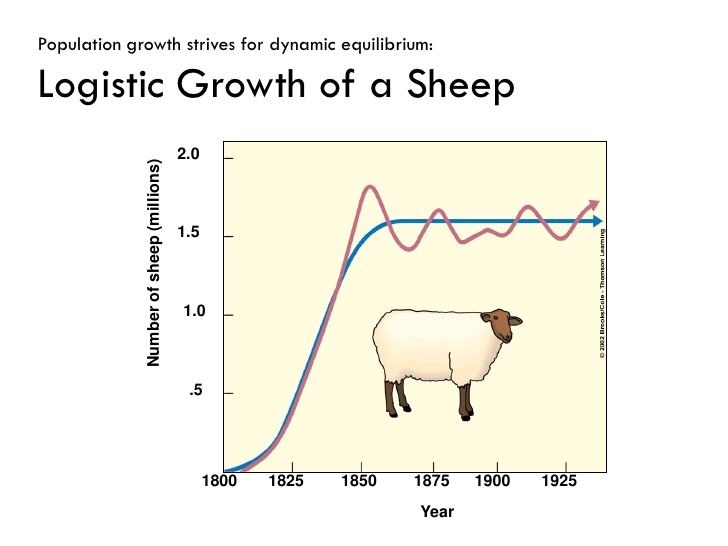
What is the carrying capacity for this sheep population?
a)
1.8 million
b)
1.25 million
c)
1.6 million
d)
1.o million
35.
When a population grows past the ecosystem's carrying capacity, what happens to the population?
a)
Continues to grow
b)
The population starts to die off to return to carrying capcity
c)
The population will go extinct due to lack of resources
d)
The population grows then finds a new carrying capacity
36.
Food, water, sunlight, shelter, and space are resources that are often __________.
a)
limiting factors
b)
wet
c)
messy
d)
found in rocks