
 Worksheets
Economy: Week 27-28
Total questions: 60
Worksheet time: 4hrs 20mins


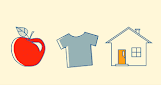
Air, shelter, and food are all examples of ______________
needs
wants

Someone who buys goods or services is called a ____________________
producer
consumer


A farmer grows grapes to sell. He is the __________ of grapes.
Producer
Consumer
The exchange of goods and services without the use of money ______.
service
consumer
producer
barter
Trade is the exchange of goods and __________.
business
services
Which of these is an exchange of a service?
fixing your computer
an iPhone
Before money was invented people had to _____.
Barter
Buy
What problem did people have in the time before money?
It was difficult to get what they wanted and needed.
The mall was too crowded
Before money, people bartered what they had for what they needed.
True
False

Why did people decide to use mediums of exchange?
Everyone wanted to trade eggs.
No one wanted to trade furs.
Sometimes people did not want what someone else had to trade.
Seashells were pretty.
What were mediums of exchange used in the past?
flowers and crops
rice and beans
shillings and pence
seashells and chocolate beans
Why was paper money used instead of coins?
a. It was easier to use.
b. It was harder to use.
c. It was prettier.
d. It was too big to carry.
Who decides what currency looks like?
a. countries
b. states
c. cities
d. schools
What type of money does the U.S. use?
a. pesos
b. dollars
c. yen
d. euros
Who was involved in the decision to base our money system on the decimal system?
George Washington
Abraham Lincoln
Benjamin Franklin
Alexander Hamilton
What is specialization?
when an individual, company, or nation focuses on what they produce so they can trade with others
when an individual exchanges goods with someone who has money
when a country imposes duties on imports in order to protect home industries
when a country binds itself to a course of action

Humans use the Atlantic Ocean in South Carolina for _____________ and ______________.
Fishing and swimming
Drinking and bathing
Farming and logging
Swimming and cooking
Which of the following shows two ways that humans use water for recreation?
Swimming and kayaking
Drinking and bathing
Farming and swimming
Transportation and hydroelectricity
Trees from the forests can used for _____________.
fishing, drinking, swimming, transportation, hydroelectricity
agriculture crops for eating, for materials (cotton), to feed animals
timber products, paper, cardboard, building materials
food (meat, eggs, milk), horseback riding, hunting
building materials, jewelry, electronics, vitamins
Rocks & minerals especially those in the Piedmont region can used for _____________.
fishing, drinking, swimming, transportation, hydroelectricity
agriculture crops for eating, for materials (cotton), to feed animals
timber products, paper, cardboard, building materials
food (meat, eggs, milk), horseback riding, hunting
building materials, jewelry, electronics, vitamins
Water found in South Carolina's rivers, lakes and the ocean can used for _____________.
fishing, drinking, swimming, transportation, hydroelectricity
agriculture crops for eating, for materials (cotton), to feed animals
timber products, paper, cardboard, building materials
food (meat, eggs, milk), horseback riding, hunting
building materials, jewelry, electronics, vitamins
Animals, which are plentiful in South Carolina, can used for _____________.
fishing, drinking, swimming, transportation, hydroelectricity
agriculture crops for eating, for materials (cotton), to feed animals
timber products, paper, cardboard, building materials
food (meat, eggs, milk), horseback riding, hunting
building materials, jewelry, electronics, vitamins
Why do some people migrate from one place to another?
less freedom
better jobs
limited resources
to join strangers
Charleston is a large port city located near a natural harbor as well as many rivers. What was the city's biggest advantage of being close to the water?
The rivers and port made agriculture easier.
The rivers and port made it easier for people to trade goods.
The rivers and port were popular with tourists.
The rivers and port were sources of fresh water.
Which natural geographic feature of South Carolina increases modern tourism in the state?
beaches
deserts
farmlands
swamps
South Carolina is bordered by what large body of water?
Atlantic Ocean
Lake Superior
Mississippi River
Pacific Ocean
How did the geography of South Carolina influence its industrialization?
Cities were built in fields to improve transportation.
Cities were built along the rivers to power factories.
Cities were built in the mountains to mine ore.
Cities were built along lakes to improve trade.
Bridges are most commonly used to help humans travel across what geographic feature?
deserts
rivers
tundra
valleys
Why did humans dam many of South Carolina’s rivers in the 1900s?
to create electricity
to protect natural marshes
to prevent industrialism
to increase tourism
The Atlantic ocean is southwest of South Carolina. The state is renowned for its fresh local seafood, including regional dishes such as she-crab soup.
Fishing
Tourism
Wood Processing
Textiles
Farming
Country that we live in and has a capital is Washington D.C.
United States
South Carolina
North America
Moore
Natural features of land like mountains and islands
Populatiion
Landform
Climate
Continent
The state that we live in
South America
South Carolina
North America
Moore
What is a type of economy?
Food
Dress
Industry
Customs
What is a type of economy?
Natural Resources
Dress
Food
Traditions
When we plant a garden, we are participating in culture or economy?
Culture
Economy
When there is not enough of something
shortage
supply
surplus
demand
When there is an extreme shortage of something
supply
shortage
surplus
scarcity
When there is extra of something
supply
shortage
surplus
scarcity
businesses that sell the same products and try to sell them to customers
competition
opportunity cost
interdependence
specialization
A farmer grows food, but they don't build tractors. This is an example of___.
opportunity cost
interdependence
Specialization
price

