
 Worksheets
MAPEH 6 Q3 SUMMATIVE TEST
Total questions: 60
Worksheet time: 30mins
What is timbre?
The succession of notes and pitches expressing an idea or thought
The repetition of long and short sounds.
The quality or character of a sound.
The loudness and softness of sound.
How are the instruments in the string family played?
By plucking the string
By rubbing the string
By blowing the string
By shaking the string
Which of the following string instrument is known as the heart of the orchestra?
Guitar
Harp
Viola
Violin
What is the smallest string instrument in the orchestra?
Guitar
Harp
Viola
Violin
The string instrument that plays the melody in an orchestra.
Guitar
Harp
Viola
Violin
The biggest string instrument.
Double Bass
Harp
Viola
Violin
Drink plenty of water before, during and after dancing.
Dancing Ability
Social Interaction
Having A Healthy Hobby
Lasting Friendships Formed
Educational Value
Wear professionally fitted shoes appropriate to your style of dance.
Dancing Ability
Social Interaction
Having A Healthy Hobby
Lasting Friendships Formed
Educational Value
Which of the following is not a member of the String Instrument Family?
Violin
Snare Drum
Viola
Harp
Which of the following has the highest pitch among the String instruments?
Guitar
Harp
Viola
Violin
What instrument has the lowest pitch in the string family?
Double Bass
Harp
Viola
Violin
Which of the following is a picture of Maglalatik folk dancers


What Folk dance category shows imaginary combat or duel with the use of fighting equipment like the bolo and spear? ex: sagayan
Comic Dance
Mimetic Dance
War dance
Itik-Itik Dance
Dance from Surigao; an example of a mimetic dance as it imitates the movements of a duck.
Dances that serve as ritual as one passes to a different stage in life; includes courtship, wedding and funeral dances
Dances that exhibit the customs, ideas, beliefs, superstitions and events of daily living in certain Filipino community
Dances that are either religious or secular and relate to the celebration of recurring events of special significance

Right arm is maintained above the head and left arm is placed in first position. Right foot placed in front of the left foot about one foot away from each other.
1st position
2nd position
3rd position
4th position

Both arms are raised in front of chest with rounded elbows. Heels together, 45 degrees open.
1st position
2nd position
3rd position
4th position
5th position
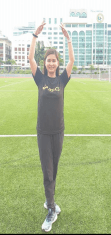
Both arms are raised above the head with rounded elbows. Right heel close to the left big toe.
1st position
2nd position
3rd position
4th position
5th position

Arms are opened sideward with rounded elbows. Feet apart about one foot away from each other.
1st position
2nd position
3rd position
4th position
5th position

Right arm is raised above the head and left arm is maintained in second position. Right heel close to the left in step.
1st position
2nd position
3rd position
4th position
5th position
Philippine National Artist and Mother of Philippine Folk Dances.
Francesca De Reyes Aquino
Francheska Reyes Aquino
Francesca Delos Reyes Aquino
Francisca Reyes Aquino
the dances movement of the tikling bird as it walks aroung through tall grass and between tree branches.
tinikling
pandanggo sa ilaw
sayaw sa bangko
itik-itik
it is performed by a couple on a narrow bench inching and hopping from one end to another.
tinikling
pandanggo sa ilaw
sayaw sa bangko
itik-itik
is performed while balancing three oil lamps-one on the head and one in each hand.
tinikling
pandanggo sa ilaw
sayaw sa bangko
itik-itik
is an indigenous dance from the Philippines in which coconut shell halves that are secured onto the dancers' hands and on vests upon which are hung four or six more coconut shell halves.
maglalatik
pandanggo sa ilaw
cariñosa
singkil
is a dance traditionally performed by single women to attract the attention of potential suitors.
maglalatik
pandanggo sa ilaw
cariñosa
singkil
is from the Spanish _______________ meaning the affectionate one.
maglalatik
pandanggo sa ilaw
cariñosa
singkil
Which of the following is NOT a primary color?
Green
Red
Yellow
Blue
What do you call the principle of art that refers to the visual arrangement of elements with a repetitive form or intelligible sequence?
Contrast
Emphasis
Balance
Pattern
Which of the following is concerned with the visual distribution or weight of the elements in a work of art?
Balance
Proportion
Movement
Variety
Which of the following can be horizontal, vertical, or diagonal; straight or curved; thick or thin?
color
form
line
space
What is the expression or application of human creative skill and imagination, typically in a visual form such as painting or sculpture, producing works to be appreciated primarily for their beauty or emotional power?
art
elements
space
texture
These colors made from primary and secondary colors
TRIADIC
COMPLEMENTARY COLORS
TERTIARY COLORS
SECONDARY COLORS
Which of these instruments requires a bow in order to be played?
violin
lute
bouzouki
clarinet
Which of the following is a stringed instrument?
trombone
saxophone
harp
timpani

The saxophone is a popular jazz instrument, but what was its first use?
wall ornament
military music
drowning out flutes
bluegrass music
How many pedals does a piano have?
2
3
4
1
How many strings does a cello have?
1
2
3
4

The clarinet is considered a
woodwind instrument
brass instrument
string instrument
percussion instrument

The trombone is rarely used in
jazz
pop
rock
folk
Which of the following instruments is the lightest?


What is this?
guitar
violin
drum

What is this?
piano
gutiar
keyboard

What is this?
keyboard
piano
harmonica

harmonica
tambourine
drum

harmonica
flute
tambourine

harp
lyre
cymbals

drums
congas
bongos

drum
congas
bass drum

french horn
trombone
clarinet

clarinet
saxophone
trumpet

clarinet
saxophone
trumpet

flute
bagpipe
triangle
A setting on your camera that will allow you to create a burst of artificial light.
Shutter button
Lens
Flash
Lightning
The file type for image files.
File
File Name
Memory Card or SD Card
JPEG

What part of the camera is this?
Shutter button
Playback button
Menu button
Menu

What does this do?
Lets you zoom.
Thumb grip
Releases the shutter to take the photo.
Releases the lens to take the photo.

What does this do?
Displays the image
Thumb grip
Button to zoom
Scrolls, selects, and has functions
Which part of the camera is the most delicate or fragile?
Flash
Lens
Battery latch
Viewfinder or display screen
This button magnifies (makes larger) the current displayed picture. You don't want to use this setting a lot because it can cause your photo to be blurry/low quality.
Menu button
Viewfinder
Lens
Zoom
The "window" through which you look to frame your picture.
Lens
Viewfinder
Shutter button
Playback button

