wayground logo

Free Printable Worksheets

Font size

S
M
L
XL
Worksheets

PBS Meiosis practice

Total questions: 28

Worksheet time: 17mins

Name
Class
Date
1.
The cells produced via meiosis are called:
a)
sex cells
b)
somatic cells
c)
body cells
d)
skin cells
2.
This produces 2 identical cells.
a)
mitosis
b)
meiosis
3.

A human usually has xx amount of chromosomes.

a)

6

b)

23

c)

4

d)

46

e)

92

4.
What phase is  shown in the picture?
a)
anaphase 1
b)
anaphase 2
c)
metaphase 1
d)
telophase 1
5.
Meiosis makes sperm and egg cells. In humans, sperm and egg cells each have _____ chromosomes. Therefore a fertilized human egg cell (sperm and egg cell combined) would create a cell with _____ chromosomes.
a)
23, 46
b)
46, 23
c)
2, 4
d)
50, 100
6.
Goes through P.M.A.T two rounds 
a)
Mitosis
b)
Meiosis
c)
Osmosis
d)
Transcription
7.
If the Diploid number of Carrots is 18, the haploid number is
a)
18
b)
9
c)
27
d)
36
8.
If a somatic cell in a butterfly contains 24 chromosomes, a butterfly egg would contain
a)
3
b)
6
c)
12
d)
24
9.

Which of the following is the best definition for MEIOSIS?

a)

the process of two haploid cells uniting

b)

the counting of chromosomes within a diploid cell

c)

a two-step process that reduces the number of chromosomes in half such that there is only one copy of all the chromosomes

d)

the equational division of a cell into two identical copies

10.

True or False? Before cells undergo meiosis they pass through interphase first.

a)

true

b)

false

11.

How many cells are formed at the end of Meiosis II?

a)

2

b)

3

c)

4

d)

8

12.

In Anaphase II, the _________ separate.

a)

Homologues

b)

Sister Chromatids

c)

Tetrads

d)

Centrioles

13.

In Metaphase II, _________ line up on equatorial plane.

a)

homologous pairs of chromosomes

b)

single chromosomes (made up of 2 sister chromatids)

c)

tetrads

d)

centrosomes

14.

Which part of MEIOSIS is identical to MITOSIS?

a)

Meiosis I

b)

Meiosis II

15.
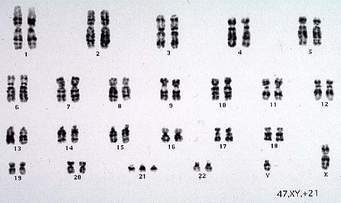
Based on the Karyotype shown, at which chromosome pair can we identify a genetic disorder? 
a)
Chromosome pair 5
b)
sex chromosomes
c)
Chromosome pair 21
d)
There are no chromosomal disorders
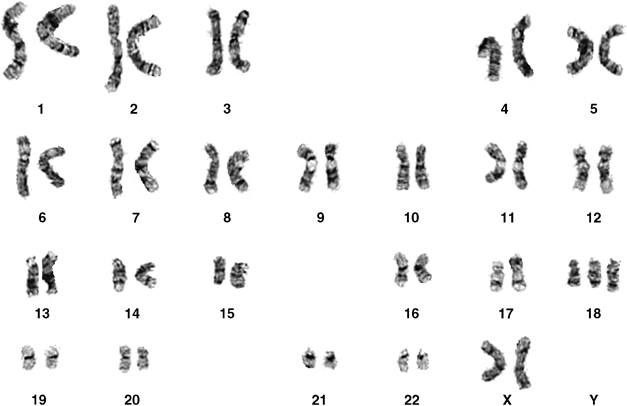
16.
a)
This karyotype shows Trisomy 21
b)
This karyotype has no abnormality
c)
This karyotype is missing a sex chromosome (monosomy x)
d)
This karyotype is from a gamete
17.
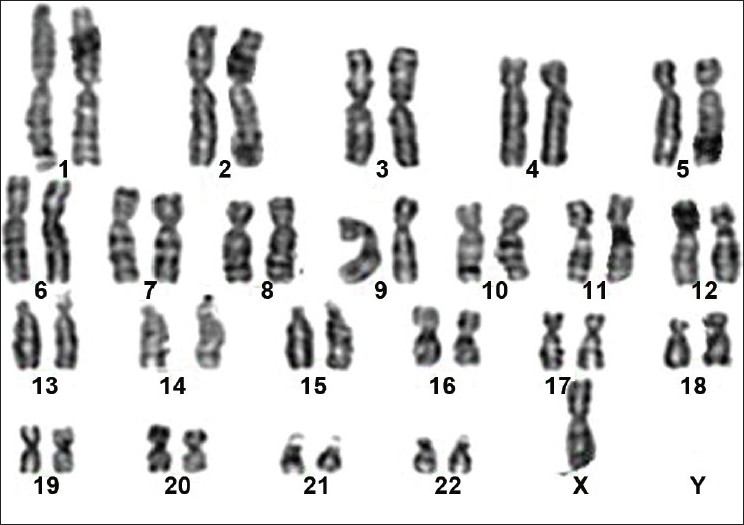
What is the chromosomal condition of the individual whose karyotype is seen in the image?
a)
Monosomy X (Turner's Syndrome)
b)
Trisomy 21 (Down's Syndrome)
c)
Trisomy 13 (Patau Syndrome)
d)
Trisomy 18 (Edwards's Syndrome)
18.
Nondisjunction can result in 
a)
trisomy conditions
b)
monosomy conditions
c)
additional sex chromosomes
d)
all of these
19.
When chromosomes fail to separate correctly during anaphase of meiosis, what can occur?
a)
extra chromosomes are found in the sex cell
b)
chromosomes of the sex cell are doubled
c)
chromosomes of the sex cell are halved
d)
meiosis never completes
20.

What would you call the failure of one or more pairs of homologous chromosomes or sister chromatids to separate normally during meiosis?

a)

nondisjunction

b)

anaphase I

c)

nondiploidy

d)

karyotype

21.

A piece of a chromosome is lost

a)

deletion

b)

duplication

c)

inversion

d)

translocation

22.

A piece of a chromosome is copied and remains within the chromosome

a)

deletion

b)

duplication

c)

inversion

d)

translocation

23.

A piece of the chromosome detches, turns 180 degrees, and reattaches

a)

deletion

b)

duplication

c)

inversion

d)

translocation

24.

A piece of one chromosome detaches and reattaches to a different chromosome

a)

deletion

b)

duplication

c)

inversion

d)

translocation

25.

The chromosomal mutation shown in the image is a

a)

deletion

b)

duplication

c)

inversion

d)

translocation

26.

The chromosomal mutation shown in the image is a

a)

deletion

b)

duplication

c)

inversion

d)

translocation

27.

The chromosomal mutation shown in the image is a

a)

deletion

b)

duplication

c)

inversion

d)

translocation

28.

The chromosomal mutation shown in the image is a

a)

deletion

b)

duplication

c)

inversion

d)

translocation