
 Worksheets
Populations & Ecosystems Recovery
Total questions: 15
Worksheet time: 13mins
Name
Class
Date
1.
What is a producer?
a)
Organism that creates their own food.
b)
Organism that eat other organisms for energy
c)
Organism that eat other dead organisms
2.
What is a consumer?
a)
Organism that creates their own food.
b)
Organism that eat other organisms for energy
c)
Organism that eat other dead organisms
3.
What is a decomposer?
a)
Organism that creates their own food.
b)
Organism that eat other organisms for energy
c)
Organism that eat other dead organisms
4.
What do Omnivores eat?
a)
Plants ONLY
b)
Animals ONLY
c)
Plants AND Animals
5.

What animal is on the top of the food chain?
*Remember Humans are on the top of all food chains because we do not get hunted.
*Remember Humans are on the top of all food chains because we do not get hunted.
a)
Grass
b)
Grasshopper
c)
Mouse
d)
Owl
6.
Who does the owl get energy from?
a)
Grass
b)
Grasshopper
c)
Mouse
d)
Ow
7.
Who is the producer in this food chain?
a)
Grass
b)
Grasshopper
c)
Mouse
d)
Ow
8.
All energy on Earth ultimately comes from what source?
a)
Water
b)
Sun
c)
Consumers
d)
Oxygen
9.
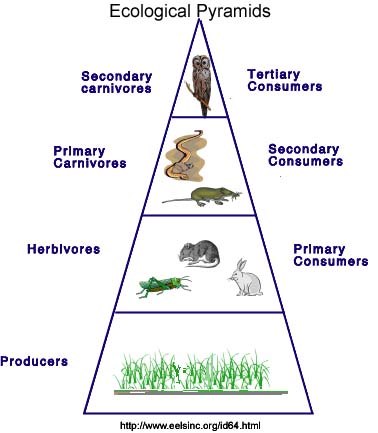
The largest group of organisms found in a food web would be:
a)
Primary Consumers
b)
Producers
c)
Decomposers
d)
Tertiary Consumers
10.
A community of living and nonliving things in their natural environment makes up a
a)
food web
b)
ecosystem
c)
food chain
11.
Non-living factor that affects an ecosystem
a)
biotic factor
b)
abiotic factor
c)
food chain
d)
biome
12.
Limiting factors are sometimes helpful because they can keep the population from getting too large.
a)
True
b)
False
13.
If the population of a certain predator increases, there is often _______ its prey
a)
a decrease the population of
b)
an increase of the population of
c)
great news for its prey of
d)
no impact found on
14.

A pearlfish spends the day inside the intestines of a sea cucumber. The fish emerges from the sea cucumber at night to feed on small crustaceans. The sea cucumber is not harmed by this.
a)
Mutualism
b)
Commensalism
c)
Parasitism
d)
Predation
15.

Bacteria live in the intestines of cows and other organisms. Bacteria help to digest food for the cow. The cow provides a warm, moist environment to live.
a)
Mutualism
b)
Commensalism
c)
Parasitism
d)
Predation
100 %

