
Font size
 Worksheets
Electricity and Magnetism
Total questions: 33
Worksheet time: 25mins
The difference between attraction and repulsion is that to attract is to pull something closer and repel is to push something away.
True
False
What happens when you touch a metal doorknob after rubbing your shoes on the carpet?
The doorknob sends a burst of electric current into your body
Millions of electrons go from your finger into the doorknob
The doorknob sends millions of electrons into your finger
Your finger becomes negatively charged

the negatively charged particle in an atom, moves freely, can be released, shared, or “stolen” from an atom
proton
neutron
electron
An object that is neutral contains the same number of electrons and protons.
True
False
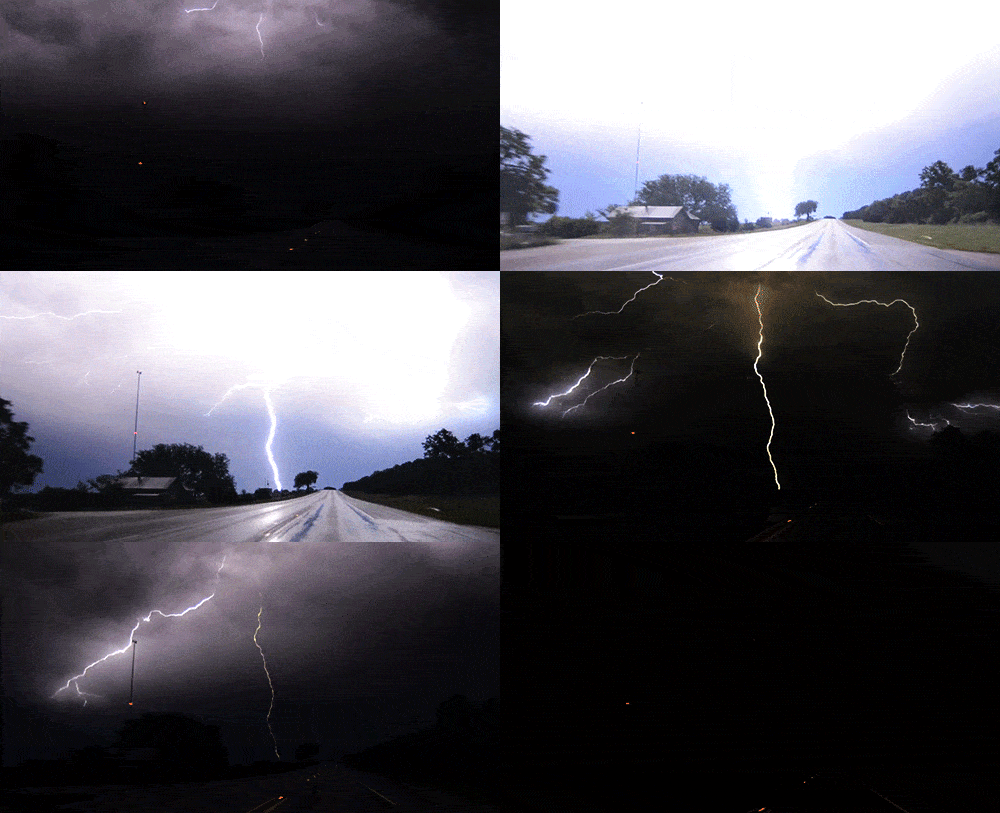
Lightning occurs because ___.
the negative charges at the bottom of clouds are attracted to the positive charges on the ground.
the positive charges at the bottom of clouds are attracted to the negative charges on the ground.
the positive and negative charges inside clouds are attracted to each other
All of these reasons are correct.
What would cause two balloons to repel?
one is positive and one is negative
both balloons are positive
both balloons are negative
one balloon is positive and one is neutral

A good conductor allows energy to easily pass by.
True
False

The electrical wires in many homes are made of copper and covered with plastic. Why are copper and plastic good choices for electrical wires?
Copper is a conductor of electricity, and plastic is an insulator of electricity.
Copper is an insulator of electricity, and plastic is a conductor of electricity.
Copper is a conductor of electricity, and plastic is an insulator of heat.
Copper is an insulator of electricity, and plastic is a conductor of heat.
If the charge on each of two small charged metal spheres is doubled and the distance between the spheres remains fixed, the magnitude of the electric force between the spheres will be
two times as great
four times as great
one-half as great
the same
Why does a Van de Graaff generator make your hair stand up if you touch the dome?
The current is trying to flow out of the hair ends.
The electrons gather on the hair ends and repel each other.
The hair is repelled by the dome of the Van de Graaff generator.
The hair is attracted to the surrounding air.
Lightning could be compared to which of the following?
running water
a wave
spark
thunder
What will happen if two negativley charged objects are pushed together?
They will repel each other
They will create a spark
They will attract each other
They will create a static charge
An object with a positive electric charge will be attracted to...
All objects with any charges
An object with a negative electric charge
An object with a positive electric charge
An object with no charge
A static electric charge can be released as...
gas
heat
a spark
a continuous current
one way to create static electricity is to
run electric current through an object
use an electric generator
turn off an electric current
rub two objects together
When you walk across a carpet and touch a metal doorknob, you create a spark. This occurs because
you have produced an electric current
the doorknob has an electric current
you have produced enough static electricity to create a spark
there is an electric field around the carpet
Electric field is defined as force per charge. It is measured in units of newtons divided by _________.
watts
coulombs
mass
grams
When a magnet spins within a coil of wires, what is produced?
blue sparks
glowing light
nuclear energy
an electric current
When an electric current flows through a wire:
a gravitational field is created around the wire
the wire becomes very cold
the wire begins to spin
the magnetic field is created around the wire

What will happen to the 2 magnets if they are released?
attract
repel

In the bottom of the picture, what explains why the balloons are repelling each other?
opposites attract
like charges in the balloon are repelling each other
the helium has negative charges

Which of the following best describes what is being created in the picture?
static electricity
potential energy
magnetic field
Copper wire, an iron nail, and a battery can be used to make an
(a)
Which of the following best describes what happens if you increase the number of turns of wire in an electromagnet?
the wire burns up
the magnetic field gets bigger
the magnet weakens
the poles reverse
Which of the following charge pairs would repel each other? (Choose all that apply)
positive and negative
negative and negative
positive and positive
negative and positive

