
 Worksheets
F1 Science Quiz 1.4 A
Total questions: 26
Worksheet time: 15mins
The ability of measuring instruments to obtain a value closest to the actual value is called ____________.
Accuracy
Consistency
Sensitivity
The ability of measuring instruments to give the same readings with repeated measurements is called ________.
Accuracy
Consistency
Sensitivity
The ability of measuring instruments to detect a small change in the measurement quantity is called __________.
Accuracy
Consistency
Sensitivity
The right measuring instruments for length are ________.
Measuring tape
Stopwatch
lever balance
ruler
The correct measuring instruments to measure mass are _______.
Laboratory thermometer
Lever balance
Triple beam balance
Ammeter
Which of the following measuring instruments is used to measure electric current ?


Which eye position will cause parallax error while reading the scale ?
Top position
Middle position
Bottom position
Which of the following shows measuring instruments for length from the most accurate to the least accurate ?
Vernier calipers - micrometer screw gauge - ruler
micrometer screw gauge - Vernier calipers - ruler
micrometer screw gauge - ruler- Vernier calipers
ruler- Vernier calipers - micrometer screw gauge

The jaws of the Vernier calipers above are closed.
What type of error shown in this diagram ?
Zero error
Random error
Parallax error
Which of the following can read measurement of mass more accurately and precisely ?
Triple beam balance
Lever balance
Digital electronic balance
Choose suitable measuring tool to measure thickness of a book.
Ammeter
Thermometer
Triple beam balance
Vernier calipers
Choose the correct measuring tool to measure mass of iron cube.
Ammeter
Spring balance
Triple beam balance
Micrometer screw gauge
Choose the correct measuring tool to measure temperature of human body.
Clinical thermometer
Laboratory thermometer
Voltmeter
Electronic balance
Choose TWO measuring instruments that can use to measure thickness of a beaker.
Ruler
Ammeter
Thermometer
Vernier calipers
Micrometer screw gauge
Choose the correct smallest division value of micrometer screw gauge
1 mm
0.1 cm
0.01 mm
1 cm
Choose the correct smallest division value for laboratory thermometer.
1 o C
0.5 o C
0.1 o C
0.01 o C
Choose the correct smallest division value for digital ammeter.
0.1 A
0.5 A
0.01 A
1 A
Choose the correct TWO types of errors when taking measurement.
Random error
Systematic error
Parallax error
Zero error
Choose TWO correct ways to overcome systematic errors and random errors
Use inaccurate measuring instrument
Take average reading from a few reading of measurement
Repeat measurement using different measuring tools
Eye level must be below the measurement scale
Choose TWO correct examples of systematic errors.
Inaccurate measuring instrument
Parallax error
Observer's eye not perpendicular to scale reading
Zero error

This is a:
feeler gauge
digital meter
vernier calipers
micrometer screw gauge

This is a:
feeler gauge
digital meter
vernier calipers
micrometer screw gauge

What is the reading on the vernier calipers?
8.62 cm
8.62 mm
8.52 cm
8.63 cm

What is the reading on the vernier calipers?
1.05 cm
1.06 cm
1.16 cm
1.66 cm
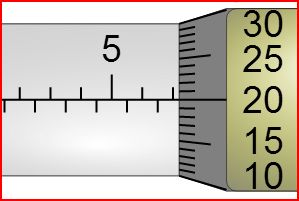
What is the reading on micrometer screw gauge ?
7.20 mm
7.20 cm
9.20 cm
9.20 mm


