
 Worksheets
LS 3 - Cell Processes and Organization
Total questions: 21
Worksheet time: 22mins
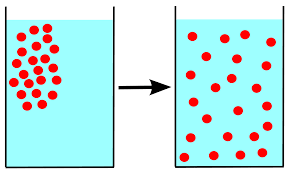
Which TWO examples show how salt molecules will diffuse?


The movement of molecules from high concentration to low concentration is known as (a) .
Draw an arrow showing which direction the water molecules will move across the cell membrane.

The movement of WATER from an area of high concentration to low concentration is known as (a)
What is the difference between osmosis and diffusion?
Osmosis involves movement of substances, diffusion involves movement of water.
Osmosis involves movement of water, diffusion involves substances.
Osmosis involves movement into a cell, diffusion involves movement out of a cell.
Osmosis requires energy, diffusion does not.
What is the correct order of organization from simplest to most complicated?
cells->tissue->organs->organ systems-> organism
tissue->cells->organs->organ systems-> organism
organs->organ systems-> organism->cells->tissue
a grouping of two or more types of tissue that performs a specific function that contributes to the larger purpose
Organ
Organ System
Organelle
Organ in an attic that is super sweet

Tissues are:
a collection of systems that make up an oragnism
a collection of similar cells grouped together that perform a specific function
the most basic building block of life.
an arrangement of organs that work to preform a function for an organism.

The dark structure in the middle of each cell is a
nucleus
lysosome
mitochondria

When similar cells group together it is called a tissue
true
false

Groups of cells of the same type form (a)
Which TWO levels of organization are the LEAST complex?
Cells
Organisms
Organs
Organ systems
Tissues

