
 Worksheets
Phyiscs-Sound
Total questions: 20
Worksheet time: 14mins
All sounds are made by ............. objects.
warm
cold
vibrating
moving
The highest point on a wave
wavelength
crest
trough
amplitude

Sound waves cannot travel through ...................
solid
liquid
space
gas
The lowest point on a wave
crest
frequency
wavelength
trough
The horizontal distance between crests
amplitude
frequency
crest
wavelength
The distance from the resting position to the crest of a wave.
amplitude
wavelength
frequency
pitch
Why can't sound travel through outer space?
There is almost no matter in outer space, so the vibrations have no way to travel through the atmosphere. There is nothing to carry the sound waves through space.
Sound actually travels very quickly through outer space because there is no matter to slow down the sound waves.
There are too many planets and stars in outer space that absorb all of the sound waves, so they cannot travel to the human ear.
Because outer space is a "vacuum," the vibrations are irregular and travel in too many directions for us to detect the sound.
Sound waves carry .............. from one place to another
crests
energy
fluid
particles
How does sound travel?
in waves
only through the air
through magnets
as thermal energy
Which frequency produces a sound that can be heard by a person?
2 HZ
10 HZ
2 kHZ
30 kHZ
What determines the pitch of a sound?
The amount of energy used to create the vibration
The wavelength of the sound wave.
The volume of the sound.
The frequency of the vibrations.
A sound wave with low amplitude produces which type of sound?
High
Low
Loud
Soft
Which TWO of the following statements about sound are NOT true?
Sound is produced through vibrations.
Sound travels in waves.
Sound can travel through outer space
Sound waves can bounce off of objects to create an echo.
Sound waves can only travel through the air.
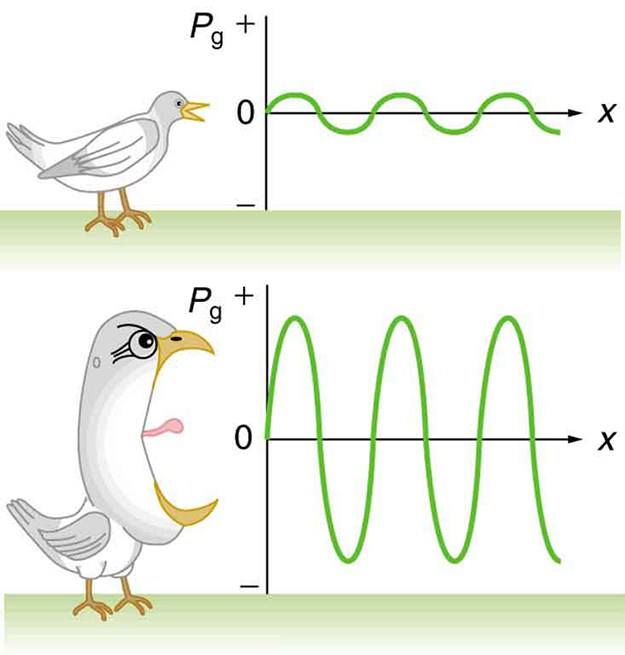
Sound waves can travel through all three states of matter. Which of the following best explains why sound travels most quickly through a solid?
Solids always produce an echo, which makes the sound seem louder to the human ear.
Only solids allow the vibrations to travel from one atom (particle) to another.
In solids, the atoms (particles) are closest together, which allows the vibrations to travel rapidly from one to another through the object.
Sound does not travel quickly through a solid. It travels most rapidly through a gas.
A student claps once when standing 330 m away from a large wall.
The speed of sound in air is 330 m / s.
How long after clapping does the student hear an echo?
(a)

An echo-sounder on a ship produces a pulse of sound. The echo is received by the echo-sounder
after two seconds.
The speed of sound in sea-water is 1500 m / s.
What is the depth of the sea-water below the ship?
(a)

