Wayground logo

Free Printable Worksheets

Font size

S
M
L
XL
Worksheets

Oliver 6th Grade Bio World

Total questions: 85

Worksheet time: 2hrs 32mins

Name
Class
Date
1.
This is the branch of biology that deals with the relations of organisms to one another and to their physical surroundings.
a)
Physics
b)
Ecology
c)
Chemistry
d)
Psychology
2.
It is a biological community of interacting organisms and their physical environment.
a)
Ecosystem
b)
Biotic System
c)
Abiotic System
d)
None of the choices
3.
What is the term used to describe all living things in an ecosystem?
a)
Biotic Factors
b)
Abiotic Factors
c)
Environmental Factors
d)
Population
4.
What is the term used to describe all non-living things in an ecosystem?
a)
Biotic Factors
b)
Abiotic Factors
c)
Environmental Factors
d)
Population
5.

Autotrophs are the same as producers.

a)

True

b)

False

6.

All of the factors listed are abiotic factors of this underwater ecosystem EXCEPT the

a)

sunlight

b)

water currents

c)

fish population

d)

water temperature

7.

In an ecosystem, a fungus, such as the mushroom pictured here, functions as a

a)

autotroph

b)

decomposer

c)

predator

d)

producer

8.

An abiotic component of an ecosystem, required by plants to perform photosynthesis

a)

sunlight

b)

water

c)

oxygen

d)

soil

9.
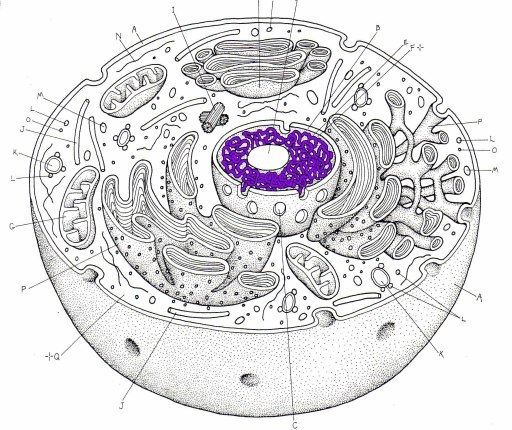
What kind of cell is this?
a)
Eukaryotic
b)
Prokaryotic
10.
Bacteria is what kind of cell?
a)
Eukaryotic
b)
Prokaryotic
11.
Cells can only be seen with the help of a...
a)
hand lens 
b)
magnifying glass
c)
3D glasses 
d)
microscope 
12.
All living things are made of...
a)
atoms 
b)
cells 
c)
bacteria 
d)
plants 
13.
What is unicellular? 
a)
one cell 
b)
many cells 
c)
no nuclues 
d)
DNA 
14.
What is multicellular? 
a)
one cell 
b)
no cells 
c)
many cells 
d)
no nucleus 
15.
All cells come from other...
a)
cells 
b)
plants 
c)
nucleus 
d)
microscopes 
16.
What type of cell has a nucleus? 
a)
eukaryotic
b)
prokaryotic 
17.
What type of cell does not have a nucleus?
a)
eukaryotic 
b)
prokaryotic 
18.
Plants and animal cells are examples of ___ cells 
a)
prokaryotic cells 
b)
eukaryotic cells 
19.

The basic building blacks from which all living organisms are made are

a)

cells

b)

DNA

c)

chromosomes

d)

Amoeba

20.
Bacteria is what kind of cell?
a)
Eukaryotic
b)
Prokaryotic
21.
Where is the DNA found in a prokaryotic cell? 
a)
floating around in the cytoplasm 
b)
in the nucleus 
22.
One example of a prokaryote is a...
a)
fungus
b)
bacteria
c)
animal
d)
plant
23.
Both prokaryotes and eukaryotes have a nucleus.
a)
True
b)
False
24.
What type of cell is pictured?
a)
Prokaryotic
b)
Eukaryotic
c)
Plant
d)
Animal
25.

This cell is a ...

a)

Prokaryotic Cell

b)

Eukaryotic Cell

26.

Which cells have cytoplasm?

a)

Prokaryotic

b)

Eukaryotic

c)

Both

27.

Which cell does NOT have a nucleus?

a)

Prokaryote

b)

Eukaryotes

28.

Which type of cell has DNA IN A NUCLEUS?

a)

Prokaryotic

b)

Eukaryotic

29.

Which type of cell is surrounded by a cell membrane?

a)

Prokaryotic

b)

Eukaryotic

c)

Both

30.

Which cell is smaller?

a)

Prokaryotic

b)

Eukaryotic

31.

This is a _________________ cell.

a)

Prokaryotic

b)

Eukaryotic

32.
Where is the DNA found in a eukaryotic cell? 
a)
floating around in the cytoplasm 
b)
in the nucleus 
33.
Plants and animal cells both have a nucleus.
a)
True
b)
False
34.
First type of cell to appear on Earth?
a)
Plant
b)
Animal
c)
Prokaryotic
d)
Eukaryotic
35.

Bacteria are an example of a ____ cell.

a)

prokaryotic

b)

eukaryotic

c)

plant

d)

animal

36.
To what domain does Kingdom Fungi belong?
a)
Eukarya
b)
Archaea
c)
Bacteria
37.
True or False: Fungi are prokaryotic.
a)
True
b)
False
38.
Parasitic fungi, such as Athlete's Foot and ringworm, are unique because they decompose _____________ cells of organisms.
a)
Living
b)
Dead
c)
Decaying
d)
Blood
39.

Scientists group similar organisms together through a process called .....

a)

identification

b)

Estimation

c)

Classification

d)

Organization

40.
Which kingdom would this organism belong to?
a)
Protist
b)
Plant
c)
Animal
d)
Fungi
41.
A hetertrophic, eukaryotic organism associated with the decomposition of dead material is a(n):
a)
bacteria
b)
fungi
c)
plant
d)
archaea
42.
How many kingdoms are there?
a)
2
b)
3
c)
6
d)
8
43.
In what kingdom would you find trees and flowers?
a)
Plantae
b)
Fungi
c)
Eubacteria
d)
Animalia
44.
What can an autotrophic organism due that a heterotrophic organism can NOT?
a)
Make their own food 
b)
Have a nucleus
c)
Reproduce through binary fission
d)
They're the same
45.
What is the difference between unicellular and multicellular?
a)
They are the same
b)
One has a nucleus and one doesn't
c)
Unicellular has one cell and multicellular has many 
d)
One is bacteria and the is archaebacteria
46.
Is fungi autotrophic or heterotrophic?
a)
Autotrophic, they make their own food
b)
Hetertrophic, they get food from other organisms
47.

Which kingdom is prokaryotic?

a)

Animalia

b)

Archae

c)

Planta

d)

Fungi

48.

What kingdom does yeast belong to?

a)

Kingdom Animalia

b)

Kingdom Plantae

c)

Kingdom Protista

d)

Kingdom Fungi

e)

Kingdom Eubacteria

49.

What kingdom does a giant barrel sponge belong to?

a)

Kingdom Animalia

b)

Kingdom Plantae

c)

Kingdom Protista

d)

Kingdom Fungi

e)

Kingdom Eubacteria

50.

What kingdom does a lion belong to?

a)

Kingdom Animalia

b)

Kingdom Plantae

c)

Kingdom Protista

d)

Kingdom Fungi

e)

Kingdom Eubacteria

51.

What kingdom does a sea anemone belong to?

a)

Kingdom Animalia

b)

Kingdom Plantae

c)

Kingdom Protista

d)

Kingdom Fungi

e)

Kingdom Eubacteria

52.

What kingdom does a fern belong to?

a)

Kingdom Animalia

b)

Kingdom Plantae

c)

Kingdom Protista

d)

Kingdom Fungi

e)

Kingdom Eubacteria

53.

What kingdom does giant kelp belong to?

a)

Kingdom Animalia

b)

Kingdom Plantae

c)

Kingdom Protista

d)

Kingdom Fungi

e)

Kingdom Eubacteria

54.

What kingdom does an amoeba belong to?

a)

Kingdom Animalia

b)

Kingdom Plantae

c)

Kingdom Protista

d)

Kingdom Fungi

e)

Kingdom Eubacteria

55.

What kingdom does E. coli belong to?

a)

Kingdom Animalia

b)

Kingdom Plantae

c)

Kingdom Protista

d)

Kingdom Fungi

e)

Kingdom Eubacteria

56.

All bacteria are bad

a)

True

b)

False

57.

Where do we find bacteria?

a)

Only in rotten food

b)

Only outside

c)

Everywhere

d)

Only in our digestive system

58.

An organism that produces its own food is called a

a)

heterotroph

b)

autotroph

59.

A eukaryotic cell

a)

has no cell membrane and no nucleus

b)

has a cell membrane and a nucleus

c)

has no cell wall

d)

has a cell wall

60.

A prokaryotic cell

a)

has no cell membrane and no nucleus

b)

has a cell membrane and a nucleus

c)

has no cell wall

d)

has a cell wall

61.
Which protist is this?
a)
Amoeba
b)
Paramecium
c)
Plasmodium
62.
Which protist is this?
a)
Amoeba
b)
Euglena
c)
Water mold
d)
Paramecium
63.
How many cells are bacteria made of?
a)
none
b)
one
c)
lots
d)
no one knows
64.

Microorganism that found in extreme environments such as hot springs and underwater volcanoes classify under which Domain?

a)

Both Archaea & Bacteria

b)

Archaea

c)

Bacteria

d)

None of these

65.
Organisms in this smallest taxonomic group share many characteristics.
a)
domain
b)
kingdom
c)
species
d)
class
66.

Organisms whose cells do not have a nucleus are called _____.

a)

Eukaryotes

b)

Multicellular

c)

Unicellular

d)

Prokaryotes

67.
What is a Heterotroph?
a)
A producer
b)
An organism that makes its own food
c)
A consumer or decomposer
68.
How many Domains are there?
Name them:
a)
3; Archaea, Bacteria, Eukarya
b)
2; Bacteria, Eukarya
c)
1; Eukarya
d)
3; Bacteria, Eukarya, Protists
69.
Organisms in the Kingdom Animalia are
a)
mutlicellular and heterotrophic
b)
multicellular and autotrophic
c)
unicellular and autotrophic
d)
unicellular and autotrophic
70.

archaeans are considered (a)   organisms because they live in impossible places

71.

All living things or organisms in an ecosystem are

a)

None

b)

biotic factors

c)

abiotic factors

72.

Is a deer an abiotic or biotic factor?

a)

abiotic

b)

biotic

73.

Is a rose an abiotic or biotic factor?

a)

abiotic

b)

biotic

74.

Is a rock considered abiotic or biotic?

a)

Abiotic

b)

biotic

c)

neither

75.

Which is an example of an abiotic factor in a pond environment?

a)

The water

b)

A frog

c)

A grasshopper

d)

A snake

76.

Which of the following shows an abiotic factor interacting with a biotic factor in the environment?

a)

Lamprey eels survive by attaching themselves to trout.

b)

Water temperature affects its oxygen level.

c)

Low light intensity affects the growth of forest pine trees.

d)

Gypsy moth caterpillars eat the leaves of apple tree.

77.

Which is an example of a seasonal change to a biotic factor?

a)

Temperatures get cooler in the fall.

b)

Hours of sunlight increase the summer.

c)

Birds fly south for the winter.

d)

Rainfall increases in the spring.

78.

Which of these is a biotic factor in a river ecosystem?

a)

the types of microorganisms that live in the river water

b)

the amount of soil and other particles carried by the river

c)

the speed at which the river water flows toward the ocean

d)

the amount of rain that flows off the land and into the river

79.

Which of the following is a biotic factor in an ocean ecosystem?

a)

the salt content of the water

b)

the temperature of the water

c)

the fish in the water

d)

the oxygen in the water

80.

Zebra

a)

Biotic (living)

b)

Abiotic (non-living)

81.

A rock

a)

Biotic (living)

b)

Abiotic (non-living)

82.

wind

a)

Biotic (living)

b)

Abiotic (non-living)

83.

Mushroom

a)

biotic (livng)

b)

Abiotic (non-living)

84.

Is competition within a species a biotic or abiotic factor?

a)

biotic

b)

abiotic

85.

Is predation a biotic or abiotic factor?

a)

biotic

b)

abiotic