
 Worksheets
Temperature and Kinetic Theory
Total questions: 20
Worksheet time: 11mins
A temperature increase causes the particles ......
to slow down
move faster
collide higher
in the right order
Why does a higher temperature increase the rate of a reaction?
it increases both the frequency and energy of particle collisions
it only increases the frequency of particle collisions
it only increases the energy of particle collisions
it reduces the activation energy of the reaction
Under which conditions of temperature and pressure does carbon dioxide behave most like an ideal gas?
A) Low temperature and low pressure
B) Low temperature and high pressure
C) High temperature and low pressure
D) High temperature and high pressure
A real gas differs from an ideal gas because the molecules of a real gas have
A) Some volume and no attraction for each other
B) Some volume and some attraction for each other
C) No volume and no attraction for each other
D) No volume and come attraction for each other
Which statement describes the particles of an ideal gas based on the kinetic molecular theory?
A) The gas particles are relatively far apart and have negligible volume.
B) The gas particles are in constant, nonlinear motion.
C) The gas particles have attractive forces between them.
D) The gas particles have collisions without transferring energy.
According to the kinetic molecular theory, the molecules of an ideal gas
A) have a strong attraction for each other
B) have significant volume
C) move in random, constant, straight-line motion
D) are closely packed in a regular repeating pattern
According to kinetic molecular theory, collisions between gas particles in a sample of an ideal gas
A) increase the energy content of the gas sample
B) produce strong attractive forces between the gas particles
C) result in a net loss of energy by the gas sample
D) transfer energy between the gas particles
Standard temperature and pressure (STP) mean
A temperature of 0°C and a pressure of 101.3 kPa, or 1 atmosphere (atm).
A temperature of 100°C and a pressure of 101.3 kPa, or 1 atmosphere (atm).
A temperature of 0°K and a pressure of 10 atmosphere (atm).
At STP, 1 mol, or representative particles, of any gas occupies a volume of......................
24.4 dm3
44.2 dm3
22.4 dm3
The quantity, 22.4 L, is called the ........................ of a gas.
molar volume
molar mass
Atomic volume
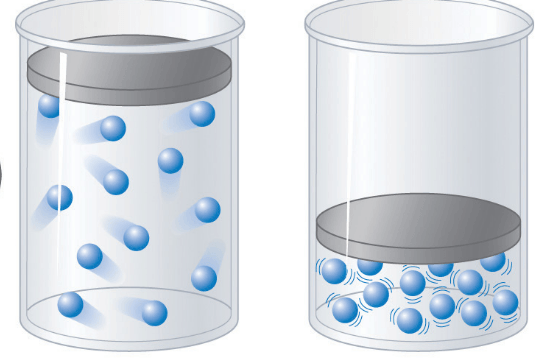
Which container will have a lower pressure?
left
right
they both have the same pressure
I don't know

