wayground logo

Free Printable Worksheets

Font size

S
M
L
XL
Worksheets

M8 Unit 6 Review (Functions)

Total questions: 89

Worksheet time: 2hrs 0mins

Name
Class
Date
1.

The first number in an ordered pair is...

a)

the larger number.

b)

the origin.

c)

the x-coordinate.

d)

the y-coordinate.

2.

The point where the two axes intersect in known as...

a)

the center.

b)

the relation.

c)

the intersection.

d)

the origin.

3.

The left grouping in a mapping is the...

a)

domain.

b)

range.

c)

y-axis.

d)

relation.

4.

The right grouping in a mapping is the...

a)

domain.

b)

range.

c)

x-axis.

d)

coordinate system.

5.
Identify the domain of the following relation:
a)
{-6, 14, 2, 28}
b)
{(-6,14), (0,32), (2,38), (4,44)}
c)
{-6, 0, 2, 4}
d)
{14, 32, 38, 44}
6.
What is the range?
a)
{-2, -1, 0, 3}
b)
{3, 0, -1, 0, -2}
c)
{-4, -2, 1, 2, 5}
d)
{-4, -2, -1, 0, 1, 2, 3, 5}
7.
What is the definition of function?
a)
Has inputs and outputs
b)
Every input has only ONE output
c)
Inputs have different outputs every time
d)
x-values and y-values
8.
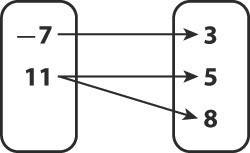
Is the relation a function? Why.
a)
Yes, because the x-value 11 has two y-values pair with it.
b)
Yes, because each x-value has only one y-value paired with it.
c)
No, because the x-value 11 has two y-values pair with it.
d)
No, because each x-value has only one y-value paired with it.
9.
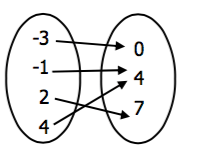
Is this mapping a function or not a function? 
a)
Function
b)
Not a Function
10.

What is the y - intercept?

a)

0

b)

5

c)

- 4

d)

4

11.
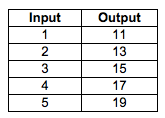
Which equation matches the table?
a)
y = x 
b)
y = 5x
c)
y = x - 4
d)
y = x + 4
12.

What is the equation for this table?

a)

y=2x+5

b)

y=2x+3

c)

y=-2x+5

d)

y=-2x+3

13.

Write the linear equation in y = mx + b form using the given points.

a)

y = -2x + 1

b)

y = -3x + 1

c)

y = 2x + 1

d)

y = 3x - 1

14.

Write the linear equation in y = mx + b form using the given points.

a)

y = -2x + 1

b)

y = 1/2x - 2

c)

y = 2x - 1

d)

y = -1/2x + 2

15.

Which of the following is the equation of the line that has a slope of 3 and passes through the point (-1, 9)?

a)

y = -3x + 12

b)

y = 3x + 3

c)

y = 3x + 12

d)

y = 3x - 3

16.
Find the rate of change
a)
1
b)
2
c)
11
d)
Not a constant slope/Non-Linear
17.
What is the initial value in this equation?
y=8x+6
a)
8
b)
6
18.
What is the rate of change in the equation?
y=8x+6
a)
8
b)
6
19.

Which function has the GREATEST rate of change?

a)
b)
c)
d)
20.

Which function has the GREATEST initial value?

a)
b)
c)
d)
21.

Compare the initial values of each function.

a)

The initial value of item I is greater than the initial value of item II.

b)

The initial value of item I is equal to the initial value of item II.

c)

The initial value of item II is greater than the initial value of item I.

22.

Compare the initial values and rate of change of both functions.

a)

Both functions have the same initial value and rate of change.

b)

The functions have different initial values and different rates of change.

c)

The rates of change are the same, but the initial values differ.

d)

The initial values are the same, but the rates of change differ.

23.

What is f(6) for the function f(x)=3x-8

a)

-8

b)

10

c)

-144

d)

answer not here

24.

What is  f(0)f\left(0\right)   for the function f(x)=2x+3f\left(x\right)=2x+3  

a)

2x

b)

-3

c)

3

d)

10

25.

f(x)=5x12f\left(x\right)=5x-12 What is f(4)f\left(-4\right)

a)

-32

b)

-3

c)

-12

d)

3

26.

Given g(x)=20x189 what is g(12)?Given\ g\left(x\right)=20x-189\ what\ is\ g\left(\frac{1}{2}\right)?  

a)

-189

b)

-179

c)

200

d)

answer not here

27.

Given h(x)=3x22x+8 what is h(0)?Given\ h\left(x\right)=3x^2-2x+8\ what\ is\ h\left(0\right)?  

a)

13

b)

8

c)

16

d)

answer not here

28.

Given f(x)=2x10 for which value of x that f(x)=8?Given\ f\left(x\right)=2x-10\ for\ which\ value\ of\ x\ that\ f\left(x\right)=8?  

a)

5

b)

10

c)

9

d)

-12

29.

How do you read f(x)?

a)

f x

b)

f of x

c)

f parenthesis x

d)

f with an x inside parenthesis

30.
f(x) is the same thing as ______.
a)
y
b)
x
c)
input
d)
an equation
31.
What is the definition of function?
a)
Has inputs and outputs
b)
Every input has only ONE output
c)
Inputs have different outputs every time
d)
x-values and y-values
32.
a)
Function
b)
Not a Function
33.
Is this mapping a function or not a function? 
a)
Function
b)
Not a Function
34.
All of the y values or outputs are called what?
a)
Domain
b)
Range
c)
Relation
d)
Function
35.
All of the x values or inputs are called what?
a)
Domain
b)
Range
c)
Relation
d)
Function
36.
Which of these is NOT the same
a)
Range
b)
Input
c)
Dependent Value
d)
Y-Value
37.
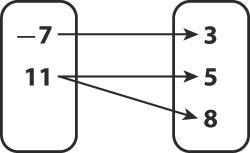
Is the relation a function? Why.
a)
Yes, because the x-value 11 has two y-values pair with it.
b)
Yes, because each x-value has only one y-value paired with it.
c)
No, because the x-value 11 has two y-values pair with it.
d)
No, because each x-value has only one y-value paired with it.
38.
Is this mapping a function or not a function? 
a)
Function
b)
Not a Function 
39.
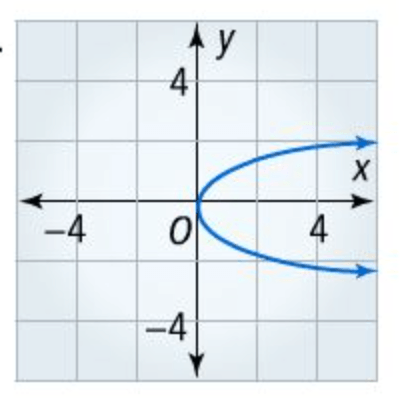
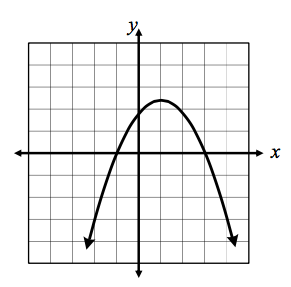
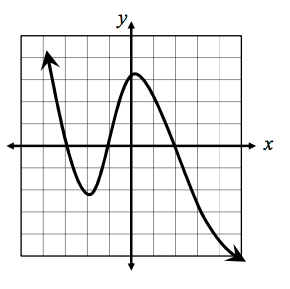
Is this graph a function or not a function? 
a)
Function
b)
Not a Function
40.
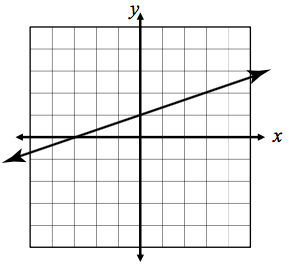
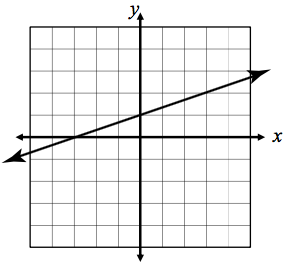
Is this graph a function or not a function? 
a)
Function
b)
Not a Function
41.
Is this table a function or not a function? 
a)
Function
b)
Not a Function
42.
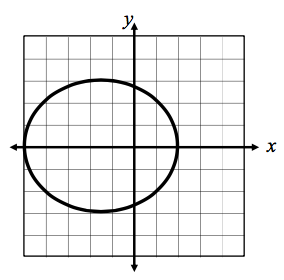
Is this graph a function or not a function? 
a)
Function
b)
Not a Function
43.
Which set of values is a function?
a)
(9,5) (10,5) (9,-5) (10,-5)
b)
(3,4) (4,-3) (7,4) (3, 8)
c)
(6,-5) (7, -3) (8, -1) (9, 1)
d)
(2, -2) (5, 9) (5, -7) (1, 4)
44.
Is this graph a function or not a function? 
a)
Function 
b)
Not a Function 
45.
For the function {(0,1), (1,-3), (2,-4), (-4,1)}, write the domain and range.
a)
D: {1, -3, -4,}
R: {0, 1, 2, -4}
b)
D:{0, 1, 2, -4}
R:{1, -3, -4}
c)
D:{0, 1, 2, 3, 4}
R:{1, -3, -4}
46.
Which ordered pair could you add to the following list of points to create a function?  (3, 5) (4, 9) (2, 5) 
a)
(3, 7)
b)
(4, 1) 
c)
(1, 9)
d)
(2, 6)
47.
Does the table represent a function?
a)
Yes, there  is a repeated x-value. 
b)
No, there aren't any repeated y-values. 
c)
Yes, there are repeated y-values. 
d)
No, there is a repeated x-value. 
48.
Is this graph a function or not a function? 
a)
Function 
b)
Not a Function
49.
Which graph does NOT pass the vertical line test?
a)
Graph 1
b)
Graph 2
c)
Graph 3
d)
Graph 4
50.
What is the definition of function?
a)
Has inputs and outputs
b)
Every input has only ONE output
c)
Inputs have different outputs every time
d)
x-values and y-values
51.
a)
Function
b)
Not a Function
52.
Is this mapping a function or not a function? 
a)
Function
b)
Not a Function
53.
All of the y values or outputs are called what?
a)
Domain
b)
Range
c)
Relation
d)
Function
54.
All of the x values or inputs are called what?
a)
Domain
b)
Range
c)
Relation
d)
Function
55.
Which of these is NOT the same
a)
Range
b)
Input
c)
Dependent Value
d)
Y-Value
56.
Is the relation a function? Why.
a)
Yes, because the x-value 11 has two y-values pair with it.
b)
Yes, because each x-value has only one y-value paired with it.
c)
No, because the x-value 11 has two y-values pair with it.
d)
No, because each x-value has only one y-value paired with it.
57.
Is this graph a function or not a function? 
a)
Function
b)
Not a Function
58.
Which set of values is a function?
a)
(9,5) (10,5) (9,-5) (10,-5)
b)
(3,4) (4,-3) (7,4) (3, 8)
c)
(6,-5) (7, -3) (8, -1) (9, 1)
d)
(2, -2) (5, 9) (5, -7) (1, 4)
59.
Is this graph a function or not a function? 
a)
Function 
b)
Not a Function 
60.
For the function {(0,1), (1,-3), (2,-4), (-4,1)}, write the domain and range.
a)
D: {1, -3, -4,}
R: {0, 1, 2, -4}
b)
D:{0, 1, 2, -4}
R:{1, -3, -4}
c)
D:{0, 1, 2, 3, 4}
R:{1, -3, -4}
61.
Does the table represent a function?
a)
Yes, there  is a repeated x-value. 
b)
No, there aren't any repeated y-values. 
c)
Yes, there are repeated y-values. 
d)
No, there is a repeated x-value. 
62.
a)

8

b)

-24

c)

24

d)

-22

63.
a)

27

b)

21

c)

24

d)

72

64.
a)

30

b)

62

c)

14

d)

32

65.
a)

106

b)

16

c)

26

d)

94

66.
a)

84

b)

92

c)

116

d)

64

67.
Is function represented by the table linear or nonlinear?
a)
linear
b)
nonlinear
68.
a)
Function
b)
Not a Function
69.
a)
Function
b)
Not a Function
70.
What is the definition of function?
a)
Has inputs and outputs
b)
Every input has only ONE output
c)
Inputs have different outputs every time
d)
x-values and y-values
71.
Is the relation a function? Why.
a)
Yes, because the x-value 11 has two y-values pair with it.
b)
Yes, because each x-value has only one y-value paired with it.
c)
No, because the x-value 11 has two y-values pair with it.
d)
No, because each x-value has only one y-value paired with it.
72.
a)
Function
b)
Not a Function
73.
Is this mapping a function or not a function? 
a)
Function
b)
Not a Function
74.
Is this table a function or not a function? 
a)
Function
b)
Not a Function
75.
Is this table a function or not a function? 
a)
Function
b)
Not a Function
76.
Which set of values is a function?
a)
(9,5) (10,5) (9,-5) (10,-5)
b)
(3,4) (4,-3) (7,4) (3, 8)
c)
(6,-5) (7, -3) (8, -1) (9, 1)
d)
(2, -2) (5, 9) (5, -7) (1, 4)
77.
Is this graph a function or not a function? 
a)
Function
b)
Not a Function
78.
Is this graph a function or not a function? 
a)
Function
b)
Not a Function
79.
Is this graph a function or not a function? 
a)
Function
b)
Not a Function
80.
Is this graph a function or not a function? 
a)
Function 
b)
Not a Function 
81.
Is this graph a function or not a function? 
a)
Function
b)
Not a Function 
82.
Is this graph a function or not a function? 
a)
Function 
b)
Not a Function
83.
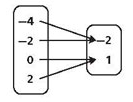
Give the domain and range. Tell if it is a function.
a)
D: {-4, -2, 0, 2}
R: {-2, -2, 1, 1}
Function
b)
D: {-4, -2, 0, 2}
R: {-2, 1}
Function
c)
D: {-4, -2, 0, 2}
R: {-2, -2, 1, 1}
Not a Function
d)
D: {-4, -2, 0, 2}
R: {-2, 1}
Not a Function
84.
Which of these is NOT the same
a)
Range
b)
Input
c)
Dependent Value
d)
Y-Value
85.
All of the x values or inputs are called what?
a)
Domain
b)
Range
c)
Relation
d)
Function
86.
What is the range of this function?
a)
(150, 275)
b)
[150, 275]
c)
[220, 265]
d)
(220, 265)
87.
All of the y values or outputs are called what?
a)
Domain
b)
Range
c)
Relation
d)
Function
88.
For the function {(0,1), (1,-3), (2,-4), (-4,1)}, write the domain and range.
a)
D: {1, -3, -4,}
R: {0, 1, 2, -4}
b)
D:{0, 1, 2, -4}
R:{1, -3, -4}
c)
D:{0, 1, 2, 3, 4}
R:{1, -3, -4}
89.
a)
Function
b)
Not a Function