
 Worksheets
Matter and Properties
Total questions: 11
Worksheet time: 32mins

Balloons A and B are the same weight. What would most likely happen if the air was released from balloon A?
Balllon A would lower, and balloon B would rise because a balloon is heavier without air.
Balloon A would rise, and balloon B would lower because balloon B would be heavier.
The sides would stay level because air has no weight, so both balloons would still be the same.
Balloons A and B would move up and down until they reach an equal weight, and then would be level again.

A student wanted to know if dissolving sugar in lemonade would change the weight of the lemonade. The initial amount of lemonade was 100 grams. Each sugar cube weighs about 5 grams.
Diagram of container of lemonade = 100 grams
Sugar cubes = 5 grams each


A student claims, "Powder A dissolved because it is much lighter in weight than the other three powder samples."
Which response uses the data from the table to best evaluate this student's claim?
The claim is false because dissolving is a property of the type of material, not how much the powder sample weighs.
The claim is correct because powders that look identical on the outside will always dissolve the exact same way in water.
The claim is false because powders can only dissolve in water if they have a completely smooth and soft physical texture.
The claim is correct because powders with less weight will always dissolve much faster when stirred into a cup of liquid.

Parker does a science investigation at home in which he puts one drop of food dye into a glass of cold water and watches what happens for 5 seconds. Then he does it again, but increases the temperature of the water. What do you predict will happen to the food dye when it is dropped into the glass with 140 degree F water, and why?
It will mix throughout the water because the dye and water particles move faster when more energy is added.
It will mix throughout the water because the dye and water particles move faster when more energy is removed.
It will mix throughout the water because the dye and water particles move slower when more energy is added.
It will mix throughout the water because the dye and water particles move faster when more energy is removed.

Bronze is a mixture of three metals: copper, zinc, and tin. When these three metals are mixed, their properties change. Read the data in the table. What are the two properties that make bronze different from the metals from which it is made?
color and hardness
brittleness and thermal conductivity
thermal conductivity and electrical conductivity
color and reactions takes place when exposed to air.
If a material feels smooth or rough, what does that tell you about its possible uses?
f a material feels rough, it must be used in construction since only rough materials are strong enough for buildings, and smooth materials are only used for things that need to be pulled up or down.
If a material feels smooth, it might be useful for things like countertops or surfaces that need to be easy to clean or reduce friction. If it’s rough, it could be better for surfaces needing grip, like sandpaper or flooring.
A smooth material means it would dissolve in water, so it can only be used indoors. Rough materials can be used inside or outside.
If a material is smooth, it conducts electricity better, making it useful for wires. A rough material means it’s waterproof, so it would only be used for things outside.
How could a material’s magnetic response help you identify the material?
A material’s response to a magnet can help identify it because some materials are magnetic and others are not.
A material attracted to a magnet will always be stronger than a material that is not attracted to a magnet.
If a material is attracted to a magnet, it must be made of plastic.
A material’s magnetic response tells you exactly what it is because all materials respond to magnets in the same way.
If you have two materials that look the same, what tests or observations would you use to tell them apart?
I would test each material’s hardness by scratching them, see if one is heavier by measuring their weight, and try a streak test to see if they leave different color marks.
I would hold both materials in sunlight to see how light interacts with them. If one glows more, it’s a different material.
I would taste both materials to see if one has a different flavor.
I would rub both materials together and see if the friction causes them to heat up differently, which would help tell them apart.
Why is it helpful to look at more than one property when identifying a material?
It’s helpful to look at more than one property because some materials can have similar appearances or textures but different hardness, solubility, magnetic responses, or other characteristics.
Looking at more than one property is only helpful if the material is a liquid because liquids are harder to identify.
It’s helpful to look at multiple properties because more properties always mean a material is of higher quality.
More properties help you see if the material is artificial or natural, since artificial materials will show more variety.

A student placed a bottled water into a freezer. The next morning it was frozen. What would happen if the ice melted back into water.
It would decrease because liquids weigh less than solids.
It would decrease because solid water takes up more space than liquid water.
It would increase because the ice added more matter to the system.
It would stay the same because the amount of water molecules does not change.
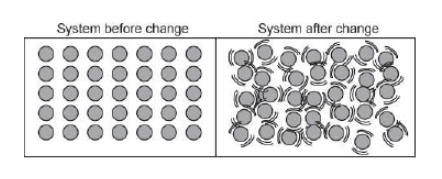
The picture below shows a closed system before and after undergoing a change.
What was changed in the system?
Particles were added to the system.
Water was added to the system.
Heat was added to the system.
Air was added to the system.

