
 Worksheets
evolution
Total questions: 20
Worksheet time: 28mins
Name
Class
Date
1.

Who hypothesized that human populations are kept in check by war, famine, and disease?
a)
Darwin
b)
Hutton
c)
Malthus
d)
Lamarck
2.

a)
analogous structures
b)
homologous structures
c)
vestigial structures
d)
none of the above
3.

What is the process of which humans breed organisms for certain traits?
a)
artificial selection
b)
descent without modification
c)
inheritance of acquired characteristics
d)
natural selection
4.

Vertebrate embryos pass through similar stages of development is evidence for
a)
use and disuse
b)
homologous structures
c)
common ancestry
d)
acquired characteristics
5.

The remnant of an organ that had a function in an early ancestor is known as a(n)
a)
vestigial structure
b)
analogous structure
c)
homologous structure
d)
fossil structure
6.

Who said that geological forces acting today are the same ones that have been acting in the past?
a)
Lamarck
b)
Darwin
c)
Hutton
d)
Lyell
7.
Survival of the Fittest and Evolution were proposed by what scientist?
a)
Charles Darwin
b)
Albert Einstein
c)
Steven Hawking
d)
Isaac Newton
8.
A fossil of an extinct dinosaur is found and the anatomy of the fossil shows similarities to that of a bird. What could this mean?
a)
This is purely by chance and isn't significant
b)
The extinct dinosaur and modern bird share a common ancestor
c)
All dinosaurs evolved into birds and that's why there aren't any dinosaurs alive today
d)
Dinosaurs choose to fly, and evolved into birds to escape predation and capture food
9.

Two organisms that are closely related would have
a)
very similar DNA sequence
b)
exactly the same DNA sequences
c)
no proteins in common
d)
completely different DNA sequence
10.
Which of the following are examples of evidence for evolution?
a)
Fossils and Cellular Structure
b)
Biological Structures
c)
Genetics/DNA
d)
All of the Above
11.

What type of selection is depicted in the picture?
a)
stabilizing
b)
directional
c)
disruptive
d)
the answer is not here
12.
Robins typically lay fours eggs. If more then four eggs are produced then the baby chicks are malnourished while smaller egg numbers result in no viable (able to live) baby chicks. This is an example of
a)
stabalizing
b)
disruptive
c)
direction
d)
none of the above
13.

What type of selection?
a)
Directional
b)
Stabilizing
c)
Disruptive
14.
Only populations can evolve.
Individuals can not evolve.
Individuals can not evolve.
a)
True
b)
False
15.
If finches with large beaks and finches with small beaks increase in a population while finches with average sized beaks decreases, which pattern of natural selection has occurred?
a)
Directional selection
b)
Disruptive selection
c)
Stabilizing selection
16.
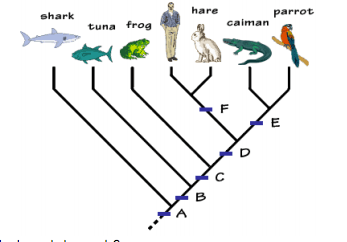
On the cladogram, which organism is the closest relative of the human?
a)
Frog
b)
Hare
c)
Caiman
d)
Parrot
17.

What type of structure does this image illustrate?
a)
Homologous structures
b)
Analogous structures
c)
Vestigial structures
18.
Why would a fox's fur be brown in the summer and white in a winter?
a)
The fox like to change fur colours.
b)
The changing colour of the fur help the fox blend with the surroundings
c)
The fox learn from its parents
d)
The fox like to do that
19.
Which is not an example of camouflage ....
a)
a tiger stripes blend in with long grass
b)
a soldier's battle uniform helps him blend in to the background
c)
a butterfly fish have an eye spot on the body to fools the predators
d)
a polar bear has thick white fur
20.

Which adaptation this organism using?
a)
camouflage
b)
mimicry
c)
hide and seek
d)
use body covering
100 %

