Worksheets
Biomolecules EOC Review
Total questions: 23
Worksheet time: 27mins
Spring, Summer, Fall, and Winter
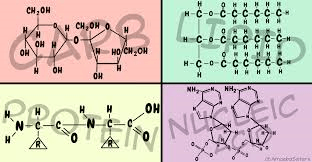
Which biomolecule forms animal tissues such as muscle and hair?
Nucleic Acid
Carbohydrate
Protein
Lipids
What is the function of nucleic acids such as DNA and RNA?
Stores energy
Stores genetic information
Movement
Physical structure

Which biomolecule makes up the cell membrane and hormones?
lipids
protein
nucleic acid
carbohydrate

The complex carbohydrates pictured below are made by linking molecules of glucose.
In all three complex carbohydrates, the subunits of glucose are bonded together differently. Because they have different structures, they most likely —
contain different chemical elements
form different proteins
carry different nucleotides
perform different functions
An advertisement for a health supplement for dogs claims to build lean muscle and strengthen tendons and ligaments, as well as provide energy. Which two biomolecules must the supplement contain to provide these benefits?
Carbohydrates and lipids
Proteins and carbohydrates
Nucleic acids and carbohydrates
Lipids and nucleic acids
Beeswax is a waxy substance that is produced by bees and then harvested by humans for a variety of uses. Ancient Romans used beeswax as a waterproofing agent because it is not water-permeable. Beeswax is which of the following types of organic molecule?
carbohydrate
lipid
nucleic acid
protein
Many land plants store energy in starch. When energy is needed, the starch molecules can be broken down quickly. This chemical reaction produces which of the following?
amino acids
lipids
monosaccharides
RNA chains

Line B in the given graph represents the reaction with an enzyme added to substrates. How did the enzyme affect the reaction?
Increased the activation energy
Increase the energy change
Lowered the energy change
Lowered the activation energy

Taq polymerase is an enzyme used in the polymerase chain reaction (PCR) to replicate fragments of DNA. A study published in 1976 examined the properties of Taq polymerase after the enzyme was isolated from Thermus aquaticus, a thermophilic bacterium that lives in the hot springs of Yellowstone National Park. The graph shows one of the results of the study.
Which statement about enzyme activity is best supported by this graph?
An enzyme must be composed of multiple polypeptides, or subunits, to be active
An enzyme’s rate of activity increases with time until it becomes inactive
An enzyme functions best under specific temperature conditions
An enzyme works equally well in bacteria that are adapted to high temperatures and in eukaryotic cells such as human cells