
 Worksheets
Neuro-Neoplasm
Total questions: 14
Worksheet time: 10mins

A 4-year-old girl with severe vomiting. CT scan reveals cerebellar mass. What is the diagnosis?
Atypical teratoid/rhabdoid (AT/RT)
Medulloblastoma
Meningioma
Metastatic carcinoma

A 23-year-old man, HIV+, presented with a cerebral mass by MRI. What is the diagnosis?
Glioblastoma
Pilocytic astrocytroma
Lymphoma
Metastatic carcinoma

A 55-year-old man, presented with a headache and seizure. CT scan shows an ill-defined mass in the gray-white junction in the right cerebral hemisphere. What is the diagnosis?
Oligodendroglioma
Germinoma
Glioblastoma
Schwannoma
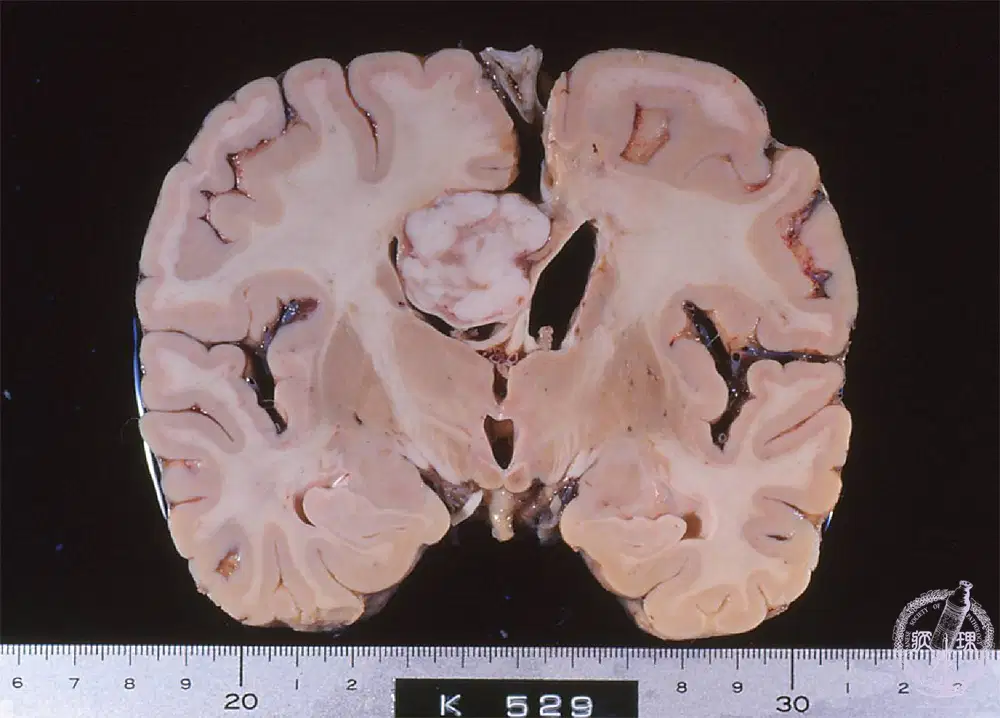
What is the diagnosis?
Schwannoma
Meningioma
Ganglioglioma
Subependymal giant cell astrocytoma

Multiple brain lesions. What is the diagnosis?
Glioblastoma
Metastatic melanoma
Metastatic carcinoma
Central neurocytoma

Seizure with frontal lobe mass. What is the diagnosis?
Oligodendroglioma
Diffuse glioma
Cortical tubers
Hemangioblastoma

An 11-year-old boy, with solid-cystic cerebellar mass. What is the diagnosis?
Glioblastoma
Pilocytic astrocytoma
Schawannoma
Meningioma

35-year-old presented with hearing loss with ataxia. Cerebello-pontine angle mass was mentioned. The histologic section is shown as figures. What is the diagnosis?
Meningioma
Schwannoma
Lymphoma
Medulloblastoma
Bilateral vestibular schwannomas is the classic presentation for which inherited syndrome?
Neurofibromatosis Type 1 (NF1)
Tuberous Sclerosis Complex (TSC)
Neurofibromatosis Type 2 (NF2)
Von Hippel-Lindau disease (VHL)
A patient with a known Vestibular Schwannoma develops facial pain and hypoesthesia. This symptom is most likely due to the compression of which cranial nerve?
Hypoglossal nerve (CN XII)
Trigeminal nerve (CN V)
Oculomotor nerve (CN III)
Abducens nerve (CN VI)
Which histological feature is exclusively characteristic of a Schwannoma and is often seen as a palisading arrangement of nuclei around anuclear zones?
Verocay bodies (part of Antoni A tissue)
Microvascular proliferation
Rosenthal fibers
Perivascular cuffing
A 68-year-old man, presents with new onset headaches, mental status changes, and multiple spherical masses identified at the grey/white matter junction on an MRI. What is the most likely diagnosis?
Primary CNS Lymphoma (PCNSL)
Pilocytic Astrocytoma
Glioblastoma (GBM), IDH-wildtype
Metastatic Carcinoma
A 50-year-old woman with a history of prior head and neck radiation therapy for Hodgkin's lymphoma at age 20 presents with a new, slow-growing headache. MRI shows a dural-based, enhancing mass over the superior sagittal sinus. This prior exposure places her at an increased risk for which tumor type?
Meningioma
Medulloblastoma
Schwannoma
Glioblastoma
Which of the following malignant tumors typically presents with symptoms of vertigo and loss of balance due to its location, but does so less frequently than the most common benign tumor in the same area?
Primary CNS Lymphoma of the brainstem
Glioblastoma of the frontal lobe
Oligodendroglioma of the temporal lobe
Meningioma of the cerebellopontine angle (CPA)

