wayground logo

Free Printable Worksheets

Font size

S
M
L
XL
Worksheets

Imperialism - Progressive Era - WWI - Roaring 20s - New Deal

Total questions: 100

Worksheet time: 2hrs 32mins

Name
Class
Date
1.

What was the name of the war where Britain sent navy to force China to allow Britain to sell opium in China

a)

Opium War

b)

War of 1812

c)

War of the worlds

d)

English war

2.

What is domination by one country of the political, economic, or cultural life of another country or region

a)

Imperialism

b)

Industrialization

3.

US entered war to gain control of Puerto Rico, Guam, Cuba, and the Philippines in this war...

a)

Rico War

b)

Spanish American War

c)

War on terrorism

d)

Island war

4.
Leader of Hawaii when the American businesses over threw the government by surrounding her throne at gunpoint.
a)
Sanford Dole
b)
Queen Liliokahlani
c)
Queen Kalakaua  
d)
Jose Marti
5.
What was the goal of President Taft's Dollar Diplomacy?
a)
Help US allies increase readiness of armed forces
b)
Raise living standards of people in poverty-stricken countries
c)
Support development of democracies in Central America
d)
Create stability abroad for benefit of US economic interests
6.
Why did nations want to be imperialistic?
a)
They wanted prestige among other nations
b)
They needed more natural resources
c)
They needed more markets to sell industrial goods
d)
All of the Above
7.
Which of the following is NOT one of the reasons/ideas behind imperialism? 
a)
Military Needs
b)
To isolate your country from the rest of the world. 
c)
Cultural Superiority 
d)
Nationalism 
8.
Who did the U.S. buy Alaska from?
a)
Cuba
b)
Germany
c)
Russia
d)
Canada
9.
Describe how the United States acquired Hawaii. 
a)
The U.S government won Hawaii in a battle with Japan
b)
After Queen Liliuokalani died the U.S. purchased Hawaii for 20 million dollars
c)
U.S. won a war with Spain and Spain sold Hawaii for $7million to the U.S.
d)
U.S. Overthrew Queen Liliuokalani and became a U.S. territory in 1898
10.
Teddy Roosevelt's policy was to "Speak softly and carry a big stick." What did he mean by this?
a)
Debate calmly, and always be willing to negotiate
b)
Speak quietly, but yell if necessary.
c)
Negotiate peacefully, but always have the threat of the military to back you up.
d)
Never back down when there is conflict.
11.
Why was building the Panama Canal so important to the United States? 
a)
It allowed endangered animals to expand their territory
b)
It allowed U.S. families to stay connected with each other
c)
It increased Canada's military capability.
d)
It would be a major shipping canal connecting the Pacific & Atlantic Oceans
12.
Which of the following is NOT one of the reasons the U.S. was involved in Hawaii?
a)
To spread Christianity
b)
Their location provided a good spot for the navy to have a base
c)
They wanted to learn the Hawaiian culture
d)
They wanted to have sole control over the sugar industry
13.
In __, sugar planters staged a rebellion.  It was annexed into the US in 1898. 
a)
Japan 
b)
Hawaii 
c)
Panama
d)
China  
14.
The Roosevelt Corollary to the Monroe Doctrine established the US’s right to ___.
a)
build the Panama Canal 
b)
annex Hawaii
c)
attack the Spanish 
d)
intervene in Latin America
15.
The purpose of the Great White Fleet’s journey was to ___.
a)
circumnavigate the globe 
b)
stop imperialism’s spread  
c)
demonstrate US power
d)
destroy the Spanish fleet
16.
What country did the U.S protect from European countries by issuing the Roosevelt Corollary and made sure the country repaid the loans by taking over collection of its Taxes collected on imports? 
a)
Panama 
b)
Hawaii
c)
Alaska
d)
Dominican Republic
17.

What does this political cartoon best represent?

a)

Public opposition to the League of Nations

b)

German Imperial Fleet discussing a blockade of Mexico

c)

The Zimmerman Telegram

d)

Talks of Germany's unrestricted submarine warfare

18.

In January 1918, President Wilson spoke to Congress about the war aims of the nation. His plan ultimately became known as the _______________________ and was designed to create a lasting peace in the world.

a)

Fourteen Points

b)

Treaty of Versailles

c)

Wilson's suggestions

d)

League of Nations

19.

Wilson's idea for a League of Nations was included in the final provisions of the Treaty of Versailles. After most European countries joined the League of Nations, the U.S. soon followed suit and joined in 1920 to become part of the Big 4 (France, Great Britain, Italy, and the U.S.)

a)

True

b)

False

20.

Which of the following are examples of propaganda?

a)

Art posters, movies, cartoons.

b)

Pro war speeches (4 minute men).

c)

Shaming campaigns (white feather).

d)

All of the above

21.

This propaganda posting wants you to do what?

a)

Sign up for the war by enlisting in the Army.

b)

Sign up for the war by enlisting in the Navy.

c)

Buy Liberty bonds.

d)

Buy a Papa Johns Pizza

22.

How did the creation of alliances contribute to the start of World War 1?

a)

The web of alliances began a chain reaction

b)

They threatened countries in the Western Hemisphere

c)

They allowed Japanese aggression in Korea.

d)

They didn't include Germany or France as members

23.

What was one result of militarism

a)

Economic rivarly

b)

Imperialism

c)

Arms Race

d)

War in the Balkans

24.

What warfare strategy was most commonly used in WWI?

a)

Guerrilla Warfare

b)

Blitzkering

c)

Standard Warfare

d)

Trench Warfare

25.

What was the name of the British Passenger liner that was sunk in May 1915, killing 128 Americans?

a)

Lusitania

b)

Sussex

c)

Titanic

d)

USS Maine

26.

Which country was Germany proposing an alliance with in the Zimmerman Telegram?

a)

America

b)

Canada

c)

Britain

d)

Mexico

27.

What was the name of the treaty signed at the end of WWI?

a)

Treaty of Paris

b)

Treaty of Versailles

c)

Treaty of Guadalupe Hidalgo

d)

Treaty of Greenville

28.

What major country left the war in 1918 due to a Communist revolution?

a)

Turkey

b)

United States

c)

Russia

d)

Middle Powers

29.
The 20s were characterized by
a)
Political Isolationism
b)
World War
c)
Economic Depression
d)
Decreased Nativism
30.
The social impact of the Red Scare was characterized by
a)
Yellow Journalism
b)
Spread of Communism
c)
Stock Market Crash
d)
Anti-Immigrant Sentiment
31.
Which music genre was created in the 20s?
a)
Bluegrass
b)
Jazz
c)
Hip Hop
d)
R&B
32.
What did Clarence Darrow represent in the Scopes Trial?
a)
Evolution was incorrect
b)
Creationism had no place in schools
c)
The Bible was always right
d)
Science would support the Bible
33.
What was the symbol of feminine change in the 1920s?
a)
Flapper
b)
Bootlegger
c)
Immigrant
d)
Musician
34.
Which Act would 1920s Nativists have agreed to?
a)
Stamp Act
b)
Pure Food and Drug Act
c)
Chinese Exclusion Act
d)
Sister Act
35.
Which author most contributed to the Harlem Renaissance?
a)
Upton Sinclair
b)
Langston Huges
c)
Dorthea Lang
d)
John Steinbeck
36.
What was the major change for women in the 1920s?
a)
Right to Vote
b)
Right to Work
c)
Right to Dance
d)
Right to Drink
37.
Which political scandal marked Warren Harding's presidency and caused increased distrust of the government?
a)
Teapot Dome
b)
Fall
c)
Yosemite Land
d)
Haymarket Square
38.
Which year marks the Stock Market Crash that began the Great Depression?
a)
1927
b)
1928
c)
1929
d)
1930
39.
The Harlem Renaissance was
a)
Celebration of African American Culture
b)
Spark of increased industrial jobs
c)
Creation of controversial policies
d)
Creation of the Department of Interior
40.
How did the automotive industry help stimulate the U.S. economy?
a)
Ended dependence on foreign cars
b)
Increased employment for female engineers
c)
Increased demand for steel, rubber, and gasoline
d)
Started the Industrial Revolution
41.
Why were Sacco and Vanzetti viewed with suspicion?
a)
Sacco owned a gun similar to the murder weapon
b)
they were Italian immigrants and anarchists
c)
they were members of the Ku Klux Clan
d)
they looked funny
42.
Reporters, journalists, photographers, and authors who used the media to raise concerns about the negative effects of industrialization were known as
a)
muckrakers
b)
suffragists
c)
immigrants
d)
abolitionists
43.
A period of time when social, economic and political problems caused by rapid industrialization were exposed and in some cases reformed
a)
Industrialization
b)
Progressive Era
c)
Reconstruction
d)
Prohibition
44.
Prohibition began with the 
a)
15th Amendment
b)
17th Amendment
c)
18th Amendment
d)
21st Amendment
45.
Progressive reformers, or muckrakers  known for taking photographs to expose unsafe or unsanitary conditions
a)
Ida Tarbell and Upton Sinclair
b)
WEB DuBois and Booker T Washington
c)
Jacob Riis and Lewis Hine
d)
Alice Paul and Carrie Catt
46.
Suffragists included
a)
Alice Paul
b)
Susan B Anthony
c)
Elizabeth Cady Stanton
d)
All of the above
47.
The Sherman anti-trust act was passed to
a)
break up monopolies
b)
give equal rights to women
c)
help people living in poverty
d)
end racism
48.
Upton Sinclair's The Jungle is credited with exposing the unsanitary conditions in the food industry and helping to pass the
a)
Sherman Anti-Trust Act
b)
18th Amendment
c)
Pure Food and Drug Act
d)
Equal Rights Amendment
49.
The major immigration center on the west coast known as Angel Island is located closest to what major city
a)
San Francisco, CA
b)
Los Angeles, CA
c)
San Diego, CA
d)
Sacramento, CA
50.
If immigrating from China, you would most likely cross what ocean
a)
Atlantic
b)
Pacific
c)
Indian
d)

Artic

51.
Who wrote about and exposed the corrupt monopolistic business practices of Standard Oil?
a)
Ida Tarbell
b)
Lewis Hines 
c)
Jacob Riis
d)
Upton Sinclair
52.

What goal are you trying to achieve if you're looking to make urban reforms?

a)

getting rid of a capitalistic economy

b)

eliminating political machines/bosses

c)

conservation of natural resources

d)

ending racial discrimination

53.

Why did we want to get rid of political machines?

a)

it was too easy to be corrupt and it was considered to be undemocratic

b)

people didn't participate in the elections

c)

there wasn't anyone willing to become a part of the machines

d)

most people thought they were too much like a labor union

54.

People who were trying to get the 19th Amendment passed were supporting what?

a)

Right to vote for 18 year olds

b)

Right to vote for African Americans

c)

Right to vote for women

d)

Right to vote for those in prison

55.

Those who wanted to make economic reform may have been concerned about which issue?

a)

the influence of monopolies and trusts

b)

eliminating political machines/bosses

c)

conservation of natural resources

d)

ending racial discrimination

56.

What was the name of the political machine in NYC in the 1800s?

a)

Rockefeller Hall

b)

Carnegie Hall

c)

Ordway Hall

d)

Tammany Hall

57.

People like W.E.B. du Bois participated in the movement against what?

a)

Racism

b)

Women's suffrage

c)

Child Labor

d)

Prohibition

58.
What were the 3 causes of the Great Depression?
a)
FDR, The New Deal, The Second New Deal
b)
Herbert Hoover, Hobos, Riding the Rails
c)
Credit, Stock Market Crash, Corruption
59.
Explain the Stock Market Crash.
a)
People purchased stocks with credit, got scared and sold their stocks. There was no money to pay people their money
b)
People purchased stock
c)
People threw their money away
60.
Which of the following would MOST contribute to people living beyond their means?
a)
Credit
b)
Rich People
c)
Goverment
d)
The Stock Market
61.
Which of the following European country faced the greatest economic challenges after WW I? 
a)
Austria
b)
Great Britian
c)
France
d)
Germany
62.
Which was NOT a LONG-TERM cause of the Great Depression?
a)
Buying stock on margin
b)
Stock market crash (Black Tuesday)
c)
too much production and consumer spending
d)
Laisezz-faire economic policies
63.
What effect did the Dust Bowl storms have on the Great Depression?
a)
Many farmers were forced to leave the Great Plains.
b)
Unemployment decreased gradually.
c)
Many homes long the Mississippi River were flooded.
d)
Hoover was re-elected as president.
64.
After the Stock Market Crash, many people lost their life savings because _______________.
a)
banks closed
b)
banks gave away their money
c)
they couldn't remember where they put it
d)
someone stole it
65.
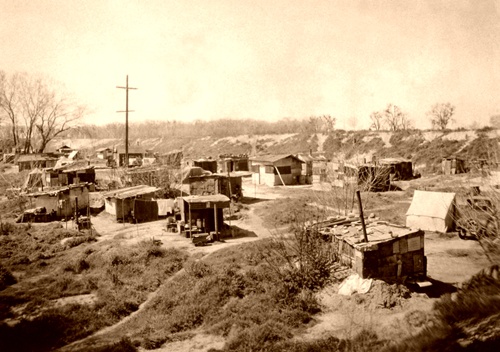
What were the villages full of shacks located in cities filled with unemployed Americans called?
a)
Hoovervilles
b)
Okies
c)
Bonus Army Bases
d)
Rooseveltowns
66.
Pick the best answer.  Over-production of what led to the Great Depression?
a)
farm goods
b)
consumer goods
c)
farm and consumer goods
d)
iPhones
67.
$100 will buy this car.  Must have cash. Lost all on the stock market.

The photograph best illustrates which cause of the Great Depression?
a)
People over speculated on stocks.
b)
Government failed to prevent the collapse of banks.
c)
Tariffs discouraged trade.
d)
Drought occurred in the Midwest.
68.
Many people lost their jobs during the Great Depression.  The national government responded with President Franklin Roosevelt's "New Deal," which
a)
provided programs to help people make money to provide for their needs. 
b)
helped reduce the national debt, providing more capital for businesses
c)
forced people to join the military forces to make money for their needs. 
d)
forced people to use charities to help them provide for their needs. 
69.
One difference between the administrations of President Roosevelt and President Hoover was that Roosevelt was-
a)
more willing to use government intervention to solve economic problems
b)
unwilling to allow government agencies to establish jobs
c)
able to ignore economic issues for most of his first term in office
d)
opposed to any type of government regulation of financial institutions
70.
What problem were both the Civilian Conservation Corps and the Works Progress Administration developed to address?
a)
Excessive stock market speculation
b)
High unemployment
c)
Increased use of credit
d)
Overproduction of goods
71.
During the New Deal, how did the government attempt to improve conditions for farmers?
a)
By ending the practice of sharecropping
b)
By encouraging farmers to grow more to increase profits
c)
By paying farmers to grow fewer crops
d)
By training farmers for jobs in a new field
72.
A major reason for creating the Tennessee Valley Authority in 1933 was to-
a)
Provide health care benefits to southerners
b)
Encourage African-Americans to settle in the valley
c)
Improve economic conditions in a poor rural region
d)
Evacuate farmers from the impoverished region
73.
What was a major result of FDR’s New Deal programs?
a)
The national deficit declined for most U.S. citizens
b)
The suffrage rights for women changed
c)
The power of the federal government was expanded
d)
The federal government lowered taxes for most Americans
74.
What was created to protect bank deposits up to $5,000?
a)
WPA
b)
CCC
c)
TVA
d)
FDIC
75.
What institution opposed parts of the New Deal because it believed it gave the federal government an unconstitutional amount of power over the states and economy?
a)
Congress
b)
Supreme Court
c)
Stock Market
d)
Executive Branch
76.
The New Deal stressed Relief, Recover, and _______.
a)
Reform
b)
Revolution
c)
Reinvention
d)
Reinforcement
77.

An arrangement placing a limit on the number of immigrants allowed from each country.

a)

Quota System

b)

Limit System

c)

Number System

d)

Immigrant System

78.

Popular baseball player who lived an excessive lifestyle that embodied the 1920s.

a)

Babe Ruth

b)

Lou Gehrig

c)

Joe Sewell

d)

Jackie Robinson

79.

Famous silent movie star of the 1920s.

a)

Shirley Temple

b)

Tom Cruise

c)

Charlie Chaplin

d)

Jessica Alba

80.

Infamous mob boss in Chicago during the age of Prohibition who was arrested for tax fraud.

a)

Al Capone

b)

Bugsy Siegal

c)

Frank Costello

d)

Lucky Luciano

81.

Name given to large numbers of African Americans moving from the South to the North for industrial jobs.

a)

Scopes Movement

b)

Huge Migration

c)

Great Depression

d)

Great Migration

82.

Name of an illegal and secret bar or saloon that sold alcohol during Prohibition.

a)

Secret Bar

b)

Scopes

c)

Flappers

d)

Speakeasy

83.

America's viewpoint on foreign policy after WWI.

a)

Isolationism

b)

World involvement

c)

Self governance

d)

Internationalism

84.

The execution of Italian immigrants Sacco and Vanzetti was another example of the fear of ___________ in the U.S. during the 1920s.

a)

Communism

b)

Monarchy

c)

Socialism

d)

Immigrant takeover

85.
It was hard for black people to find jobs in the south because of __________, which made segregation legal.
a)
Jim Crow laws
b)
Slave laws
c)
Segregational Act of 1900
d)
Civil Rights
86.

Jim Crow laws

a)

Segregated blacks and whites

b)

Killed minorities

c)

Resulted in slavery

d)

Were ended after the Civil War

87.

Forcing a person to read a paragraph before they were allowed to vote is called a

a)

Poll Tax

b)

Literacy Test

c)

Grandfather Clause

d)

Lynching

88.

A political murder of an African American to intimidate called a

a)

Grandfather Clause

b)

Literacy Test

c)

Poll Tax

d)

Lynching

89.

This Black leader was born in the north and was the first African American to graduate with a Ph.D from Harvard University

a)

Malcolm X

b)

W.E.B. DuBois

c)

Booker T. Washington

d)

Martin Luther King Jr.

90.

This civil rights leader thought that Black Americans should accept racism and embrace a long term fight for equality

a)

W.E.B DuBois

b)

Booker T. Washington

91.

This civil rights leader said that African Americans should demand their rights now and should be treated equal to whites

a)

W.E.B. DuBois

b)

Booker T. Washington

92.

True or False: It was illegal for black and whites to get married during the Jim Crow era?

a)

True

b)

False

93.

Which of the following BEST explains the purpose of the Jim Crow system?

a)

Keep public facilities cleaner

b)

keep African-Americans as second-class citizens

c)

keep the races pure

d)

keep African-Americans from voting

94.
Jim Crow was
a)
President of the United States
b)
Donald Duck's best friend
c)
a white actor who put charcoal on his face
d)
a bird 
95.
Define an immigrant
a)
Person who moves to a country from another country
b)
Person who moves from one state to another state
c)
Person who works in the United States
d)
Person who leaves the United States
96.
Beginning as a social club for former Confederates, this organization terrorized African Americans across the country.
a)
Fraternal Order of Elks
b)
Ku Klux Klan
c)
Freemasons
d)
Illuminati
97.

Segregation happened in which parts of the United States

a)

North

b)

South and West

c)

North and South

d)

North and East

98.
How did the end of WWI affect the economic opportunities available to women and African Americans?
a)
it had little effect on either group
b)
women gained jobs, but African Americans lost them
c)
It spelled the end of many economic opportunities for both groups
d)
Both groups enjoyed increased opportunities after the war
99.

H16-2) What was the cause of immigrant restriction as seen in the National Origins Act and the Emergency Quota Act?

a)

The Great Depression

b)

WWI

c)

The Red Scare

d)

U.S. imperialism

100.
The data in the chart supports the idea that the immigration laws of 1921 and 1924 were primarily designed to
a)
admit skilled workers
b)
Stop illegal entry into the country
c)
Reduce immigration from specific regions
d)
Encourage immigration from southern Europe