wayground logo

Free Printable Worksheets

NEW

Font size

S
M
L
XL
Worksheets

Bonding and Elements, Compounds, Mixtures

Total questions: 35

Worksheet time: 18mins

Name
Class
Date
1.
How many valence electrons does carbon have?
a)
1
b)
2
c)
3
d)

4

2.
How do covalent bonds form?
a)
Donating & receiving valence e- between atoms.
b)
Opposite slight charges attract each other between compounds.
c)
Scientists are still not sure how they form.
d)
Sharing valence e- between atoms.
3.
What two types of atoms make a covalent bond?
a)
2 Nonmetals
b)
1 Nonmetal and 1 Metal
c)
2 Metals
d)
2 Noble Gases
4.
A covalent compound made of one sulfur and two oxygen atoms would be named
a)
sulfur dioxide.
b)
sulfur oxide.
c)
disulfur oxide.
d)
sulfide oxygen.
5.
Which of the following is NOT formed by a covalent bond?
a)
K2S
b)
H2O
c)
I2
d)
CO2
6.
Is hydrogen considered a metal or a non-metal?
a)
A metal
b)
Nonmetal
c)
Metalloid
7.
Ionic bonds are between...
a)
Metal and Non-metal
b)
Non-metal and Non-metal
c)
Metal and Metal
8.
Atoms are most stable when their outer shell is complete.
a)
true
b)
false
9.
Why do elements bond?
a)
To be friends
b)
To create a new element
c)
To become stable
10.
Ionic or covalent?
NaBr
a)
Ionic
b)
Covalent
11.
Ionic or covalent?
H2O
a)
Ionic
b)
Covalent
12.
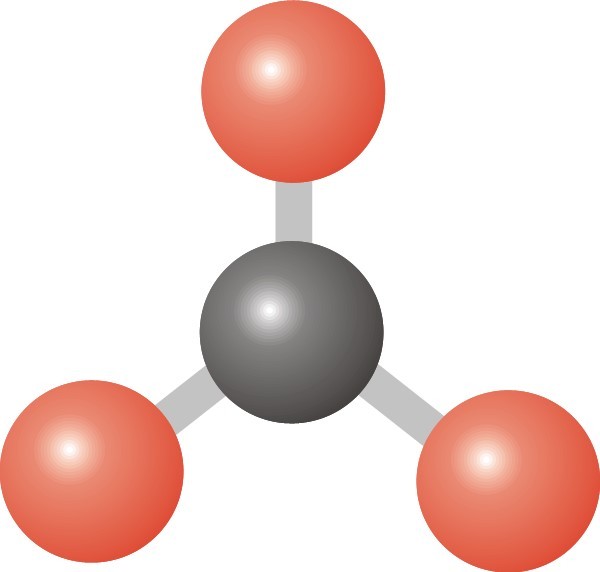
What molecule could this be? 
a)
BF3
b)
CH4
c)
H2O
d)
CO2
13.
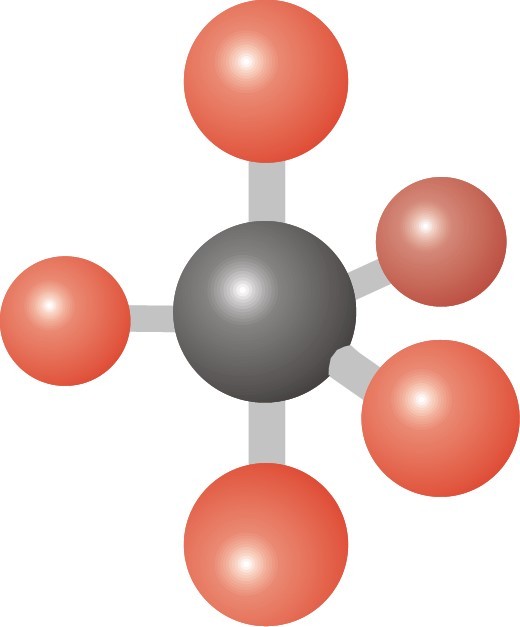
What molecule could this be? 
a)
H2O
b)
CCl4
c)
PCl5
d)
NaCl
14.

The number of electron pairs shared in double bond.

a)

One

b)

Two

c)

Three

15.

Which category of elements usually form negative ions?

a)

metals

b)

nonmetals

c)

metalloids

d)

noble gases

16.

The metal atoms tend to _____________ electrons.

a)

lose

b)

gain

17.

When an atom loses an electron, it becomes a

a)

positive ion

b)

negative ion

c)

neutral ion

d)

neutral atom

18.
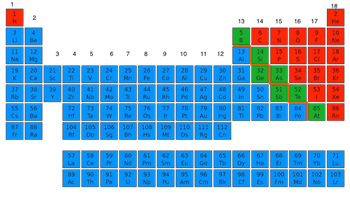
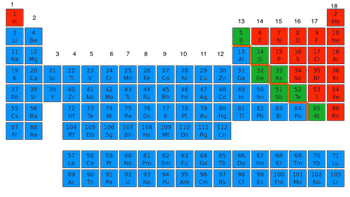
Where are the nonmetals located on the periodic table? 
a)
Blue
b)
Red
c)
Green
19.
Where are metals located on the periodic table?
a)
Blue
b)
Green
c)
Red
20.

How does calcium become an calcium ion?

a)

it loses 2 electrons

b)

it gains 2 electrons

21.

How does oxygen become an oxide ion?

a)

it loses 2 electrons

b)

it gains 2 electrons

22.

Group numbers on the periodic table help us determine

a)

number of valence electrons

b)

state of the element (solid, liquid, gas)

23.

What is aluminum (Al)?

a)

Element

b)

Compound

c)

Mixture

24.
a)

Element

b)

Compound

c)

Mixture

25.
a)

Elements

b)

Compounds

c)

Mixture of compounds

d)

Mixture of elements

26.
a)

Compounds

b)

Mixture of elements

c)

Mixture of compounds

d)

Mixture of elements and compounds

27.
A Nitrogen molecule (N2) has one triple bond. How many electrons do the nitrogen atoms share?
a)
1
1
b)
3
c)
4
d)
6
28.
Compared to ionic compounds, molecular compounds generally have...
a)
good conductivity
b)
greater densities
c)
more chemical bonds
d)
a low boiling point
29.
Compared to ionic compounds, molecular compounds generally have...
a)
stronger chemical bonds
b)
poor conductivity
c)
a high melting point
d)
lower densities
30.
The forces between molecules are much STRONGER than the forces between ions. 
a)
True
b)
False
31.

Correct diagram for HF

a)
b)
c)
d)
32.

Correct diagram for CF4

a)
b)
c)
33.

Correct diagram for CO2CO_2  

a)
b)
c)
34.

Correct diagram for HCN

a)
b)
c)
35.

Correct diagram for SO2

a)
b)
c)
d)