
Font size
S
M
L
XL
 Worksheets
10 DAY REVIEW- NO MORE REVIEW!!!
Total questions: 257
Worksheet time: 2hrs 9mins
Name
Class
Date
1.
Which statement best explains the significance of the Mayflower Compact?
a)
It limited the power of the future colonial governments.
b)
It weakened the influence of religion in government.
c)
It established a form of self-government based on a social contract.
d)
It allowed for a proclamation of equality.
It guaranteed liberties for colonists through local governments.
It guaranteed liberties for colonists through local governments.
2.
Catholics immigrated to the Maryland colony in the seventeenth century primarily to -
a)
profit from natural resources
b)
avoid crop failures and famine
c)
produce cash crops to pay off debts
d)
escape persecution
3.
What was the primary reason for the English Colonization of Jamestown in 1607 near the James River?
a)
wealth creation
b)
creating a new social structure
c)
religious freedom
d)
political alliances with other countries
4.

By establishing communities and holding town meetings, one can say...
a)
The Puritans allowed women to participate in government.
b)
The Puritans refused to obey the appointed governor.
c)
The Puritans outlawed slavery in Massachusetts.
d)
The Puritans developed a form of representative self-government.
5.
Climate of tolerance and acceptance, production of grain, and a diverse population describes...
a)
Southern colonies
b)
New England colonies
c)
Middle colonies
d)
Atlantic colonies
6.
Which of the following did not contribute to the rise of self-government in the American colonies?
a)
distance from England
b)
need for societal structure
c)
protection of individual rights
d)
defense of English sovereignty and control
7.
Although established long before the American colonies, the Magna Carta in 1215 influenced what feature of colonial life?
a)
equal taxation
b)
wealth distribution
c)
individual rights
d)
centralized power
8.
Which of the following is incorrect?
a)
New England: fishing, whaling, shipping, towns
b)
Middle: breadbasket, trade centers, small farms, diversity
c)
Southern: plantations, self-sufficient, cash crops like grain, land ownership
d)
self-government: House of Burgesses, Mayflower Compact, Fundamental Orders of Connecticut
9.
Which of the following occurred in the correct order?
a)
Jamestown, Mayflower Compact, Magna Carta, Fundamental Orders of Connecticut
b)
Mayflower Compact, Jamestown, Fundamental Orders of Connecticut, Magna Carta
c)
Magna Carta, Jamestown, Mayflower Compact, Fundamental Orders of Connecticut
d)
Fundamental Orders of Connecticut, Magna Carta, Mayflower Compact, Jamestown
10.
Which one is an incorrect match?
a)
John Peter Zenger - Freedom of the Press
b)
Anne Hutchinson: Rhode Island
c)
Quakers: equality for all
d)
Maryland's Toleration Act: freedom of speech
11.
British colonists largely objected to which of the following prohibitions of westward expansion following the French an Indian War?
a)
Stamp Act of 1765
b)
Proclamation of 1763
c)
Treaty of Paris 1783
d)
Sugar Act of 1764
12.

The following quote from Samuel Adams in 1772 is an argument against what practice imposed by Britain on the American colonists?
a)
taxation without representation
b)
prohibition of slavery
c)
banning of the right to own firearms
d)
imposing limitations on land expansion
13.
Which of the following is not one of the Intolerable Acts of 1774?
a)
The closing of the Port of Boston
b)
The mandatory quartering of British soldiers
c)
The right to ban all town meetings by the governor
d)
The increased taxation on all exported goods from Boston
14.

The diagram depicts what economic relationship between the American colonies and Britain in 1760?
a)
tax-free trade
b)
mercantilism
c)
balance of trade power
d)
federalism
15.

The image was one of the required depictions to be place on newspapers and other documents by the Stamp Act in 1765. What was the purpose of the Stamp Act?
a)
To indicate British approval on official government documents
b)
To prevent fraudulent newspapers being printed in the colonies
c)
To produce revenue for Britain through taxation on the colonists
d)
To encourage colonists to remain faithful to their royal allegiance
16.

The quote is an account of what Revolutionary battle?
a)
Battle of Yorktown
b)
Battle of Lexington
c)
Winter at Valley Forge
d)
Battle of Bunker Hill
17.
Which of the following statements is found in the Treaty of Paris of 1783?
a)
"His Britannic Majesty acknowledges the said United States...to be free sovereign and independent states, that he treats with them as such, and for himself, his heirs and successors, relinquishes all claims to the government, propriety, and territorial rights of the same and every part thereof."
b)
"We hold these truths to be self-evident, that all men are created equal, that they are endowed by their Creator with certain unalienable Rights, that among these are life, liberty, and the pursuit of Happiness."
c)
"We the People of the United States, in Order to form a more perfect Union, establish Justice, insure domestic Tranquility, provide for the common defense, promote the general Welfare, and secure the Blessings of Liberty to ourselves and our Posterity, do ordain and establish this Constitution for the United States of America."
d)
"Congress shall make no law respecting an establishment of religion, or prohibiting the free exercise thereof; or abridging the freedom of speech, or of the press; or the right of the people peaceably to assemble, and to petition the Government for a redress of grievances."
18.
The US Constitution establishes the following provision:
"All legislative powers herein granted shall be vested in a Congress of the United States, which shall consist of a Senate and House of Representatives." - Article 1, US Constitution
This provision is directly related to which of the following grievances listed in the Declaration of Independence?
"All legislative powers herein granted shall be vested in a Congress of the United States, which shall consist of a Senate and House of Representatives." - Article 1, US Constitution
This provision is directly related to which of the following grievances listed in the Declaration of Independence?
a)
"judges dependent on the [king's] will alone for the tenure of their offices, and the amount and payment of their salaries"
b)
"quartering large bodies of armed troops among us"
c)
"imposing taxes on us without our consent"
d)
"refused for a long time... to cause others to be elected, whereby the legislative powers...have returned to the people at large for their exercise"
19.
The following grievance found in the Declaration of Independence is addressed in which Amendment in the Bill of Rights?
"For depriving us in many cases, of the benefit of Trial by Jury" - Declaration of Independence, 1776
"For depriving us in many cases, of the benefit of Trial by Jury" - Declaration of Independence, 1776
a)
First Amendment
b)
Second Amendment
c)
Fourth Amendment
d)
Sixth Amendment
20.

Which of the following unalienable human rights were not defined in the Declaration of Independence?
a)
right to liberty
b)
right to be free of taxation
c)
right to life
d)
right to pursue happiness
21.
Why does the Declaration of Independence use the word "unalienable" to describe the rights listed in the preamble?
a)
The writers wanted to communicate they felt they were not recognized as British citizens.
b)
These rights were thought of as basic rights given to any human being.
c)
These rights can only be establish by loyalty to their local governing body.
d)
These rights should not be transferred to anyone else who did not live in the American colonies.
22.
The name given to the first ten original amendments to the US Constitution.
a)
Declaration of Independence
b)
Bill of Rights
c)
US Constitution
d)
Articles of Confederation
23.
Describes the relationship between a colony sending raw materials to the mother country in return for goods and products.
a)
Mercantilism
b)
Colonial Grievances
c)
Treaty of Paris
d)
Trade Law
24.
Pennsylvania location where the Continental Army endured the harsh winter of 177-1778.
a)
Hidden Valley Ranch
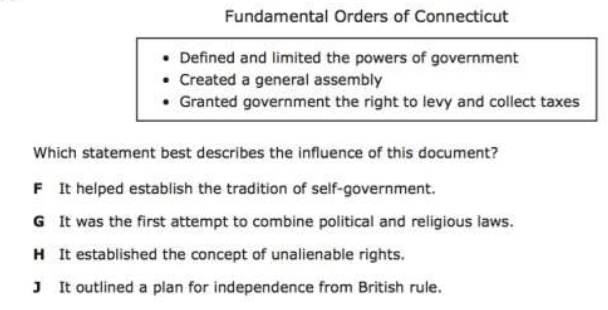
b)
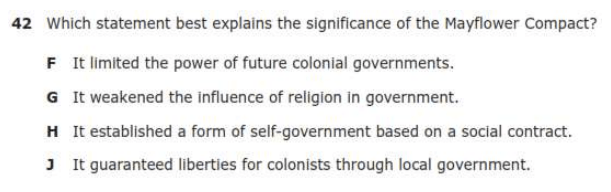
Cold Winter Valley
c)
Silicon Valley
d)
Valley Forge
25.
Agreement that allowed for British recognition of American independence.
a)
Treaty of Paris 1763
b)
Treaty of Paris 1783
c)
Treaty of Ghent
d)
Treaty of Guadalupe-Hildalgo
26.
Royal decision that prohibited settlement west of the Appalachian Mountains.
a)
Declaration of Independence
b)
Proclamation of 1763
c)
Stamp Act
d)
Mercantilism
27.
British tax imposed on newspapers and other printed colonial documents
a)
Tea Act
b)
Paper Act
c)
Stamp Act
d)
Intolerable Acts
28.
Indictments against the King of England in the Declaration of Independence
a)
Articles of Confederation
b)
Olive Branch Petition
c)
Colonial Grievances
d)
Bill of Rights
29.
God-given to all humans
a)
Alien and Sedition Acts
b)
Bill of Rights
c)
right to property
d)
unalienable rights
30.
Final battle of the Revolutionary War that resulted in British surrender.
a)
Battle of Yorktown
b)
Battle of Lexington/Concord
c)
Battle of Saratoga
d)
Battle of New Orleans
31.
Document declaring the American colonies to be free from British rule.
a)
Declaration of Independence
b)
Declaration of Rights and Sentiments
c)
Magna Carta
d)
U.S. Constitution
32.
Punishment established as a result of the Boston Tea Party
a)
Intolerable Acts
b)
Stamp Act
c)
Tea Act
d)
Navigation Acts
33.
First battle of the American Revolution resulting in a small colonial victory.
a)
Battle of Yorktown
b)
Battle of Lexington/Concord
c)
Battle of Saratoga
d)
Battle of Vicksburg
34.
Conflict that left Britain with a huge debt and desire to avoid future conflict.
a)
quasi-war
b)
French and Indian War
c)
American Revolution
d)
War of 1812
35.
Created first US government structure without executive or judicial branches.
a)
Magna Carta
b)
Articles of Confederation
c)
Confederate States of America
d)
U.S. Constitution
36.
Turning point in the American Revolution in which France became allies
a)
Battle of Yorktown
b)
Battle of Lexington/Concord
c)
Battle of Saratoga
d)
Battle of Gettysburg
37.
Argument that the government cannot impose taxes without the consent of citizens.
a)
Civil disobediene
b)
separation of powers
c)
No taxation without representation.
d)
No taxation.
38.
Occurrence of civil disobedience in protest to British taxation
a)
refusal to pay taxes to fund the Mexican-American war
b)
Boston Massacre
c)
Harper's Ferry
d)
Boston Tea Party
39.
Document that established the three branches of government and the rights of citizens in 1787
a)
U.S. Constitution
b)
Articles of Confederation
c)
Magna Carta
d)
Mayflower Compact
40.
The protection of individual freedoms from the federal government was a demand for the addition of what component to the Constitution?
a)
Process of Ratification
b)
Separation of Power
c)
Preamble
d)
The Bill of Rights
41.

The quote, attribute to Patrick Henry, indicates his strong position as and Anti-Federalist. What were the Anti-Federalists opposed to in 1787?
a)
ratification of the Constitution
b)
slave ownership
c)
states' rights
d)
local control of governmnet
42.
Arguments for the ratification of the Constitution can be found in what historical documents (s)?
a)
The Articles of Confederation
b)
The Federalists Papers
c)
The Declaration of Independence
d)
The Bill of Rights
43.

The cartoon from 1788, titled "The GLORIOUS [FABRIC]", is supporting what political position in New Hampshire?
a)
Federalists position to secede from the United States
b)
Anti-Federalist position to vote against ratification
c)
Federalist position to support ratification
d)
Anti-Federalist position to centralize government power
44.
How would the "Three-Fifths Compromise" affect Virginia, the most populous slave state in 1790?
a)
It would allow for the slave population of Virgina to count equally in federal taxation and representation.
b)
Virginia would have three-fifths of the total representation in Congress.
c)
Three-fifths of the slave population would count toward determining federal taxation and representation.
d)
Three-fifths of the slave population must be set free in order to ratify the Constitution.
45.
The Magna Carta and the English Bill of Rights heavily influenced what provision in the US Constitution?
a)
separation of power
b)
congressional approval of all taxes
c)
executive authority over taxation
d)
equal congressional representation
46.

What do columns A and B represent, respectively?
a)
colonial grievances and constitutional provisions
b)
state's rights and federal authority
c)
reasons for and against ratification
d)
legislative and executive powers
47.
Which of the following quotes did not come from The Federalist Papers in support of ratification of the Constitution?
a)
"I had rather be a free citizen of a small republic of Massachusetts, than an oppressed subject of the great American empire."
b)
"The operations of the federal government will be most extensive and important in times of war and danger; those of the State governments, in times of peace and security."
c)
"To all general purposes we have uniformly been one people each individual citizen everywhere enjoying the same national rights, privileges, and protection."
d)
"You must first enable the government to control the governed; and in the next place, oblige it to control itself."
48.
Anti-Federalists argued all of the following except:
a)
The US Supreme Court should not be able to overturn decisions made in the state courts.
b)
The federal governmnet is given too much control over local affairs.
c)
Individual rights should be given priority over government authority.
d)
The national legislative and executive branches are not given enough power.
49.
The following quote from Thomas Jefferson indicates that he supports what political position in 1788?
"Our country is too large to have all affairs directed by a single government." - Thomas Jefferson
"Our country is too large to have all affairs directed by a single government." - Thomas Jefferson
a)
Ratification
b)
Republicanism
c)
Anti-Federalism
d)
Federalism
50.
James Madison and Alexander Hamilton were instrumental in writing essays supporting what cause?
a)
Creating strong state governments
b)
Protecting the rights of individual land ownership
c)
Ratifying the Constitution
d)
Westward expansion
51.
The name given to the first ten original amendments to the US Constitution that protect individual freedoms
a)
Articles of Confederation
b)
Bill of Rights
c)
Preamble
d)
The Federalist Papers
52.
A set of essays written in support of the ratification of the Constitution
a)
Articles of Confederation
b)
Bill of Rights
c)
Preamble
d)
The Federalist Papers
53.
People who argued against the ratification of the Constitution because it weakened states' rights
a)
Anti-Federalists
b)
Federalists
c)
Democratic-Republicans
d)
Whigs
54.
The author of the majority of The Federalist papers
a)
Alexander Hamilton
b)
James Madison
c)
John Jay
d)
Mercy Otis Warren
55.
Constitutional provision that ensures no single branch of government has complete authority
a)
Individual Rights
b)
Limited Government
c)
Popular Soverieghty
d)
Separation of Powers
56.
1786 revolt in Massachusetts that revealed a need for a national army
a)
Battle of Lexington/Concord
b)
Shays's Rebellion
c)
Whiskey Rebellion
d)
Harper's Ferry
57.
Freedoms granted to people and protected by the government
a)
Individual Rights
b)
Limited Government
c)
Popular Soverighnty
d)
Republicansism
58.
An agreement of governance that created a bond between states for foreign affairs, but could not tax or raise an army
a)
Articles of Confederation
b)
Bill of Rights
c)
Constitution
d)
Declaration of Independence
59.
An agreement between the states that created two houses of Congress based on both state population and equal representation for each state
a)
The Great Compromise
b)
Three-Fifths Compromise
c)
Missouri Compromise
d)
Compromise of 1850
60.
Opening statement of the Constitution that sets its purpose
a)
Articles of Confederation
b)
Bill of Rights
c)
Preamble
d)
Article I
61.
Process by which each state had to approve the Constitution in order to establish the federal government
a)
Revolution
b)
Ratification
c)
Republicanism
d)
Recognition
62.
Political philosophy that federal laws should be made by elected representativs
a)
Limited Government
b)
Popular Sovereignty
c)
Repubilcianism
d)
Separation of Powers
63.
An agreement that states could count their slave population as a fraction in comparison to their free population for the purpose of representation and taxation
a)
The Great Compromise
b)
Three-Fifths Compromise
c)
Missouri Compromise
d)
Compromise of 1850
64.
People who argued for the ratification of the Constitution
a)
Anti-Federalists
b)
Federalists
c)
Democratic-Republicans
d)
Know-Nothings
65.
Idea that government should not be unrestricted in authority over individuals
a)
Limited Government
b)
Popular Sovereignty
c)
Republicansim
d)
Separation of Powers
66.
A Federalist known as the "Father of the US Constitution"
a)
Alexander Hamilton
b)
James Madison
c)
George Washington
d)
John Paul Jones
67.
Gathering of representatives in 1787 in Philadelphia to revise the Articles of Confederation
a)
Continental Congress
b)
Stamp Act Congress
c)
Constitutional Convention
d)
Virginia House of Burgesses
68.
The principle that the authority of the government is created and sustained by the consent of its people
a)
Limited Government
b)
Popular Sovereignty
c)
Republicanism
d)
Separation of Powers
69.

Which principle of US government is illustrated in the diagram?
a)
Limited government
b)
Popular sovereignty
c)
Checks and balances
d)
Federalism
70.
Which of the following is not an example of the principle of limited government defined in the US Constitution
a)
Each state establishes its own system of public education.
b)
Congress passes a resolution to declare war.
c)
The Supreme Court upholds recent legislation passed by Congress.
d)
The President signs and executive order to increase taxes.
71.

The quote from Patrick Henry addresses what principle of the US Constitution?
a)
Individual rights
b)
Checks and balances
c)
Judicial review
d)
Separation of powers
72.

What principle of US government is illustrated in the diagram?
a)
Unalienable rights
b)
Republicanism
c)
Judicial review
d)
Federalism
73.

What principle of the US Constitution is illustrated in the political cartoon?
a)
Limited government
b)
Popular sovereignty
c)
Checks and balances
d)
Federalism
74.
Suppose Congress wants to amend the Constitution. If 60% of both houses have voted in favor of the proposed legislation, can the amendment be passed into law and why?
a)
Yes, but only if it is signed by the President.
b)
Yes, no other action is required and the amendment passes.
c)
No, two-thirds of both houses id not vote in favor of the amendment.
d)
No, the Supreme Court has not reviewed the amendment.
75.
When writing the Declaration of Independence, Thomas Jefferson referred to the rights of life, liberty, and the pursuit of happiness as:
a)
expendable
b)
unalienable
c)
given by government
d)
uncommon
76.
During the Constitutional Convention in 1787, James Madison said that federal courts could declare a law void if the law violates the "constitution established by the people themselves." Madison was advocating what principle to be included in the US Constitution?
a)
Individual rights
b)
Checks and balances
c)
Judicial review
d)
Separation of powers
77.
All of the following rights are guaranteed in the Bill of Rights except:
a)
The right to property ownership
b)
The right to own a gun
c)
The right to due process
d)
The right to religious freedom
78.

The image of a protest is appealing to what right?
a)
Unalienable rights in the Declaration of Independence
b)
First Amendment of the Bill of Rights
c)
Second Amendment of the Bill of Rights
d)
Individual rights provided by state governments
79.
What action would be protected by the First Amendment?
a)
A business owner refuses to allow his personal property to be used by the military for training and housing.
b)
A family may choose to attend worship service at a newly founded church in teh community.
c)
An accused man seeks advice from his attorney before being questioned by the police.
d)
A woman wants to purchase a firearm and keep it in her house for security.
80.
Right that protects freedom of personal expression
a)
1st Amendment
b)
2nd Amendment
c)
5th Amendment
d)
10th Amendment
81.
Each branch of government has the power to control the other two
a)
Checks and Balances
b)
Popular Sovereignty
c)
Republicanism
d)
Separation of Powers
82.
Authority to govern must be given by the people
a)
Checks and Balances
b)
Popular Sovereignty
c)
Republicanism
d)
Separation of Powers
83.
Citizens elect representatives to make and enforce laws
a)
Checks and Balances
b)
Popular Sovereignty
c)
Republicanism
d)
Separation of Powers
84.
Right that protects owning a firearm
a)
8th Amendment
b)
5th Amendment
c)
1st Amendment
d)
2nd Amendment
85.
Right that gives authority to the individual states if not addressed in the Constitution
a)
4th Amendment
b)
9th Amendment
c)
7th Amendment
d)
10th Amendment
86.
Right that protects you from cruel or unusual punishment
a)
2nd Amendment
b)
7th Amendment
c)
6th Amendment
d)
8th Amendment
87.
Right to other rights not necessarily listed in the Constitution
a)
6th Amendment
b)
10th Amendment
c)
3rd Amendment
d)
9th Amendment
88.
Requires 2/3 vote of both houses and majority vote in 3/4 of states
a)
Judicial Review
b)
Process for Amendment
c)
Unalienable Rights
d)
Checks and Balances
89.
All legislative and executive actions are subject to possible examination in court
a)
Judicial Review
b)
Republicanism
c)
Federalism
d)
Unalienable Rights
90.
A plan to create a national bank in order to stabilize the new economy of the United States was:
a)
Met with harsh criticism from George Washington vetoed.
b)
A key part of Alexander Hamilton's economic plan.
c)
Initially tried, but abandoned under the Monroe Doctrine.
d)
Approved and established only as a publicly owned bank, not privately owned.
91.
At the end of the Revolutionary War, a major economic issue that faced the United States was:
a)
The number of failed small businesses.
b)
Lack of natural resources.
c)
No strong, international trading partners.
d)
The large amount of war debt.
92.
Disagreement over Alexander Hamilton's national economic policies:
a)
Gave rise to the first political parties.
b)
Caused Washington to fire Hamilton as the Secretary of the Treasury.
c)
Ignited riots among northern business owners.
d)
Brought federalists and anti-federalists together in agreement to oppose Hamilton's plan.
93.

What titles should be given to Column A and Column B respectively?
a)
Southern States, Northern States
b)
Federalists, Democratic-Republicans
c)
Slave Owners, Abolitionists
d)
Labor Union, Business Owners
94.
The statement, "The duty and interest of the United States require that they should adopt a conduct friendly and impartial toward the [warring] powers" best summarizes:
a)
Alexander Hamilton's economic plan
b)
The Monroe Doctrine
c)
The foreign policy of George Washington
d)
France's appeal to the United States in 1793
95.
Which of the following is not a statement from George Washington's Farewell Address?
a)
"The great rule of conduct for us in regard to foreign nations is in extending our commercial relations [with] foreign nations..."
b)
"it is our true policy to steer clear of permanent alliances with any portion of the foreign world."
c)
"Avoid the accumulation of debt...not ungenerously throwing upon [future generations] the burden, which we ourselves ought to bear."
d)
"as a principle in which the rights and interests of the United States are involved, that the American continents... are the henceforth not to be considered as subjects for future colonization by any European powers."
96.
Marbury v. Madison (1803) was significant because:
a)
It gave significant decision making power to the President.
b)
It established teh first case of judicial review in which a law was struck down as unconstitutional.
c)
It created a system of lower courts and weakens the Supreme Court.
d)
State courts were given a higher level of authority than federal courts.
97.

The Northwest Ordinance:
a)
Allowed for slave ownership in territories not yet defined as a "state".
b)
Defined the process for which new states would be admitted to the United States.
c)
Prohibited settlement in this region.
d)
Created a peace treaty with Native Americans
98.
The Proclamation of Neutrality (1793) and the Monroe Doctrine (1823) were common in what aspect?
a)
Created a strong political and military alliance with France.
b)
Established a stronger United States presence in world affairs.
c)
Sought to avoid conflicts with European nations.
d)
Communicated teh United States the desire for westward expansion.
99.
What major foreign policy declared that the American continents were no longer open to exploration and settlement by European nations?
a)
The Monroe Doctrine
b)
George Washington's Farewell Address
c)
Proclamation of Neutrality of 1793
d)
Embargo Act of 1807
100.
All of the following were significant policies and occurrences of George Washington's presidency, except:
a)
Neutral stance on foreign conflicts that did not directly involved the United States.
b)
Establishment of a national bank and a federal system of credit and currency.
c)
Emergence of major political parties.
d)
Purchase of Louisiana Territory from France.
101.
In 1787, Thomas Jefferson said, "I think it is wise... not to entangle ourselves with the affairs of Europe." What document shares this same belief?
a)
George Washington's Farewell Address
b)
The Declaration of Independence
c)
Marbury v. Madison (1803)
d)
Federalist Papers
102.
The first Secretary of the Treasury's proposal to establish a national bank to stabilize the economic system
a)
Jefferson's Financial Plan
b)
Adams-Onis Treaty
c)
Hamilton's Financial Plan
d)
Jackson's veto of the bank charter renewal
103.
Conflict with Britain over the impressment of US sailors that proved the nation could defend itself
a)
Mexican-American War
b)
American Revolution
c)
Civil War
d)
War of 1812
104.
The first president's advice to the nation to remain neutral in European affairs
a)
Washington's Farewll Address
b)
Northwest Ordinance
c)
Monroe Doctrine
d)
War of 1812
105.
Uprising by western farmers in response to Hamilton's taxation plan
a)
Shays's Rebellion
b)
Whiskey Rebellion
c)
John Brown's attack on Harper's Ferry
d)
Secession of South Carolina
106.
Supreme Court assertion that it can declare a law unconstitutional and established the first major instance of judicial review
a)
Marbury v. Madison
b)
Gibbons v. Ogden
c)
Scott v. Sandford
d)
McCulloch v. Maryland
107.
Political organization that supports stronger state governments and limited federal government
a)
Democratic-Republican Party
b)
Federalist Party
c)
Free Soil Party
d)
Know-Nothing Party
108.
One of the leaders of the Democratic-Republican party
a)
George Washington
b)
John Adams
c)
Thomas Jefferson
d)
Alexander Hamilton
109.
Taxation o imported goods from other countries
a)
"No taxation without representation"
b)
Nullificatoin
c)
compromise
d)
tariff
110.
1803 expansion of US territory that doubled the size of the nation
a)
Louisiana Purchase
b)
Adams-Onis Treaty
c)
Annexation of Texas
d)
Gaddsen Purchase
111.
1793 declaration that the US would not engage itself in French-British conflicts
a)
Monroe Doctrine
b)
Proclamation of Neutrality
c)
War of 1812
d)
American Revolution
112.
Political party that advocated for a strong national government
a)
Democratic-Republican Party
b)
Federalist Party
c)
Free Soil Party
d)
Know-Nothing Party
113.
Established territorial law and path for new states to be admitted into the Union
a)
Northwest Ordinance
b)
Northeast Ordinance
c)
Southwest Ordiance
d)
Southeast Ordiance
114.
Agreement between anti-slavery advocates and pro-slavery supporters over where slavery was permitted
a)
Missouri Compromise
b)
Great Compromise
c)
3/5th Compromise
d)
Mississippi River Compromise
115.

The invention of the cotton gin by Eli Whitney in 1793 made cotton growing in the south to become very efficient, and therefore profitable, for southern farmers. This lead to which of the occurrences:
a)
I and II only
b)
I and III only
c)
II and III only
d)
I, II, and III
116.
The key issue of the Nullification Crisis was a debate over:
a)
Individual power of states over federal authority
b)
Abolition of slavery
c)
Women’s right to vote and run for office
d)
Relocation of Indians to western territories
117.
Andrew Jackson dispatched naval ships to Charleston harbor and warned South Carolina that its action to void the Tariff of 1832 within its territory was treason. This was his response to:
a)
Indian Removal Act
b)
Industrial Revolution
c)
Missouri Compromise
d)
The Nullification Crisis
118.
Andrew Jackson believed that:
a)
South Carolina farmers could determine their own level of taxation
b)
South Carolina was correct in its assertion that it could secede from the Union over the Tariff of 1832
c)
South Carolina did not have the authority to nullify a federal law and call it unconstitutional
d)
South Carolina was no longer a slave state under federal law
119.
Why were southern states against the higher tariffs enacted by Congress?
a)
It would make it more difficult to export crops.
b)
It would give northern farmers an economic advantage.
c)
It would give slaves more individual rights.
d)
It would prevent manufacturing businesses from growing.
120.
How did the southern plantation system influence the northern economic system?
a)
The economic system of the northern states was completely independent from the southern plantations.
b)
The tariffs on southern plantations made northern businesses more profitable.
c)
Northern plantations could not compete with cheaper prices from southern plantations because of their use of slave labor.
d)
Southern plantations produced cotton used in northern mills and factories.
121.
Name given to the 1828 taxation on raw materials that angered many states.
a)
Spoils System
b)
Jacksonian Democracy
c)
Tariff of Abominations
d)
Second Great Awakening
122.
Political organization founded in opposition to the policies of Andrew Jackson.
a)
Democratic Party
b)
Republican Party
c)
Whig Party
d)
Know-Nothing Party
123.
The practice of replacing government officials aligned with views of the president
a)
Spoils System
b)
Jacksonian Democracy
c)
Free Enterprise System
d)
You Pick'em Policy
124.
which women demanded equality with men, including the right to vote
a)
Second Continental Congress
b)
Women's Rights Conference
c)
Seneca Falls Convention
d)
Niagara Falls Committee Meeting
125.
1830 law that required the relocation of Cherokees to western territories.
a)
Oregon Trail Law
b)
Indian Removal Act
c)
Worcester v. Georgia
d)
Trail of Tears
126.
Standoff between South Carolina and the federal government on the state's belief it could declare a federal law unconstitutional within its own borders
a)
Spoils System
b)
Nullification Crisis
c)
Free Enterprise System
d)
No Taxation Without Representation
127.
Inventor of the cotton gin, a device that changed the profitability of cotton farmers and the need of slave labor
a)
Eli Manning
b)
Eli Whitney
c)
Elye Bowen
d)
John Deere
128.
Large movement of Cherokees from their native lands, resulting in the deaths of thousands of Indians
a)
Indian Removal Act
b)
Worcester v. Georgia
c)
Trail of Tears
d)
Oklahoma Trail
129.
People who oppose slavery
a)
Anti-Slaveryists
b)
Abolitionists
c)
Confederates
d)
13th Amendmentites
130.
Supreme Court ruling that declared only the federal government, not an individual state, could enforce laws on distinct Indian communities.
a)
Marbury v. Madison
b)
Worcester v. Georgia
c)
McCulloch v. Maryland
d)
Gibbons v. Ogden
131.
He proposed a compromise on tariffs that essentially ended the Nullification Crisis
a)
Andrew Jackson
b)
Henry Clay
c)
John Quincy Adams
d)
John C. Callhoun
132.
Nation-wide revival of strong religious feelings that sparked many reform movements of the 1820s and 1830s.
a)
Era of Good Feelings
b)
Second Great Awakening
c)
Nationalism
d)
Religious Reform Revival
133.
Term given to the presidential policies of Andrew Jackson and his belief that politics had been corrupted by special intersts
a)
Jacksonian Democracy
b)
Spoils System
c)
Rotation in Office
d)
Jeffersonian Democracy
134.
Economic system characterized by minimal government interference and free action between producers and consumers
a)
Mercantilism
b)
Free Enterprise System
c)
Competition
d)
Socialism
135.

The political cartoon and commentary was in response to the "reckless power" of Andrew Jackson.
Criticism of Jackson's ideas led to what major political movement?
Criticism of Jackson's ideas led to what major political movement?
a)
Women's right to vote.
b)
Establishment of the Whig Party
c)
Trail of Tears
d)
War of 1812
136.

What statement below best answers the flow chart?
a)
Workers moved into cities where factories are located.
b)
Factory owners bought large amounts of rural land.
c)
Factories were built away from transportation hubs.
d)
Labor unions were weakened due to a decline in farming.
137.
Which of the following was not a factor in bringing about rapid industrialization?
a)
Improvement in roads, canals, and railroad networks
b)
Advances in technology and machinery
c)
Decline in the need for food grown on farms
d)
Increasing population and demand for produced goods
138.

Newspaper ads, like the one below, were becoming common in the 1860s.
Which of the following is true about railroad shipping in the 1860s?
Which of the following is true about railroad shipping in the 1860s?
a)
Railroad companies were suffering financially from rapid industrialization.
b)
Railroad shipping made it easier to transport manufactured products from factories to rural areas.
c)
Railroads were not an efficient form of transporting goods in 1860.
d)
Shipments through canals and rivers could reach more people in the western states than railroads.
139.

Which of the following is a key innovation in produced goods during the 1850s and 1860s, as shown in the example below?
a)
Gasoline-powered engines
b)
Individualized and unique production
c)
Electrical motors
d)
Interchangeable parts
140.
A form transportation that revolutionized shipment of goods and travel from New Orleans to Kansas City in the 1850s was:
a)
Railroad
b)
Steamboat
c)
Paved roads
d)
Cotton gin
141.

Based on the map below, which of the following is a true statement about transportation in 1825?
a)
Railroads were vital for transporting goods from New York to Chicago.
b)
The Erie Canal opened up trade opportunities from the East Coast to the Midwest
c)
Traditional mail routes were the only option of sending a package from Buffalo to Cleveland.
d)
Telegraphs were important to sending daily news from western states to the East Coast.
142.
What technological advancement of the mid-1800s allowed for news to travel from Boston to Kansas City within the same day?
a)
Transcontinental Railroad
b)
Steamboat
c)
Telegraph
d)
Radio
143.
The “Second Great Awakening” was a catalyst for all of the following major social reforms of the 1800s except:
a)
Ending slavery
b)
Banning alcoholic drinks
c)
Reforming prisons
d)
Extending voting rights to women
144.
What social reform effort is Horace Mann advocating for in his quote below?
“Every addition to true knowledge is an addition to human power.” – Horace Mann, 1855
“Every addition to true knowledge is an addition to human power.” – Horace Mann, 1855
a)
Slavery cannot be avoided as a means to building a wealthy, civilized society.
b)
Basic education for all is essential to the success of the United States in the industrial revolution.
c)
The availability of alcoholic beverages ruins the quality of the workforce.
d)
Prison reform and the decent treatment of the mentality ill is a moral imperative.
145.

The following document is from the Seneca Falls Convention of 1848.
What social reform and reference are the authors making?
What social reform and reference are the authors making?
a)
Temperance movement related to the Constitution
b)
Women’s rights related to the Declaration of Independence
c)
Prison reform related to the Bill of Rights
d)
Abolitionism related to the Mayflower Compact
146.
Increased the capacity and speed for river travel
a)
Steamboat
b)
Telegraph
147.
Movement of people from rural areas to cities
a)
Urbanization
b)
Industrialization
148.
Invention by Eli Whitney that increased the profitability of plantations
a)
Interchangeable Parts
b)
Cotton Gin
149.
Ability to create goods in large quantities at affordable prices
a)
Interchangeable Parts
b)
Mass Production
150.
Restriction of alcoholic beverages
a)
Temperance
b)
Prison Reform
151.
Religious revival that sparked many social reform efforts in the 1800s
a)
Abolitionism
b)
Second Great Awakening
152.
Reformer for the availability of education for all children
a)
Horace Mann
b)
Elizabeth Stanton
153.
Reform effort that sought to end the practice of slavery
a)
Abolitionism
b)
Prison Reform
154.
A leader of the women’s rights movement and organizer of the Seneca Fall Convention
a)
Dorothea Dix
b)
Elizabeth Stanton
155.
The rapid changing in the creation of goods brought about by technological advances that allowed for mass production
a)
Abolitionism
b)
Industrialization
156.
The uniformity of products allowed for common components to be swapped
a)
Interchangeable Parts
b)
Telegraph
157.
The sending of electrical impulses, usually in code language, along a wire
a)
Telegraph
b)
Temperance
158.
1848 convention seeking the advancement of women’s rights
a)
Seneca Falls Convention
b)
Second Great Awakening
159.
Connection of the east and west coasts of the United States for transportation of people and goods
a)
Transcontinental Railroad
b)
Abolitionism
160.
Leader who campaigned for caring for the mentally ill and prison reform
a)
Dorothea Dix
b)
Horace Mann
161.
Campaign for human treatment of criminals and transition back into society
a)
Abolitionism
b)
Prison Reform
162.
All of the following are considered significant roots of the Manifest Destiny except:
a)
Americans believed that it was their mission to extend democracy from Atlantic to Pacific coast
b)
Expanding westward was a way to secure the United States from rival powers like England, Spain, and Russia.
c)
Plantation owners in the south wanted to expand their farming operations, and slavery, into the western frontier
d)
Americans romanticized the pioneering spirit and as a symbol of individualism and freedom.
163.
The Louisiana Purchase of 1803, the purchase of Florida in 1819, and the annexation of Texas in 1845 are all examples of what political philosophy of the 19th century?
a)
Free Enterprise System
b)
Federalism
c)
Abolitionism
d)
Manifest Destiny
164.
Sam Houston’s victory at the Battle of San Jacinto eventually led to which of the following occurrences?
a)
The Annexation of Texas in 1845 and the US-Mexican War
b)
The Louisiana Purchase in 1803
c)
The opening of the Oregon Trail to pioneers in the 1840s
d)
The Gadsden Purchase of 1853
165.
How did the Compromise of 1850 affect land gained through the US-Mexican War?
a)
Established free markets of trade with both Mexico and the United States
b)
Expanding voting rights to women
c)
Opened Texas to the practice of slavery
d)
Created a new railroad system to transport goods from Texas to the east coast
166.

Fighting between pro-slavery and anti-slavery groups was a result of which congressional action?
a)
The Annexation of Texas in 1845The Annexation of Texas in 1845
b)
Compromise of 1850
c)
Kansas-Nebraska Act of 1854
d)
Missouri Compromise of 1820
167.
Texas and California both have what historical characteristic in common?
a)
Achieved statehood in 1845
b)
Former territories of Mexico
c)
Settled by Mormons
d)
Allowed the practice of slavery
168.

Using the map below, which territories of land were acquired by the United States between 1845 and 1855?
a)
Territories B, C, and D
b)
Territories D and E
c)
Territories B, E, and G
d)
Territories E, G, H and J
169.

Using the map in question #7, which territory was purchased for $10 million from Mexico to construct a railroad route to the Pacific?
a)
Territory F
b)
Territory G
c)
Territory H
d)
Territory J
170.
Which of the following is not true about why pioneers and settlers pursued western territories?
a)
The availability of natural harbors for shipping
b)
Inexpensive land
c)
Abundant natural resources
d)
Fertile soil for farming
171.
All of the following contribute to sectionalism of the United States in 1850 except
a)
Differences in local geography
b)
Regional availability of natural resources
c)
Uniform currency and federal taxation
d)
Religious values and beliefs within a community
172.

Beginning in 1847, thousands of Mormons moved westward and settled near the Great Salt Lake for what reason?
a)
Economic opportunities associated with mining
b)
Religious freedom
c)
Strong belief in the Manifest Destiny
d)
Farming and cattle ranching
173.
Which of the following quotes does not support the idea that it should be the mission of the United States to control all territory from Atlantic to Pacific coasts?
a)
“We are anxious to force free government on all; It is a great mistake.” – John Calhoun
b)
“And that claim is by the right…to overspread and to possess the whole of the continent which Providence has given us for the development of the great experiment of liberty and federated self-government entrusted to us.” – John O’Sullivan
c)
“For the common happiness of them all, for their peace and prosperity, I believe it is indispensable that they should be associated in one federal Union.” – John Quincy Adams
d)
“The United States…are fully determined…to bring into cultivation every portion of the territory contained within their acknowledged boundaries.” – Henry Clay
174.
Belief that it is the fate of the United States to occupy North America from Atlantic to Pacific coasts
a)
Manifest Destiny
b)
Sectionalism
175.
Came to America to escape famine
a)
German Immigrants
b)
Irish Immigrants
176.
Purchased from Spain in 1819 for $5 million
a)
Florida
b)
Mexican Cession
177.
Path of thousands of settlers westward to the fertile Williamette Valley
a)
Oregon Territory
b)
Mormons
178.
Religious group founded during the “Second Great Awakening” by Joseph Smith in 1830
a)
Dred Scott Decision
b)
Mormons
179.
Occurrence of statehood in 1845 following independence from Mexico
a)
Annexation of Texas
b)
Mexican Cession
180.
Land purchase from Mexico in 1853 to build a railroad connecting the South to the Pacific Coast
a)
Gadsden Purchase
b)
Louisiana Purchase
181.
1803 purchase of land from France that doubled the size of the United States
a)
Gadsden Purchase
b)
Louisiana Purchase
182.
People coming to America flee political unrest in their home country
a)
Irish Immigrants
b)
German Immigrants
183.
Tendency for people living in a particular region to develop their own unique way of life
a)
Sectionalism
b)
Manifest Destiny
184.
Law that allowed Southern slave owners to hunt down escaped slaves in the North
a)
Dred Scott Decision
b)
Fugitive Slave Law
185.
California was admitted as a free state in exchange for the passage of the Fugitive Slave Law
a)
Compromise of 1850
b)
Manifest Destiny
186.
1854 law that allowed popular sovereignty to decide whether a state will be free
a)
Fugitive Slave Law
b)
Kansas-Nebraska Act
187.
Resulted in an American victory and established the Rio Grande border with Mexico
a)
Republican Party
b)
US-Mexican War
188.
The purchase of much of the southwest territory of the United States through the Treaty of Guadalupe Hidalgo
a)
Mexican Cession
b)
Gadsden Purchase
189.
Critics of the Kansas-Nebraska Act founded this organization to stop the spread of slavery
a)
. Republican Party
b)
Compromise of 1850
190.
Supreme Court ruling that declared slaves were not views as citizens, but as property
a)
Fugitive Slave Law
b)
Dred Scott Decision
191.
All of the following are considered significant roots of the Manifest Destiny except:
a)
Americans believed that it was their mission to extend democracy from Atlantic to Pacific coast
b)
Expanding westward was a way to secure the United States from rival powers like England, Spain, and Russia.
c)
Plantation owners in the south wanted to expand their farming operations, and slavery, into the western frontier
d)
Americans romanticized the pioneering spirit and as a symbol of individualism and freedom.
192.
The Louisiana Purchase of 1803, the purchase of Florida in 1819, and the annexation of Texas in 1845 are all examples of what political philosophy of the 19th century?
a)
Free Enterprise System
b)
Federalism
c)
Abolitionism
d)
Manifest Destiny
193.
Sam Houston’s victory at the Battle of San Jacinto eventually led to which of the following occurrences?
a)
The Annexation of Texas in 1845 and the US-Mexican War
b)
The Louisiana Purchase in 1803
c)
The opening of the Oregon Trail to pioneers in the 1840s
d)
The Gadsden Purchase of 1853
194.
How did the Compromise of 1850 affect land gained through the US-Mexican War?
a)
Established free markets of trade with both Mexico and the United States
b)
Expanding voting rights to women
c)
Opened Texas to the practice of slavery
d)
Created a new railroad system to transport goods from Texas to the east coast
195.
Fighting between pro-slavery and anti-slavery groups was a result of which congressional action?
a)
The Annexation of Texas in 1845The Annexation of Texas in 1845
b)
Compromise of 1850
c)
Kansas-Nebraska Act of 1854
d)
Missouri Compromise of 1820
196.
Texas and California both have what historical characteristic in common?
a)
Achieved statehood in 1845
b)
Former territories of Mexico
c)
Settled by Mormons
d)
Allowed the practice of slavery
197.
Using the map below, which territories of land were acquired by the United States between 1845 and 1855?
a)
Territories B, C, and D
b)
Territories D and E
c)
Territories B, E, and G
d)
Territories E, G, H and J
198.
Using the map in question #7, which territory was purchased for $10 million from Mexico to construct a railroad route to the Pacific?
a)
Territory F
b)
Territory G
c)
Territory H
d)
Territory J
199.
Which of the following is not true about why pioneers and settlers pursued western territories?
a)
The availability of natural harbors for shipping
b)
Inexpensive land
c)
Abundant natural resources
d)
Fertile soil for farming
200.
All of the following contribute to sectionalism of the United States in 1850 except
a)
Differences in local geography
b)
Regional availability of natural resources
c)
Uniform currency and federal taxation
d)
Religious values and beliefs within a community
201.
Beginning in 1847, thousands of Mormons moved westward and settled near the Great Salt Lake for what reason?
a)
Economic opportunities associated with mining
b)
Religious freedom
c)
Strong belief in the Manifest Destiny
d)
Farming and cattle ranching
202.
Which of the following quotes does not support the idea that it should be the mission of the United States to control all territory from Atlantic to Pacific coasts?
a)
“We are anxious to force free government on all; It is a great mistake.” – John Calhoun
b)
“And that claim is by the right…to overspread and to possess the whole of the continent which Providence has given us for the development of the great experiment of liberty and federated self-government entrusted to us.” – John O’Sullivan
c)
“For the common happiness of them all, for their peace and prosperity, I believe it is indispensable that they should be associated in one federal Union.” – John Quincy Adams
d)
“The United States…are fully determined…to bring into cultivation every portion of the territory contained within their acknowledged boundaries.” – Henry Clay
203.
Belief that it is the fate of the United States to occupy North America from Atlantic to Pacific coasts
a)
Manifest Destiny
b)
Sectionalism
204.
Came to America to escape famine
a)
German Immigrants
b)
Irish Immigrants
205.
Purchased from Spain in 1819 for $5 million
a)
Florida
b)
Mexican Cession
206.
Path of thousands of settlers westward to the fertile Williamette Valley
a)
Oregon Territory
b)
Mormons
207.
Religious group founded during the “Second Great Awakening” by Joseph Smith in 1830
a)
Dred Scott Decision
b)
Mormons
208.
Occurrence of statehood in 1845 following independence from Mexico
a)
Annexation of Texas
b)
Mexican Cession
209.
Land purchase from Mexico in 1853 to build a railroad connecting the South to the Pacific Coast
a)
Gadsden Purchase
b)
Louisiana Purchase
210.
1803 purchase of land from France that doubled the size of the United States
a)
Gadsden Purchase
b)
Louisiana Purchase
211.
People coming to America flee political unrest in their home country
a)
Irish Immigrants
b)
German Immigrants
212.
Tendency for people living in a particular region to develop their own unique way of life
a)
Sectionalism
b)
Manifest Destiny
213.
Law that allowed Southern slave owners to hunt down escaped slaves in the North
a)
Dred Scott Decision
b)
Fugitive Slave Law
214.
California was admitted as a free state in exchange for the passage of the Fugitive Slave Law
a)
Compromise of 1850
b)
Manifest Destiny
215.
1854 law that allowed popular sovereignty to decide whether a state will be free
a)
Fugitive Slave Law
b)
Kansas-Nebraska Act
216.
Resulted in an American victory and established the Rio Grande border with Mexico
a)
Republican Party
b)
US-Mexican War
217.
The purchase of much of the southwest territory of the United States through the Treaty of Guadalupe Hidalgo
a)
Mexican Cession
b)
Gadsden Purchase
218.
Critics of the Kansas-Nebraska Act founded this organization to stop the spread of slavery
a)
. Republican Party
b)
Compromise of 1850
219.
Supreme Court ruling that declared slaves were not views as citizens, but as property
a)
Fugitive Slave Law
b)
Dred Scott Decision
220.
Which of the following was not a condition of the southern states immediately after the Civil War?
a)
Freed slaves were protected by civil rights laws
b)
Large number of businesses were bankrupt
c)
Crop failures drove up food prices
d)
Confederate currency had little or no value
221.
Samuel McCall, a member of the United States House of Representatives and the 47th Governor of Massachusetts stated in 1899 that conditions for freed slaves in the south following the Civil War were a “little better than that of slavery, and in one important respect, far worse.” What condition is Samuel McCall referring to?
a)
Voting suffrage for freed slaves
b)
Civil rights protection from the federal government
c)
Freed slaves becoming self-employed
d)
Southern states passing “Black Code” laws
222.

Following the Civil War, Congress established federal assistance for freed slaves, such as the school pictured below.
This assistance was known as the:
This assistance was known as the:
a)
Black Codes
b)
Jim Crow laws
c)
Freedman’s Bureau
d)
Civil War Amendments
223.

Seven African-Americans, pictured below, were elected to Congress during Reconstruction.
Which answer below best explains why they were able to be elected?
Which answer below best explains why they were able to be elected?
a)
The creation of the Freedman’s Bureau helped educate many freed slaves.
b)
Black Codes were passed in many southern state legislatures
c)
The 15th Amendment was added to the Constitution.
d)
President Johnson was impeached by Congress.
224.
In order to deal with the South’s economic problems after slavery, plantation owners and freedmen developed a system of:
a)
Carpetbaggers
b)
Sharecropping
c)
Joint-ownership agreements
d)
Revenue sharing
225.

Terroristic organizations like the Ku Klux Klan gained strength in the South after Reconstruction mainly because:
a)
Sharecropping replaced slavery.
b)
Carpetbaggers protected the rights of ex-Confederates.
c)
The 15th Amendment was passed by Congress.
d)
Northern troops withdrew and local control was returned.
226.
The Emancipation Proclamation was given real power by the passage of the:
a)
13th Amendment
b)
15th Amendment
c)
Black Code laws
d)
Freedman’s Bureau
227.
The 15th Amendment, as passed and ratified in 1870, applied to all of the following except:
a)
Ex-Confederates
b)
Freed Slaves
c)
Women
d)
Non-Landowners
228.
The Declaration of Independence and the 14th Amendment both address what rights of American citizens?
a)
Freedom of Speech
b)
Right to Bear Arms
c)
Inalienable Rights of Life and Liberty
d)
Right to a Jury Trial
229.
Laws passed in southern states that contained much of the same language as Slave laws
a)
Freedman’s Bureau
b)
Black Codes
230.
Became president after the assassination of Lincoln; later impeached
a)
Ulysses S. Grant
b)
Andrew Johnson
231.
Made the Emancipation Proclamation federal law
a)
13th Amendment
b)
14th Amendment
232.
Gave federal lands away to settlers in the West
a)
Black Codes
b)
Homestead Act
233.
Federal organization that provided education, food, and medical care to former slaves
a)
Black Codes
b)
Freedman’s Bureau
234.
First African-American elected to Congress
a)
Hiram Rhodes Revels
b)
Susan B. Anthony
235.
Political group that sought to maintain troops in southern states to ensure freedmen rights and protection
a)
Ku Klux Klan
b)
Radical Republicans
236.
Term given to the time directly after the Civil War when southern states rejoined the Union
a)
Reconstruction
b)
Civil Rights Bill
237.
Extended suffrage to AfricanAmericans
a)
14th Amendment
b)
15th Amendment
238.
Congressional action to guarantee freedmen’s rights
a)
Civil Rights Bill
b)
Black Codes
239.
Massive project connecting California to the East Coast in 1869
a)
Sharecropping
b)
Transcontinental Railroad
240.
Group founded by ex-Confederates who terrorized freedmen
a)
Ku Klux Klan
b)
Carpetbaggers
241.
Fought for extended voting right to women
a)
Susan B. Anthony
b)
Hiram Rhodes Revels
242.
Former Union general that oversaw much of the Reconstruction efforts as President
a)
Andrew Johnson
b)
Ulysses S. Grant
243.
Name given to northerners who moved to the South during Reconstruction
a)
Carpetbaggers
b)
Scalawags
244.
Made all freed slaves American citizens
a)
13th Amendment
b)
14th Amendment
245.
Practice of former slaves working for plantation owners in exchange for livestock, tools, and land
a)
Civil Rights Bill
b)
Sharecropping
246.
Name given to southerners who sided with the Union cause during the Civil War
a)
Scalawags
b)
Radical Republicans
247.
Locke's UNALIENABLE rights include...
a)
life, liberty, and property
b)
pizza, chips, and soda
c)
life, property, and travel
d)
freedom of speech, freedom to bear arms, and freedom of assembly
248.
First written constitution, created by Thomas Hooker, in the American colonies that influenced many ideas that are found in the U.S. Constitution.
a)
Mayflower Compact
b)
Fundamental Orders of Connecticut
c)
Declaration of Independence
d)
Magna Carta
249.
1st representative governing body in the American colonies.
a)
English Bill of Rights
b)
Articles of Confederation
c)
Virginia House of Burgesses
d)
Congress
250.
What did the Mayflower Compact include?
a)
It was the first constitution in the colonies
b)
it had a form of self-government
c)
in was the first elected legislative assembly in the colonies
d)
none of these
251.
What is the Magna Carta?
a)
limited the power of the monarchy and allowed a trial by jury
b)
strengthened the power of the monarchy
c)
form of self-government
d)
1st representative assembly in the colonies
252.
The House of Burgesses is important in history because it was the
a)
the first time a council advised the Virginia Company
b)
only legislative body in England
c)
first election of women as leaders
d)
first elective legislative body in America
253.
8.3 (B) The Mayflower Compact, House of Burgesses, and FundamentalOrders of Connecticut were important in the development of democracy because they --
a)
gave all colonists the right to vote.
b)
ensured religious freedom
c)
overrode the power of the English king
d)
focused on the importance of self-government.
254.
8.3 (B)
a)
It helped establish the tradition of self-government.
b)
It was the first attempt to combine political and religious laws.
c)
It established the concept of unalienable rights.
d)
It outlined a plan for independence from British rule.
255.
8.3 (B)
a)
It limited the power of future colonial governments.
b)
It weakened the influence of religion in government.
c)
It established a form of self-government based on a social contract.
d)
It guaranteed liberties for colonists through local government.
256.

8.3(A)
a)
Created a general council to manage the colonies
b)
Experienced strict control by Parliament
c)
Established their own representative institutions
d)
Appointed governors who reported to the King
257.

8.3 (C)
a)
limited property ownership to church members
b)
extended voting rights beyond church members
c)
restricted trade with neighboring colonies
d)
asked the king to appoint a governor for the colony
Reset