
 Worksheets
4C Viruses
Total questions: 13
Worksheet time: 37mins
Viruses are surrounded by a protein coat known as a
Capsid
Capsule
Enzyme
Nucleotide
Viruses are microscopic infectious agents that can only replicate inside a host cell
FALSE
TRUE
Viruses are living organisms
FALSE
TRUE


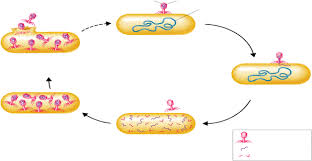
An illness caused by a certain virus includes fever, rash, joint pain, red eyes, and headache. The virus is transmitted to people by infected mosquitoes. Symptoms quickly occur within three to twelve days after contracting the virus. There is no vaccine for this virus.
Which description best explains the reproductive cycle of this virus?
Lytic, because the virus is transmitted by mosquitoes
Lysogenic, because there is no way to vaccinate against it
Lytic, because of the quick incubation time
Lysogenic, because the virus causes a fever

A diagram of an HIV infection is shown.
Which conclusion about the HIV infection of a host cell is best supported by the diagram?
It takes place outside of living cells.
It relies on the host cell to reproduce.
It involves the process of meiosis.
It requires carbon dioxide.

A photograph of a virus is shown below.
The projections on the surface of this virus allow the virus to —
the mechanism used by the virus to infect cells
how closely related the virus is to cold viruses
the metabolism of the virus
meiosis in the virus

A student produces a labeled drawing of a virus for a presentation. The student states that the capsid has a function similar to the nuclear membrane found in animal cells.
Which of these describes the similar functions of capsids and nuclear membranes?
Both transport proteins throughout the structures.
Both provide energy for activities in the structures.
Both protect genetic information for the structures
Both code for the proteins needed for reproduction of the structures.

Which viral cycle kills its host cell by lysing (exploding)?
lytic
mitosis
lysogenic
S phase

