
Font size
 Worksheets
Science 9 unit d section 2
Total questions: 49
Worksheet time: 1hrs 14mins
Ohm's Law states
the resistance of a conductor changes
the current is proportional to the voltage
electrical energy is conserved
all of the above
The longer and thinner a wire, the more resistance it has.
True
False
What kind of device turns mechanical energy into electrical energy?
parallel circuit
generator
motor
magnet
What kind of circuit has only one path?
current circuit
series circuit
parallel circuit
short circuit
What kind of circuit has more than one path?
current circuit
series circuit
parallel circuit
short circuit

Where is the resistor located on this diagram?
A
C
D
B

In the diagram, if a lightbulb is placed at D and B is closed (as shown), what will happen?
the lightbulb will be dimmer than normal
the lightbulb will be off
the lightbulb will be shorted
the lightbulb will be on
If you have a string of lights and one light goes out but the others stay lit, which type of circuit do you have?
broken
parallel
short
series


What is the electrical consumption of a 400W per day (24 hrs)?
0.4 kWh
0.96 kWh
4 kWh
9.6 kWh
A conductor has a resistance of 2.8 Ω .
If the potential difference across it is 9.0 V, what current is flowing through it?
1.3 A
3.2 A
4.3 A
5.7 A

In which circuit the bulbs will light up brighter?
X
Y

What is the type of this electrical circuit?
Parallel circuit
Series circuit
Which of the following affect the brightness of bulb? Tick the correct answers.
Type of circuit
Number of dry cell
Size of bulb
Number of bulb

Which bulb will light up the dimmest?
A
B
C

If bulb J is broken, what will happen to the other bulbs? Tick the correct answer.
bulb K lights up
bulb L lights up
bulb K and L do not light up

Power is measured in:
Watts
Joules
Amps
Volts
Which items would have this energy transformation: mechanical energy -> sound energy?
turning on a flashlight
writing with a pencil
jumping frog
playing a violin

What will be observed when switch S1 is closed?
bulb A lights up
bulb B light up
bulb A and bulb B light up
bulb A and bulb B do not light up

The plastic covering on the wire is there to:
Provide a conductor for electrical energy to flow.
Provide an insulator so that electrical energy will not pass outside of the wires.
Provide a conductor so that electrical energy can NOT flow.
Provide an insulator so that electrical energy can flow.

Match the following
1 - unit which resistance is measured in
2 - abbreviation for current used in Ohm’s Law
3 - units which potential difference is measured in
4 - units which current is measured in
(a)
Which of the following will cause an increase in the resistance of a wire?
Shorten the length of the wire.
Increase the diameter of the wire.
Increase the length of the wire.
Change the type of wire to one that is a better conductor.
A circuit has a 24 volt battery and the resistor is 8 ohms. How much current is running through the circuit?
192 A
3 A
0.33 Ω
3 Ω
Neil wants to determine the voltage passing through a circuit composed of a battery and a length of wire. The problem is that he does not have a voltmeter. He does, however, have an ammeter. Neil also knows that the wire has a resistance of 25 Ω. When Neil connects the ammeter to the circuit he records a current of 10A. What is the voltage passing through the circuit?
250 V
2.5 V
0.4 V
35 V
What resistance is needed to cause a 20A current flow because of a 100V battery?
0.2 Ω
2000 Ω
120 Ω
5 Ω
If an electric toaster runs off of a 120V wall outlet and has a current of 10.5 A running through it, what is the resistance in ohms in the toaster? Round your answer to the tenths place.
(a)

What is resistance represented by in the graph shown? (Use Ohm’s Law.)
3 Ω
0.33 Ω
1.2 Ω
0.83 Ω

Electrical circuits can be set up as either parallel circuits or as series circuits. For each example given below, identify whether it is a parallel circuit or a series circuit.
1 = parallel circuit
2 = series circuit
(a)
A 240W light bulb is running at 120V. What is the current?
0.5 A
5 V
2 A
2 V
In science class, you learned that a conductor is a material that passes electrons easily and that an insulator is a material that does a poor job of conducting (or passing) electrons. How are the electrons in an insulator different from the electrons in a conductor?
The electrons in an insulator are tightly bound to the positively charged nucleus.
The electrons in an insulator are tightly bound to the positively charged nucleus.
The electrons in an insulator flow toward the negative terminal.
There are no electrons present in insulating materials
Resistance is a measure of how difficult it is for electrons to flow through a substance. The unit used for measuring resistance is the:
volt
ampere
ohm
joule
Some lights are controlled by dials rather than by switches. These dials are called dimmer switches and turning the dial controls the brightness of the light. This type of device is called a
conductor
controller
variable resistor
rheostat
While on a field trip to the Alberta Legislature you see a beautiful chandelier hanging in the main hallway. You notice that one of the light bulbs is burnt out yet the remaining bulbs continue to burn. This is possible because
the bulbs on the chandelier each have a different electrical source
the bulb that is burnt out is still able to conduct electricity
the bulbs on the chandelier are set up on a parallel circuit
the bulbs on the chandelier are set up on a series circuit
Which characteristic of wire will offer the most resistance?
a short, thick wire
a long, thick wire
a short, thin wire
a long, thin wire
The plastic covering on the wire is there to:
Provide a conductor for electrical energy to flow.
Provide an insulator so that electrical energy will not pass outside of the wires.
Provide a conductor so that electrical energy can NOT flow.
Provide an insulator so that electrical energy can flow.
Match the following
1 - unit which resistance is measured in
2 - abbreviation for current used in Ohm’s Law
3 - units which potential difference is measured in
4 - units which current is measured in
(a)
Which of the following will cause an increase in the resistance of a wire?
Shorten the length of the wire.
Increase the diameter of the wire.
Increase the length of the wire.
Change the type of wire to one that is a better conductor.
A circuit has a 24 volt battery and the resistor is 8 ohms. How much current is running through the circuit?
192 A
3 A
0.33 Ω
3 Ω
Neil wants to determine the voltage passing through a circuit composed of a battery and a length of wire. The problem is that he does not have a voltmeter. He does, however, have an ammeter. Neil also knows that the wire has a resistance of 25 Ω. When Neil connects the ammeter to the circuit he records a current of 10A. What is the voltage passing through the circuit?
250 V
2.5 V
0.4 V
35 V
Electrical circuits can be set up as either parallel circuits or as series circuits. For each example given below, identify whether it is a parallel circuit or a series circuit.
1 = parallel circuit
2 = series circuit
(a)
A 240W light bulb is running at 120V. What is the current?
0.5 A
5 V
2 A
2 V

Imagine electricity as a waterfall and a river. What is the waterfall's height stand for?
Resistance
Current
Power
Voltage

Imagine electricity as a waterfall and a river. What is the amount of water stand for?
Resistance
Current
Power
Voltage
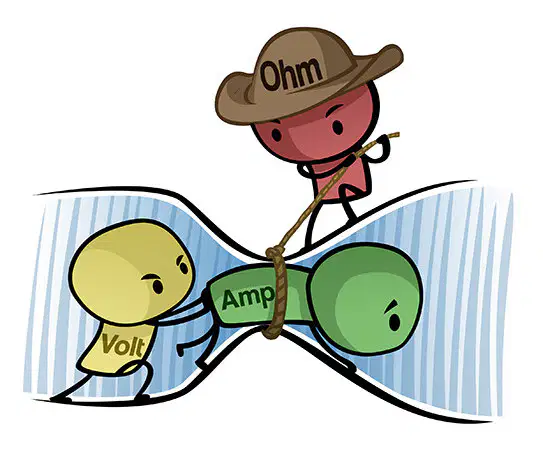
What will happen to the current if we increase the resistance?
The current will increase
No correct answer

What will happen to the current if we increase the voltage?
All is possible

The diagram on the left is a schematic drawing of a circuit consisting of four switches and three bulbs. If switches A and C are closed, and switches B and D are opened, then
None of the bulbs will light up
Only Bulb 2 will light up
Bulbs 2 and 3 will light up
Bulbs 1 and 3 will light up

When shopping for a set of holiday lights, you see this image on the package. This is a diagram of
A Closed Series Circuit
A Closed Parallel Circuit
An Open Series Circuit
A Closed Series Circuit
Mohamad wants to be an engineer. To practice, he sets up a series circuit with a 9-V battery and four small flashlight bulbs. When he adds a fifth flashlight bulb, he notices that the other four are now dimmer. This is because
Each additional bulb increases resistance, increasing the voltage in the circuit
Each additional bulb increases resistance, reducing the current in the circuit
Each additional bulb decreases resistance, reducing the current in the circuit
Each additional bulb decreases resistance, increasing the voltage in the circuit.

