wayground logo

Free Printable Worksheets

NEW

Font size

S
M
L
XL
Worksheets

EOC Review Week 3

Total questions: 34

Worksheet time: 32mins

Name
Class
Date
1.
What is a phenotype?
a)
The expression of a trait; physical appearance.
b)
refers to the genetic makeup of an individual
c)
An organism that has the same genes for a trait (ex. TT or tt)
d)
the passing of traits from parent to offspring
2.
R=round seed
r=wrinkled seed.
Cross a homozygous round with a wrinkled. Which statement predicts the results?
a)
offspring will be Rr
b)
offspring will be RR
c)
round seeds will be recessive to wrinkled
d)
Wrinkled will be observed in half of offspring
3.
W=white hair
w= non-white hair
If you cross a horse with WW and a horse with ww what fraction of the offspring would be expected to have white hair?
a)
none
b)
3/4
c)
1/2
d)
all
4.
Two brown eyed parents (Bb) have a baby. What is the chance the baby is blue eyed?
a)
0 %
b)
25%
c)
50%
d)
75%
5.
This type of inheritance pattern is a MIXTURE of both traits.
a)
incomplete dominance
b)
co-dominance
c)
complete dominance
d)
recessive pattern
6.
A dog gives birth to 5 puppies. What percentage of the chromosomes does each puppy share with the mother?
a)
25%
b)
50%
c)
75%
d)
100%
7.
This is an example of what?
a)
Complete dominance
b)
Incomplete dominance
c)
Codominance
d)
None of the above
8.
W=white hair
w= non-white hair
If you cross a horse with WW and a horse with ww what fraction of the offspring would be expected to have white hair?
a)
none
b)
3/4
c)
1/2
d)
all
9.
The letters on the TOP AND SIDE of a punnett square represent ______________.
a)
The combination of alleles in offspring.
b)
The possible alleles given by the parents following meiosis.
c)
The genotype and phenotype of offspring.
d)
The results of genetic mutations in offspring.
10.
In a certain species of plant, the color purple (P) is dominant to the color white (p).
According to the Punnett Square, what is the probability of an offspring being white?
a)
25%
b)
0%
c)
100%
d)
50%
11.

Who is considered the "father of genetics"?

a)

Reginald Punnett

b)

Gregor Mendel

c)

James Watson

d)

Charles Darwin

12.
Some organisms that share a common ancestor have features that have different functions, but similar structures.  These are known as
a)
vestigial structures
b)
analogous structures
c)
homologous structures
d)
fossil structures
13.
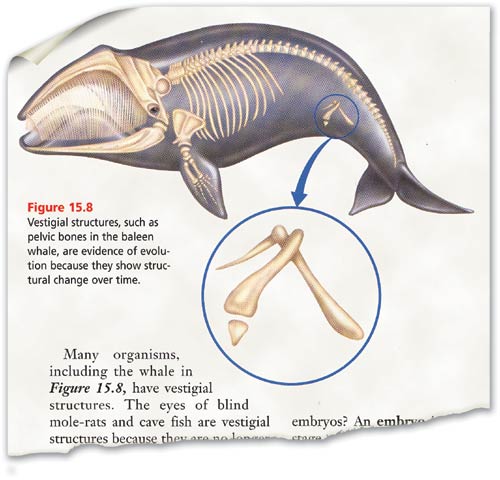
What kind of evidence for evolution is shown in this image?
a)
fossil evidence
b)
anatomical evidence
c)
molecular evidence
14.
Study of embryos of various organisms to show a common ancestor because of similarities in development (such as a post anal tail and gill pouches)
a)
natural selection
b)
embryology
c)
speciation
d)
evolution
15.
Which of the following is an example of a vestigial structure?
a)
the wings of a red-tailed hawk
b)
the hind limbs of a house cat
c)
the fins of sharks
d)
the tailbone of a human
16.
Structures like bird wings and insect wings that have the same function but different structures are...
a)
homologous structures
b)
analogous structures
c)
vestigial structures
d)
embryology 
17.
Two organisms that are closely related would have
a)
very similar DNA sequence
b)
exactly the same DNA sequences
c)
no proteins in common
d)
completely different DNA sequence
18.
The fact that both these mammals incubate their immature offspring in a pouch provides evidence that they --
a)
belong to the same species
b)
can reproduce with each other
c)
have very similar skeletal structures
d)
are descended from a common ancestor
19.
When scientists compare animals currently living on different continents, they often find those with similar characteristics, who are not actually close relatives, living in similar environmental conditions even though they are geographically very distant. One example is the Anteater/Armadillos of the Americas and the Pangolin of Africa. What can we deduce from this evidence?
a)
Living things can adapt similarly to similar environments over time.
b)
Living things do not change over time
c)
They must all have the same recent common ancestor
d)
I don’t know
20.
The Table below shows the # of differences in amino acids in a protein called “Cytochrome C” when comparing humans to other organisms. 
List the 4 closest human relatives based on this biochemical comparison.
a)
chimpanzee, horse, rattlesnake, snapping turtle
b)
chimpanzee, gorilla, rhesus monkey, horse
c)
fruit fly, bread mold, tuna fish, snapping turtle
d)
gorilla, rhesus monkey, rattlesnake, gorilla
21.

The average otter has slight webbing on its paws to assist in gliding through water. Unfortunately, a group of otters' habitat has recently dried up, decreasing the need for webbing. Over many generations, the webbing has lessened. This is:

a)

Stabilizing Selection

b)

Directional Selection

c)

Disruptive Selection

22.

A group of finches has survived for years on medium sized seeds; because of this, they have evolved to have medium-sized beaks. In recent years, medium sized seeds have been on the decline, and the beaks will adjust accordingly. This is an example of:

a)

Gene Flow

b)

Founder's Effect

c)

Directional Selection

d)

Disruptive Selection

23.

Robins typically lay fours eggs. If more then four eggs are produced then the baby chicks are malnourished while smaller egg numbers result in no viable (able to live) baby chicks. This is an example of

a)

stabalizing

b)

disruptive

c)

directional

24.
A flash flood carried a raft of Amazon ants away from their original population. There is enough distance between the two groups, that they will never meet in nature again. What type of reproductive barrier is this?
a)
behavioral isolation
b)
temporal isolation 
c)
gametic isolation
d)
geographic isolation 
25.
Gentoo penguins will present a mate with a pebble that they find to attract a mate. Emperor penguins have a specific call and movement that they make to attract a mate. Which type of isolation do these penguins demonstrate?
a)
temporal isolation 
b)
behavioral isolation
c)
geographical isolation
d)
anatomical isolation
26.

The American toad (Anaxyrus americanus) and Fowler's toad (Bufo fowleri) live in the same area. However, The American toad mates in early summer while Fowler’s mates in late summer.

a)

Geographic isolation

b)

Behavioral isolation

c)

Temporal isolation

27.

What is a specially developed characteristic that enables an organism to live in a specific environment?

a)

adaptations

b)

natural selection

c)

survival of the fittest

d)

variations

28.
A wasp beetle has the same body markings as a wasp.  this helps the wasp beetle because predators think it's a wasp.  This adaptation is called...?
a)
behavior
b)
countershading
c)
camouflage
d)
mimicry
29.
What is taxonomy?
a)
The study of DNA and RNA
b)
The study of how organisms are related
c)
The study of classifying and describing organisms
d)
The study of organisms in their habitat
30.
I have cell walls
I am an autotroph
I am multicellular
What am I?
a)
Plant
b)
Animal
c)
Eubacteria
d)
Unicorn
31.
I have no cell walls
I am eukaryotic
I reproduce sexually
I am multicellular
What kingdom do I belong to?
a)
Plantae
b)
Animalia
c)
Protista
d)
Fungi
32.
When a virus invades a living cell, its _______
takes over the cell's functions.
a)
outer coat
b)
genetic material
c)
core
d)
cytoplasm
33.
What provides direct energy for the virus?
a)
food
b)
its host
c)
the sun
d)
a parasite
34.
Which of the following occurs after a virus attaches to a host cell in the viral reproduction process?
a)
The host cell dies
b)
The virus dies
c)
The virus inserts its genetic information into the host cell
d)
copies of the virus are immediately released from the host