wayground logo

Free Printable Worksheets

Font size

S
M
L
XL
Worksheets

Genetics Review

Total questions: 52

Worksheet time: 50mins

Name
Class
Date
1.

What is an example of a mutagenic agent

a)

acetelcholine

b)

UV Radiation

c)

maltase

d)

an amino acid

2.

The physical transfer of a gene from the DNA of one organism into another organism in order to produce an organism with desired traits is called

a)

Genetic engineering

b)

Karyotype

c)

Cloning

d)

Selective breeding

3.
An organism that is genetically identical to the organism from which it was produced.
a)
Clone
b)
Carrier
c)
Hybridization
d)
Selective Breeding
4.
The process of selecting a few organisms with desired traits to serve as parents of the next generation.
a)
Gene Therapy
b)
Genome
c)
Selective Breeding
d)
Pedigree
5.

Selective breeding is...

a)

a process to create an organism with desired traits from parents with those desired traits

b)

natural method of producing offspring with desired traits

c)

creating a new species

d)

making organisms reproduce during times of stress

6.
Making changes in the DNA of an organism is
a)
selective breeding
b)
artificial selection
c)
genetic engineering
d)
genetic transformation
7.
What term is used to express creating an identical copy of a gene or organism?
a)
hybridization
b)
inbreeding 
c)
cloning 
d)
gene splicing 
8.
What process is shown in the picture?
a)
Gene therapy
b)
Cloning
c)
DNA Fingerprinting
d)
Gene Splicing
9.

Advantages of genetically modified crops include(s)

a)

insect resistance

b)

drought/freeze resistance

c)

higher yield

d)

all of these are reasons for using GMOs

10.

Why might people be against cloning?

a)

It is a little creepy

b)

It can cause unknown defects

c)

It is detrimental to genetic diversity

d)

All of the above

11.
Which of the following is used to cut DNA so it can be studied?
a)
Gel Electrophoresis
b)
Restriction Enzymes
c)
Karyotypes
d)
Haplotypes
12.
What is shown here?
a)
DNA Microarrays
b)
Virus Scans
c)
Recombinant DNA
d)
DNA Fingerprints
13.
Which Suspect Committed the crime?
a)
Suspect #1
b)
Suspect #2
c)
Suspect #3
d)
Suspect #4
14.
In gel electrophoresis, which DNA Fragments move farthest from the starting point?
a)
Large Fragments
b)
Small Fragments
c)
Medium Fragments
d)
Smooth Fragments
15.
In gel electrophoresis, DNA fragments move from 
a)
Positive to Negative
b)
Negative to Positive
c)
Positive to Positive
d)
Negative to Negative
16.
What was the first cloned animal?
a)
Dolly the Sheep
b)
Robby the Rat
c)
Milton the Mouse
d)
Beth the Goat
17.
The small ring of DNA found in a bacterial cell used as a biological vector
a)
Helix
b)
Plasmid
c)
Clone
d)
Nucleotide
18.
When trying to determine the genotype of an unknown parent, we cross the unknown parent with 
a)
A Heterozygous Individual
b)
A Co-Dominant Individual
c)
A Homozygous Recessive Individual
d)
A Homozygous Dominant Individual
19.
The physical separation of mixtures into individual components is..
a)
chromatography
b)
opacity 
c)
latent
d)
trace evidence 
20.

This laboratory procedure is known as

a)

CLONING

b)

gel electrophoresis

c)

chromatography

d)

use of a dichotomous key

21.

In preparation for an electrophoresis procedure, enzymes are added to DNA in order to

a)

convert the DNA into gel

b)

cut the DNA into fragments

c)

change the color of the DNA

d)

produce longer sections of DNA

22.

A student performed a gel electrophoresis experiment. The results are represented in the diagram

below. Compared to the fragments at the top of the gel, the fragments at the lower end are

a)

larger, and move slower

b)

larger, and move faster

c)

smaller, and move faster

d)

smaller, and move slower

23.

a photograph or picture of chromosomes grouped in ordered pairs is a ______________

a)

pedigree

b)

Punnett Square

c)

Venn Diagram

d)

Karyotype

24.

The following karyotype shows an individual with...

a)

Down's syndrome

b)

Kleinfelter's syndrome

c)

Turner's syndrome

d)

Someone exposed to UV light

25.

Which is Heterozygous?

a)

Tt

b)

BB

c)

ff

d)

Dominant

26.

Which is homozygeous?

a)

Tt

b)

BB

c)

Ff

d)

Blue

27.

What are the chances that the offspring will have homozygous recessive traits?

a)

1 in 4

b)

3 out of 4

c)

75%

d)

50%

28.

What are the chances of heterozygous genotypes in offspring?

a)

50%

b)

25%

c)

1 in 4

d)

75%

29.

What is the dominant trait here?

a)

Bb

b)

Recessive eyes

c)

Blue eyes

d)

Brown eyes

30.
Black hair color is dominant to white hair color in mice.  Determine the phenotypic ratio for the offpring of a heterozygous black mouse and a white mouse.
a)
4 Black: 0 White
b)
3 Black: 1 White
c)
2 Black: 2 White
d)
0 Black: 4 White
31.

What are the proper complementary base-pairs?

a)

A--T and G--C

b)

A--G and C--T

c)

G--T and A--C

d)

A--C and T--G

32.

T A G G A C T


The complementary strand is...

a)

T A G G A C T

b)

A T G G T G A

c)

A T C C T G A

d)

T T C C A G T

33.

If a strand of DNA has 39% Cytosine, it has...

a)

39% Adenine

b)

39% Guanine

c)

39% Thymine

d)

39% combined Cytosine and Guanine

34.

The following are true about DNA:

a)

single helix, deoxyribose, GCAU

b)

single helix, deoxyribose, GCAT

c)

double helix, ribose, GCAU

d)

double helix, deoxyribose, GCAT

35.

How many nucleotide bases are there?

a)

1

b)

2

c)

3

d)

4

36.
Which of the following best describes a DNA molecule?
a)
double helix
b)
contains ribose
c)
made of amino acids
d)
contains Uracil
37.
Which of the following units are repeatedly joined together to form a strand of DNA?
a)
amino acids
b)
nucleotides
c)
fatty acids
d)
polysaccharides
38.
Guanine bonds with ______________.
a)
Adenine
b)
Guanine
c)
Cytosine
d)
Thymine
39.
Why is DNA important?
a)
it is very small and very complicated
b)
it's in everything
c)
it serves as the blueprint for traits of all living things
d)
because we eat it every day for energy
40.
What determines the code, or information, of a DNA molecule?
a)
the shape (structure) of the nitrogen bases
b)
the order (sequence) of the nitrogen bases
c)
the color of the nitrogen bases
d)
the frequency (number) of nitrogen bases
41.
Which 2 molecules form the sides (backbone) of the DNA ladder?
a)
deoxyribose sugar and adenine
b)
deoxyribose sugar and a hydrogen bond
c)
deoxyribose sugar and the nucleus
d)
deoxyribose sugar and phosphate
42.
What are the three components of a nucleotide?
a)
sugar, hydrogen, nitrogen base
b)
sugar, oxygen, nitrogen base
c)
sugar, phosphate, nitrogen base
d)
sugar, phosphate, protein
43.
A process in which DNA has the unique ability to make an exact copy of itself.
a)
Replication
b)
Translation
c)
Transcription
44.
Nitrogenous bases are joined by which type of bond?
a)
polar bonds
b)
ionic bonds
c)
covalent bonds
d)
hydrogen bonds
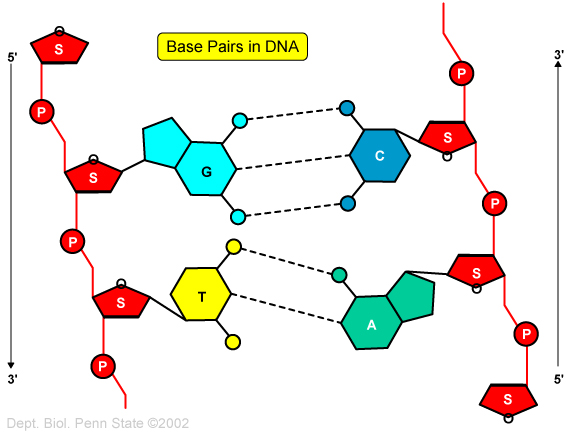
45.
What does this picture represent?
a)
amino acid
b)
base pairing
c)
nucleotide
d)
the DNA molecule
46.
Adenine bonds with ______________.
a)
Guanine
b)
Thymine
c)
Cytosine
d)
Adenine
47.
RNA contains the sugar
a)
ribose
b)
deoxyribose
c)
glucose
d)
lactose
48.
Which of the following statements is true?
a)
DNA is single-stranded
b)
RNA is single-stranded
c)
DNA contains uracil
d)
RNA contains deoxyribose
49.
What is the difference between DNA and RNA in terms of bases?
a)
RNA contains uracil in place of thymine
b)
RNA contains uracil in place of adenine
c)
RNA contains uracil in place of guanine
d)
RNA contains uracil in place of  cytosine
50.

The diagram below represents a change that occurred in a pair of chromosomes during the formation of an egg cell. The alteration that occurred will most likely be passed on to every cell that develops from the egg cell. Why would this type of alteration result in offspring with combinations of traits that differ from those found in either parent?

a)

It converts sex cells into body cells.

b)

It results in the formation of diploid gametes.

c)

. It results in new combinations of genes on each chromosome.

d)

It changes the chromosome number of the body cells that develop from the egg cell.

51.

The diagram shows the process of crossing over. Which claim about crossing over in chromosomes is best supported by the diagram?

a)

Crossing over increases genetic diversity through deletion.

b)

Crossing over decreases genetic diversity through mutation.

c)

Crossing over increases genetic diversity by creating new combinations of genes.

d)

Crossing over decreases genetic diversity by inserting nucleotides into gene sequences.

52.
New combination of genetic information in a gamete as a result of crossing over during prophase I of meiosis
a)
fertilization
b)
sex chromosome
c)
genetic recombination
d)
benign tumor