
 Worksheets
Evolution Quiz
Total questions: 13
Worksheet time: 8mins
Name
Class
Date
1.

The picture represents what evidence of evolution?
a)
Homologous structure
b)
Analogous structure
c)
Vestigial structure
d)
Heterozygous structure
2.
Which of the following is not evidence of evolution or common ancestry?
a)
Vestigial Structures
b)
Homologous Structures
c)
Fossil Records
d)
Mutations
3.
Which of the following is not evidence of evolution or common ancestry?
a)
Vestigial Structures
b)
Homologous Structures
c)
Fossil Records
d)
Mutations
4.
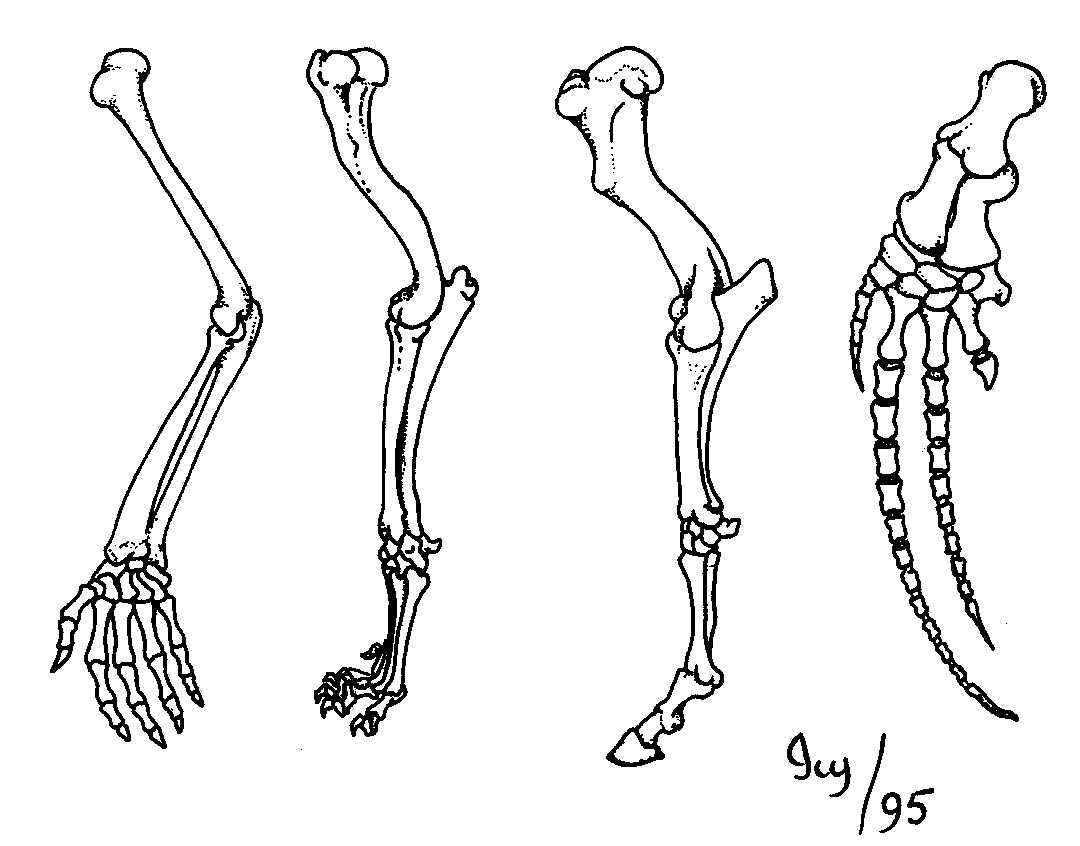
Structures with the same parts have different functions; suggests that organisms share a common ancestry
a)
vestigial structures
b)
homologous structures
c)
adaptive radiation
d)
fossil
5.

The diagram shows fossils in different rock layers. Which of these statements about the age of these fossils is most likely correct?
a)
Fossil A and C are the same age
b)
Fossil B is older than fossil C
c)
Fossils A is older than fossil B
d)
Fossil D is older than fossil C
6.
The scientific theory of evolution is supported by different types of evidence. The diagrams below show the skeletons of two different animal species. How does comparing the skeletons of these animals provide support for the scientific theory of evolution?
a)
It provides information about the organisms' habitats.
b)
It shows possible common ancestry between organisms.
c)
It provides information to determine the organisms' ages.
d)
It shows possible chromosomal similarities between organisms.
7.

The diagram illustrates an embryonic stage of two organisms.Which of the following can be determined by observing the embryos shown in the diagram?
a)
The organisms share a common ancestry.
b)
The organisms belong to the same genus.
c)
The organisms are native to the same geographic areas.
d)
The organisms will grow into anatomically similar adults.
8.

The pelvic bone of whales is not needed for movement within the water. This is an example of a(n) ______________ structure.
a)
vestigial
b)
analogous
c)
homologous
9.

The forelimbs of mammals have similar anatomy because these groups descended from a recent common ancestor. Their bone structure is an example of a(n) ______________ structure.
a)
vestigial
b)
analogous
c)
homologous
10.

Many different groups of organisms have wings, even though they do not share a recent common ancestor. This is because they evolved in environments with similar selective pressures. Wings are an example of a(n) ______________ structure.
a)
vestigial
b)
analogous
c)
homologous
11.

If an organism has a vestigial structure, that structure likely once had a function in a(n)
a)
close relative
b)
early ancestor
c)
unrelated organism
d)
embryological stage
12.
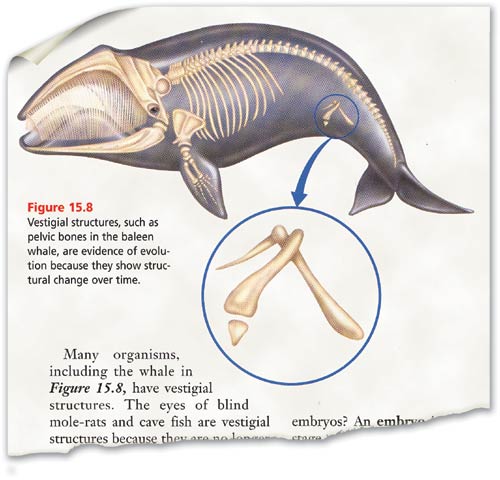
Which of the following is an example of a vestigial structure?
a)
the wings of a red-tailed hawk
b)
the hind limbs of a house cat
c)
the fins of sharks
d)
the tailbone of a human
13.

This picture is best known as
a)
homologous structures
b)
analogous structures
c)
vestigial structures
d)
embryology
100 %

