

Wayground logo

Free Printable Worksheets

Font size

S
M
L
XL
Worksheets

Fusion and fission practice

Total questions: 35

Worksheet time: 25mins
Name
Class
Date
1.
Nuclear power uses ____ for fuel.
a)
steel
b)
coal
c)
uranium
d)
hydrogen
2.
The splitting of a nucleus into smaller nuclei is
a)
fusion
b)
fission
c)
decay
d)
gamma radiation
3.
What is a chain reaction?
a)
When electrons are emitted causing electricity
b)
When a nuclear fission reaction occurs, the protons emitted can strike other nuclei in the sample, and cause them to split
c)
When a nuclear fission reaction occurs, the neutrons emitted can strike other nuclei in the sample, and cause them to split
d)
When a nuclear fission reaction occurs, the electrons emitted can strike other nuclei in the sample, and cause them to split
4.
An example of an uncontrolled fission reaction is _______________
a)
Nuclear power plants
b)
Radio active decay
c)
Atomic Bomb
d)
On the surface of the sun
5.
Where does fusion occur naturally?
a)
Underwater
b)
All around us
c)
In the radioactive waste
d)
On the sun
6.
Nuclear energy uses _____ to turn turbines to power a generator.
a)
wind
b)
water
c)
steam
d)
solar
7.
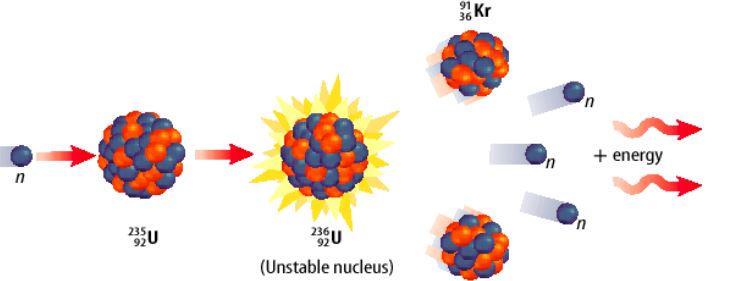
This is an example of...
a)
Fission  reaction
b)
Fusion reaction
c)
Decomposition reaction
d)
Decay
8.

Which type of reaction does the diagram illustrate?

a)

Fission

b)

Fusion

c)

Alpha Decay

d)

Beta Decay

9.

What occurs in both fusion and fission reactions?

a)

Small amounts of energy are converted into large amounts of matter.

b)

Small amounts of matter are converted into large amounts of energy.

c)

Heavy nuclei are split into lighter nuclei.

d)

Light nuclei are combined into heavier nuclei.

10.

For the balanced equation, which particle is represented by X?

a)

0-1 e

b)

11 H

c)

42 H

d)

10 n

11.

Nuclear fusion differs from nucleus fission because nucleus fusion reactions

a)

form heavier isotopes from lighter isotopes

b)

form lighter isotopes from heavier isotopes

c)

convert mass to energy

d)

convert energy to mass

12.

Which reaction represents fusion?

a)
b)
c)
d)
13.

Which reaction represents fission?

a)
b)
c)
d)
14.

Where does fusion take place? (Check all that apply)

a)

sun

b)

stars

c)

deep inside the earth

d)

nuclear reactors

15.
Which of the following is true about nuclear fission?
a)
The mass of the product is greater than the mass of the original nucleus
b)
The mass of the product is less than that of the original nucleus
c)
The mass of the product is the same as the mass of the original nucleus
d)
The mass of the product is 100 times greater than the original nucleus
16.

Radium is linked to effects on human health including (check all that apply).

a)

Bone marrow disease

b)

Cancer

c)

Tooth loss

17.

In what ways can radioactive tracers be administered to a patient? Choose all that apply.

a)

Oraly

b)

Injected

c)

Inhaled

d)

None of the above

18.

True or False: Radioisotopes used in medicine generally have short half lives.

a)

True

b)

False

19.

True or False: Radioisotopes in medicine are used for both diagnosis and treatment.

a)

True

b)

False

20.
What is a chain reaction?
a)
When electrons travel are emitted causing electricity
b)
When a nuclear fission reaction occurs, the protons emitted can strike other nuclei in the sample, and cause them to split
c)
When a nuclear fission reaction occurs, the neutrons emitted can strike other nuclei in the sample, and cause them to split
d)
When a nuclear fission reaction occurs, the electrons emitted can strike other nuclei in the sample, and cause them to split
21.

Any reaction that involves the particles in the nucleus of an atom are called ________?

a)

Fission

b)

Nuclear Reaction

c)

Fusion

d)

Particle Accelerator

22.

Which of the following correctly display nuclear fission?

a)
b)
c)
d)
e)
23.

The process of combining the nuclei of atoms to make different atoms is called _________?

a)

Fission

b)

Nuclear Reaction

c)

Fusion

d)

Particle Accelerator

24.

Breaking up the nucleus of an atom is called _________?

a)

Fusion

b)

Nuclear Reaction

c)

Fission

d)

Particle Accelerator

25.

Which of the following correctly display nuclear fusion?

a)
b)
c)
d)
e)
26.

_________ is how we describe any process where the nucleus emits particles or energy.

a)

Fission

b)

Nuclear Reaction

c)

Fusion

d)

Particle Accelerator

27.
What is true about nuclear fusion? 
a)
The mass of the product is less than that of the original nucleus
b)
The mass of the product is 100 times less than that of the original nucleus
c)
The mass of the product is the same as that of the original nucleus
d)
The mass of the product is greater than that of the original nucleus
28.
Which of the following is true about nuclear fission?
a)
The mass of the product is greater than the mass of the original nucleus
b)
The mass of the product is less than that of the original nucleus
c)
The mass of the product is the same as the mass of the original nucleus
d)
The mass of the product is 100 times greater than the original nucleus
29.

Which of the following isotopes is used to diagnose and treat thyroid disorders?

a)

Iodine-131

b)

Cobalt-60

c)

Technetium-99

d)

Uranium-238

e)

Carbon-14

30.

Which of the following isotopes is used to treat prostate cancer?

a)

Iodine-131

b)

Cobalt-60

c)

Technetium-99

d)

Uranium-238

e)

Carbon-14

31.

Which of the following isotopes is used to date fossils?

a)

Iodine-131

b)

Cobalt-60

c)

Americium-241

d)

Uranium-238

e)

Carbon-14

32.

Which of the following isotopes is used in smoke detectors?

a)

Iodine-131

b)

Cobalt-60

c)

Americium-241

d)

Uranium-238

e)

Carbon-14

33.
Gamma rays damage human cells/tissue.
a)
True
b)
False
34.

True or False: Radioisotopes used in medicine generally have short halve lives.

a)

True

b)

False

35.

True or False: Radioisotopes in medicine are used for both diagnosis and treatment.

a)

True

b)

False







