wayground logo

Free Printable Worksheets

Font size

S
M
L
XL
Worksheets

Computational Thinking, Algorithms & Flowcharts

Total questions: 28

Worksheet time: 9mins

Name
Class
Date
1.

What do we mean by COMPUTATIONAL THINKING?

a)

Understanding a complex problem and developing possible solutions.

b)

Breaking a task into smaller tasks.

c)

Selecting a computer to use.

d)

Focusing on what is important, ignoring what is unnecessary.

2.

Define ABSTRACTION

a)

Breaking a task into smaller tasks.

b)

Drawing a map to show how to reach a destination.

c)

Creating step by step instructions.

d)

Focusing on what is important and ignoring what is unnecessary.

3.

Define DECOMPOSITION

a)

Breaking a task into smaller tasks.

b)

Looking for similarities and trends.

c)

A sequence of instructions.

d)

Focusing on what is important and ignoring what is unnecessary.

4.
What is an algorithm?
a)
A problem
b)
A solution to a problem
c)
The steps that are taken to solve a problem
d)
The words to enter when typing
5.

What is pseudocode?

a)

A way of describing a set of instructions in text form

b)

A specific programming language that all computers use

c)

A diagrammatic representation of a set of instructions

6.
Why do we use flowcharts?
a)
To represent algorithms in an easy way
b)
To use different maths shapes
7.
What symbol shows a decision?
a)
oval
b)
parallelogram
c)
rectangle
d)
diamond
8.
What is the purpose of a parallelogram within a flowchart?
a)
Input / Output
b)
Sub-process
c)
Decision
d)
Output
9.
What is the purpose of a rectangle within a flowchart?
a)

Process

b)
Input / Output
c)
Decision
d)
Start / Stop
10.
What is the purpose of an arrow in a flowchart?
a)
Shows the relationships between shapes/ the flow of information
b)
They look nice when we use them
c)
We don't use arrows
d)
Shows the way the arrow is directed
11.

What does sequence mean?

a)

To create a pattern

b)

To do something in order

c)

To do something randomly

d)

To repeat something over and over again

12.

What does selection mean?

a)

Selection is following instructions in order.

b)

Selection is to repeat something over and over again

c)

Selection is when you have a choice of options

d)

Selection is choosing the best option

13.

What is iteration?

a)

This is choosing what to do next

b)

This means doing something in order

c)

It is repeating something over and over again.

d)

It is writing pseudocode

14.

What is a subroutine?

a)

A flowchart shape that allows for a decision to be made

b)

It shows the paths that information flows down in a flowchart

c)

A flowchart shape that allows for inputs and outputs to a program

d)

A set of instructions designed to perform a frequently used operation within a program
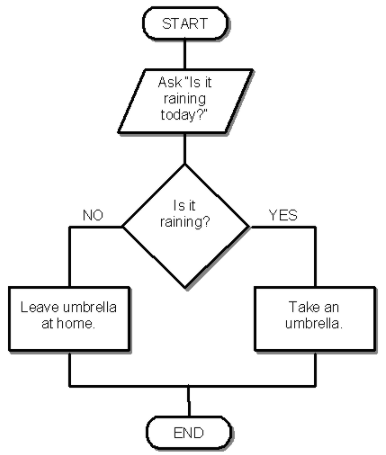
15.
What is the Output if the user enters:
Yes
a)
Leave umbrella at home
b)
Take an umbrella
16.
Identify a variable within this flowchart.
a)
INPUT
b)
Start
c)
12
d)
RESULT
17.

What will happen if the user's book return is late?

a)

Sends them an SMS (text)

b)

Does not send them an SMS (text)

18.
What is this symbol used for in a flowchart?
a)
A decision/question
b)
A task to carry out
19.
What is this symbol used for in a flowchart?
a)
A decision/question
b)
A task to carry out
20.
What does this symbol represent?
a)
Decision
b)
Input/Output
c)
Start
d)
Process
21.
Can this shape be used for both Start and Stop?
a)
Yes
b)
No
22.
A logical way of getting from the problem to the solution. If the steps you take to solve a problem follow an algorithm then they can be reused and adapted to solve similar problems in the future.
a)
Decomposition
b)
Abstraction
c)
Programming
d)
Algorithmic Thinking
23.
What is the correct definition of an algorithm?
a)
An algorithm is a step by step instructions to solve a problem.
b)
An algorithm is a process of baking bread.
c)
An algorithm is a software used to compute numbers.
d)
An algorithm is the process of breaking problems.
24.
Breaking a complex problem down into smaller problems and solving each one individually.
a)
Decomposition
b)
Abstraction
c)
Programming
d)
Algorithmic Thinking
25.
Picking out the important bits of information from the problem, ignoring the specific details that don't matter.
a)
Decomposition
b)
Abstraction
c)
Programming
d)
Algorithmic Thinking
26.
Why do we need to think computationally?
a)
To help us program
b)
To help us solve complex problems more easily
c)
To help us to think like a computer
27.

A diagram that represents a set of instructions is called:

a)

Flow Chart

b)

Pseudocode

c)

Shapes

28.

A simple way of describing a set of instructions that does not have to use specific syntax is called:

a)

Flow Chart

b)

Pseudocode

c)

Shapes