
NEW
Font size
 Worksheets
SOL Review #1: Early Humans
Total questions: 25
Worksheet time: 13mins
Which of the following DOES NOT describe the Paleolithic Era?
Societies were hunter-gatherer in nature
Paleolithic people depended on what naturally was produced around them for resources
Developed written language
First to use fire
What was the most common reason in which Paleolithic peoples chose to migrate, or move from place to place?
They needed to find employment and an income
To find resources such as food and shelter
To explore the world
To perform agriculture in different regions and gain access to new crops
Which statement best explains the greatest effect the emergence of agriculture had on early societies?
The population steadily decreased
People were not able to specialize in just one trade
Agriculture made it harder to find food
The population steadily increased
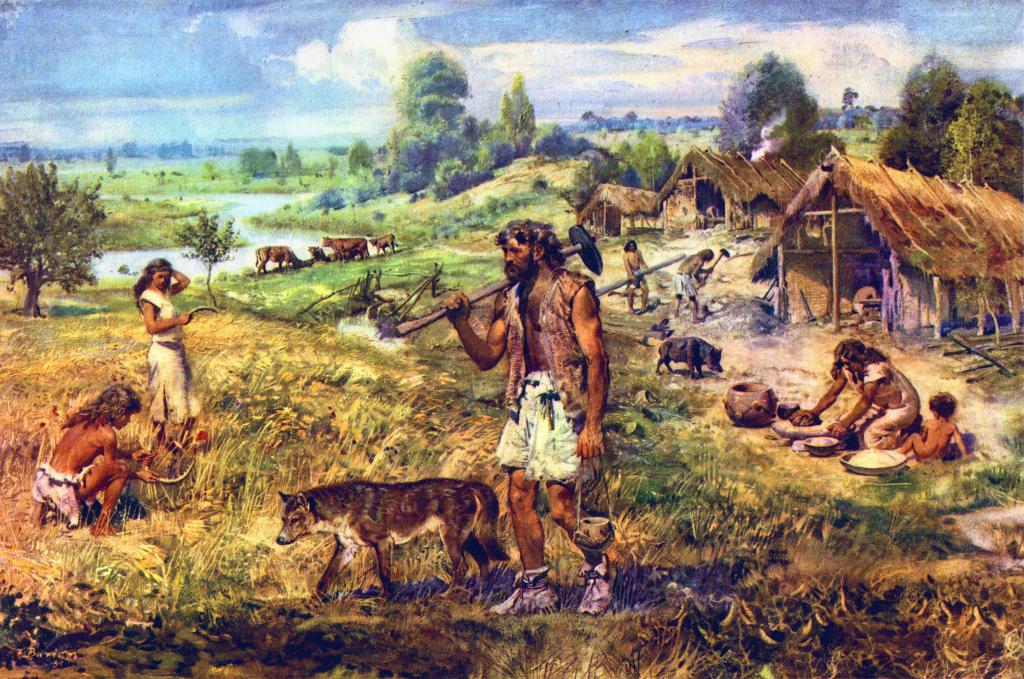
What change marked the beginning of the Neolithic Revolution?
The beginning of hunting and gathering
The development of written language
The advent (beginning) of agriculture
The construction of the first city
When the Neolithic Revolution happened and society became settled agricultural communities, new occupations emerged to fill the needs of increasingly complex societies. This is called:
Specialization of labor
Mandate of Heaven
Engineering
Theocratic governments
Catalhuyuk and Jericho are Neolithic settlements located in which world region?
South Asia
The Middle East
North America
North Africa
Which of the following is not true about prehistory?
It refers to the time after the advent (emergence) of written language
The earliest settled societies were created by humans during the prehistoric era
Historians learn about prehistoric societies by studying the artifacts they produced
Carbon dating is often used to date prehistoric artifacts
Which of the following most likely accounts for the growth in human population seen in the Neolithic period?
The invention of spoken language
The development of plant and animal domestication
The decline of species that competed with humans for food
The use of more efficient weapons of warfare
What is polytheism?
The belief in no gods
The belief in many gods
The belief in only one god
The belief in only female gods
It forced them to stay in one place and build villages and cities
It caused them to continue to hunt animals and gather plants
It ended fighting between the tribes for land
It stopped them from building temples for their gods
They lived in large villages, where they raised crops and livestock
They stayed in one place, living in caves and beneath rock shelters
They lived in small villages and farmed the land
They lived in caves or built collapsible shelters
They migrated from place to place to hunt animals for food
They could settle in one place because they had a reliable food supply
They used only simple tools made from stone
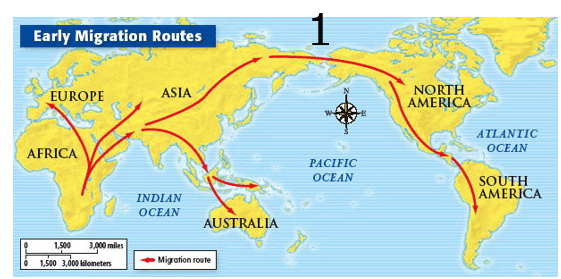
The map shows one explanation of the migration routes of early humans. What made it possible for them to move from Asia to North America?
They constructed large ships to sail across at #1
They crossed the land bridge at #1
They swam the short distance at #1
They built a bridge out of wood at #1
Which location best describes where the earliest humans (Homo sapiens) emerged?
South Asia
North America
East Africa
Western Europe
Early humans prior to the Agricultural/Neolithic Revolution lived lifestyles that are best described as:
Urban-focused
Monotheistic
Settled farmers
Hunter-gatherers
Paleolithic Era or Neolithic Era: Which came first?
Paleolithic Era
Neolithic Era
Paleolithic Era or Neolithic Era: First to use stone tools?
Paleolithic Era
Neolithic Era
Paleolithic Era or Neolithic Era: First to develop fire?
Paleolithic Era
Neolithic Era
Paleolithic Era or Neolithic Era: First to use cave art?
Paleolithic Era
Neolithic Era
Paleolithic Era or Neolithic Era: Development of agriculture?
Paleolithic Era
Neolithic Era
Paleolithic Era or Neolithic Era: Use stone AND metal tools?
Paleolithic Era
Neolithic Era
Paleolithic Era or Neolithic Era: Domesticated animals?
Paleolithic Era
Neolithic Era

