wayground logo

Free Printable Worksheets

Font size

S
M
L
XL
Worksheets

Biodiversity/Ecological Succession

Total questions: 22

Worksheet time: 29mins

Name
Class
Date
1.

Which of the following forms of biodiversity describes all of the different types of biotic factors in an ecosystem?

a)

Species

b)

Habitat

c)

Genetic

d)

None of the Above

2.

Which do you think has a higher species diversity biodiversity, a food chain or a food web?

a)

Food Chain

b)

Food Web

3.

What has a higher biodiversity: a rain forest or a desert?

a)

Rain forest

b)

Desert

c)

They have a similar biodiversity

4.

In general, as you move from the equator to the poles, what happens to biodiversity>

a)

Increases

b)

Decreases

c)

Remains the same

5.

Why is biodiversity in an ecosystem so important?

a)

Because it can help humans where to determine good places to develop farm land.

b)

Because places that have a healthy biodiversity are unaffected by major disturbances.

c)

Because having a high biodiversity allows ecosystems to withstand major changes.

d)

Because having a high biodiversity allows for fewer opportunities of competition for similar resources.

6.

Which factor is most likely to cause the number of rabbits living in an area to increase?

a)

less water

b)

fewer predators

c)

lack of shelter

d)

limited food

7.
When there is higher biodiversity
a)
more organisms are likely to die because they can't adapt to environmental changes.
b)
there is less diversity.
c)
there is more diversity and higher sustainability of life.
d)
there is more diversity and lower sustainability of life
8.
How do biodiversity and sustainability work together?
a)
The lower the biodiversity the greater the sustainability.
b)
The higher the biodiversity, the less sustainable the ecosystem
c)
The higher the biodiversity, the greater the sustainability.
d)
Biodiversity has nothing to do with sustainability.
9.
What is ecological succession?
a)
A slow change in an environment
b)
A change that takes days in an environment
c)
No change
d)
Abiotic change
10.
What are examples of pioneer species in a primary succession?
a)
Bushes and Shrubs
b)
Oak trees
c)
Mossess and Lichens 
d)
A rose Bush
11.
A pioneer species is...
a)
a large organism
b)
the first organisms to adapt to a new environment 
c)
The best organism 
d)
Abiotic organisms 
12.
What is the most important function of pioneer species?
a)
To create rocks
b)
To create soil and add nutrients to the environment 
c)
To look nice
d)
Food for animals 
13.
A climax community is ….
a)
the beginning of a new ecological succession.
b)
the rocks in a new environment.
c)
the fire that will cause destruction.
d)
an area that reaches its greatest growing potential.
14.
What is the difference between primary and secondary succession?
a)
Primary succession already has soil.
b)
Primary has soil and secondary does not
c)
soil is present in both
d)
primary has no soil and secondary has soil
15.
A large tree forest is an example of ...
a)
a small community
b)
a abiotic community
c)
a climax community
d)
a pioneer species 
16.
Why does primary succession take longer to reach climax community?
a)
Because trees do not perform photosyntheses.
b)
Because climax community is in a forrest.
c)
Because primary succession already has soil
d)
Because primary succession does not have soil
17.
Which is the correct order in primary succession?
a)
Rocks, Lichens & Mosses, Bushes & Shrubs, Trees
b)
Lichens & Mosses, Rocks, Trees, Bushes & Shrubs 
c)
Trees, Bushes and Shrubs, Lichens & Mosses, Lichens & Mosses
d)
Rocks, Grass, Trees, Bushes & Shrubs
18.
First species occuring in areas of primary succession are mosses and
a)
grasses
b)
wildflowers
c)
trees
d)
lichens
19.
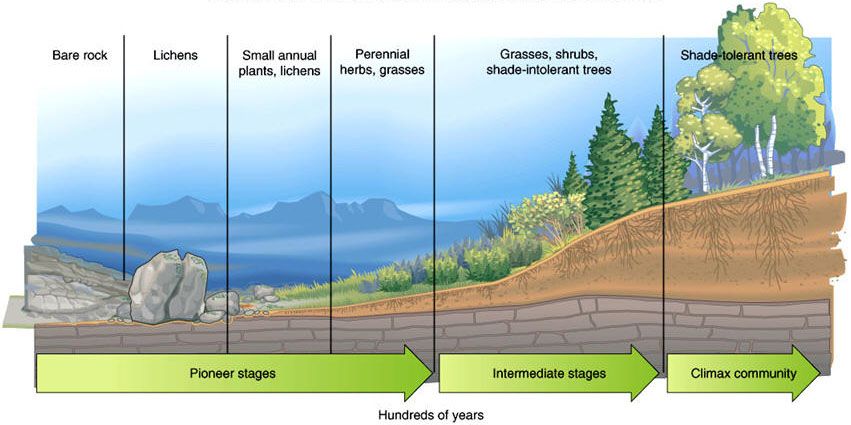
The picture shows what type of succession?
a)
primary
b)
secondary
c)
tertiary
d)
quadanary
20.
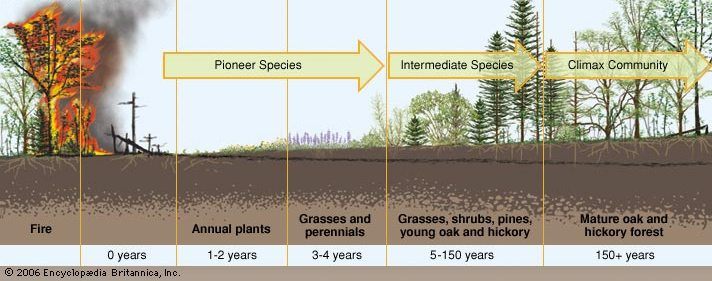
The picture shows what type of succession?
a)
primary
b)
secondary
c)
tertiary
d)
quadanary
21.
After a volcanic eruption, lava covers the land. What is the order that plants grow to repopulate the area?
a)
Lichens → Shrubs → Grasses → Trees
b)
Lichens → tree → shrubs→Grasses
c)
Grasses → Lichens → Shrubs → Trees
d)
Lichens → Grasses → Shrubs → Trees
22.
This is an example of...
a)
Climax communities
b)
Secondary succession
c)
Lichen
d)
Pioneer species