
 Worksheets
Final Review
Total questions: 33
Worksheet time: 1hrs 6mins
Friction is an example of _____________
contact force
non contact force
both of these
none of these
Rough surfaces have _________
greater friction
less friction
the same level of friction
Then how much work is done if it takes 20N to move a box 10 meters
An object that has momentum can be described as _________
a) changing its velocity
b) moving fast
c) resisting changes in its state of motion
d) having its mass in motion
e) encountering a net force
Which one of the following units represents the standard metric units of momentum
Newtons * meter / second
Kilograms * meter / second2
meter / second
Kilograms * meter / second
During a collision. an object experiences an impulse. The impulse causes and is equal to the _____ of the object
energy change
kinetic energy change
force
momentum
momentum change
In an elastic collision...
objects bounce off each other
objects stick together
objects stick together for a while then separate
one object flips over the other
What is wavelength?
the number of waves that pass a given point each second
the height of a wave
the flow of charged particles (electrons)
the length of one cycle of a wave (from crest to crest)
The frequency of a wave is the--
number of waves that pass a given point each second
length of one cycle of a wave (from crest to crest)
tendency to continue moving
the height of a wave
________ is energy that is stored in an object as a result of its position, shape, or chemical composition.
Chemical
Mechanical
Kinetic
Potential
What is the formula for work?
F = M(A)
W = F(D)
KE = 1/2M (V)2
Power = W/T
States that energy cannot be created or destroyed,
only transformed/transferred.
Newtons 2nd Law
Law of Conservation of Energy
Gravity
Law of Thermodynamics
Energy can't be .....
harnessed or produced.
made or destroyed.
transformed.
converted.
An airplane accelerates down a runway from rest at 3.20 m/s2 for 32.8 s until is finally lifts off the ground. Determine the distance traveled before takeoff.
Which equation is appropriate?
vf=vi+a*t
x=vi*t+1/2at2
vf2=vi2+2aX
x=((vf+vi)/2)t
A car is traveling to the right with a speed of 29m/s when the rider slams on the accelerator to pass another car. The car passes in 110 m with constant acceleration and reaches a speed of 34m/s. We want to find the acceleration of the car as it sped up. What equation should you choose?
vf=vi+at
x=vit+1/2at2
vf2=vi2+2aX
x=((vf+vi)/2)t
Rocket-powered sleds are used to test the human response to acceleration. If a rocket-powered sled is accelerated to a speed of 444 m/s in 1.83 seconds, then what is the distance that the sled travels?
Choose the appropriate equation.
vf=vi+at
x=vit+1/2at2
vf2=vi2+2aX
x=((vf+vi)/2)t
Kinematic equation can only be used when you have a constant ....
Position
Velocity
Acceleration
Time
The unit we use to measure acceleration is ___.
m/s
m
s
m/s2
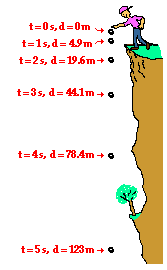
A ball is dropped from a building. How fast is it traveling after falling for 1.77 s? (Hint: It's a free falling object)
14.76 m/s
17.35 m/s
18.91 m/s
20.03 m/s
A car starts from rest and accelerates uniformly over a time of 5.21 seconds for a distance of 110 m. Determine the acceleration of the car. Choose the appropriate equation.
v=vo+at
d=vot+1/2at2
v2=vo2+2ad
d=1/2(v+vo)t
Rocket-powered sleds are used to test the human response to acceleration. If a rocket-powered sled is accelerated to a speed of 444 m/s in 1.83 seconds, then what is the distance that the sled travels?
Choose the appropriate equation.
v=vo+at
d=vot+1/2at2
v2=vo2+2ad
d=1/2(v+vo)t
If Michael Jordan has a vertical leap of 1.29 m, then what is his takeoff speed if his acceleration is -9.8 m/s2 and his velocity at the top of his leap i 0 m/s?
v=vo+at
d=vot+1/2at2
v2=vo2+2ad
d=1/2(v+vo)t
An engineer is designing the runway for an airport. Of the planes that will use the airport, the lowest acceleration rate is likely to be 3 m/s2. The takeoff speed for this plane will be 65 m/s. All airplanes will start from rest. Assuming this minimum acceleration, what is the minimum allowed length for the runway?
v=vo+at
d=vot+1/2at2
v2=vo2+2ad
d=1/2(v+vo)t

