
 Worksheets
Botany 4th Quarter
Total questions: 30
Worksheet time: 11mins
Which of the following is NOT a characteristic of an ecosystem?
Energy flows through a trophic level.
It has a continuous output of energy.
It has a cyclic path of materials.
It has different ecological relationships.
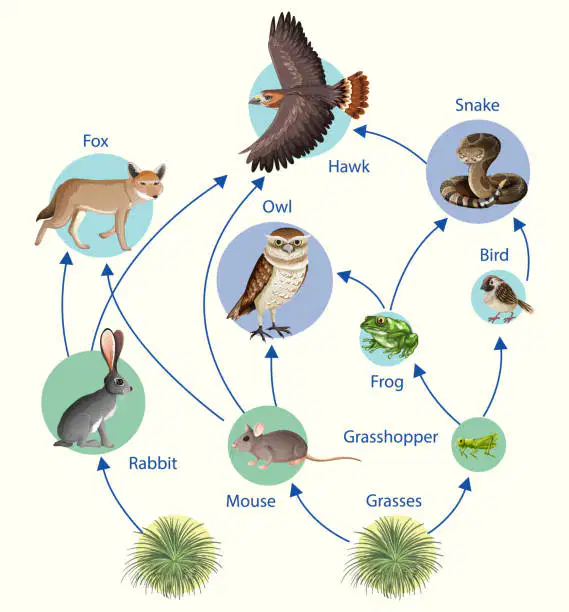
Which of the following organisms shown in the Food Web is considered as the Apex Predator?
mouse
snake
hawk
rabbit
Tropical rainforest is also known as the Land of Evergreens.
TRUE
FALSE
The highest strata of the rainforest biome is called (a) .
The green plants make up the (a) trophic level.

In the food chain shown below, what organism is considered as the secondary consumer?
snake
grass
frog
eagle
According to the energy pyramid, how much energy at any trophic level is transferred to the next level?
1%
5%
10%
90%
What is the other term used to identify decomposers in a food chain?
(a)
The following countries are the locations of Coniferous forest biome EXCEPT ________.
Australia
Canada
North America
Russia
Cyanide and dynamite fishing contribute to fishing industry and help conserve the Philippine Reef System.
TRUE
FALSE

In the aquatic food chain shown in the picture, which organism is considered as the tertiary consumer?
(a)
Which of the following is not considered as a producer?
Green plants
phytoplankton
fungi
algae
Which of the following best describes a desert biome?
It has high humidity.
It has lush vegetation and abundant wildlife.
It can only be either subtropical or polar desert.
It has an average rainfall of less than 10 inches annually.
The following are some of the animals that can withstand the extreme temperature of desert biome EXCEPT _________.
moose
jack rabbit
sidewinder rattlesnake
horned toads
The following are names given to a Grassland Biome EXCEPT _____.
Veldt
Llano
Evergreen
Rangeland
The soil in a Grassland Biome is rich in (a) and decomposed organic matter.
Most plant-eating animals or the herbivores belong to what trophic level?
first
second
third
fourth
This refers to the most abundant mineral found in the marine biome.
Sodium carbonate
Calcium carbonate
Sodium chloride
Potassium chloride
The phenomenon called (a) refers to the birth of new desert due to climate change and deforestation.
Which of the following plants is common in a Tropical Rainforest Biome?
Conifers
Algae
Cacti
Tree ferns
This refers to the community of bottom dwellers in the marine biome.
Pelagic
Benthic
The Deciduous Forest Biome has an average annual temperature of ____ degrees Fahrenheit.
60
50
40
30
Both Food Chain and Food Web begin with the producers and end with the reducers.
TRUE
FALSE
The unit of measure for metabolic energy is called (a) . (answer in plural)
Cacti and prickly pear are most commonly found in what type of biome?
Desert
Rainforest
Marine
Coniferous Forest
The following countries have the largest Tropical Rainforest EXCEPT _________.
Brazil
Peru
Colombia
North Africa
Which of the following is considered as the largest biome covering 70% of the planet?
Tropical Rainforest
Marine
Grassland
Tundra

In the food web shown, which animal competes with the snake for the mouse?
(a)

According to the energy pyramid, which organism received the LEAST amount of energy?
snake
rabbit
owl
plants
Which of the following strata of a Tropical Rainforest biome is haven for birds for its proximity to food fruits yet does not receive direct heat from the sun?
forest floor
canopy
understory
emergent

