wayground logo

Free Printable Worksheets

Font size

S
M
L
XL
Worksheets

Algebraic Reasoning 2nd Semester Review

Total questions: 60

Worksheet time: 15hrs 0mins

Name
Class
Date
1.
Solve for x
l 2x−1 l = 9
a)
x = 5 and x =-4
b)
x = 5 and x = -5
c)
Only x = 5
d)
No Solution
2.
Solve for x
l 2x−1 l +4 = 8 
a)
x = 2.5 and x = -1.5
b)
x = 2 and x = -1
c)
x = -2 and x = 9
d)
No Solution
3.
Evaluate each expression.
| x + 9 | = -5
a)
-14
b)
-4
c)
{-14, -4}
d)
no solution
4.
| x + 2 | > 5
a)
x < - 7 or x > 3
b)
x > 7 or x < 3
c)
x < -7 and x > 3
d)
x > -3 and x < 7
5.
| m - 2 | < 8
a)
m > 8 or m < 9
b)
m < -6 or m > 2
c)
m > -6 and m < 10
d)
0 > m < 0
6.
|v + 8| − 5 = 2 
a)
{-1,-15}
b)
{-1,-5}
c)
{-15,15}
d)
No Solution
7.
Solve:
 |x + 3| > 8
a)
x > 5 or x < -11
b)
x > 5
c)
all real numbers
d)
no solution
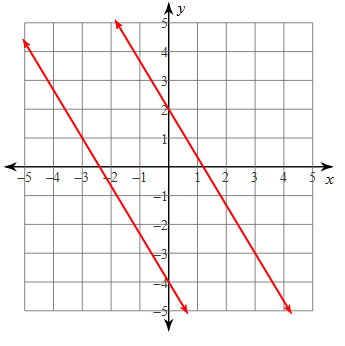
8.
What is the solution?
a)
No solution
b)
(0, 2)
c)
(0, -4)
d)
(3, -3)
9.
Where do these two lines intersect?
a)
No solution
b)
(-2, 3)
c)
(3, -2)
d)
(2, 3)
10.

Solve the system of equations by graphing.

a)

(4, 7)

b)

(3, 5)

c)

(6, 7)

d)

(5, 3)

11.

Solve the system of equations by graphing.

a)

(-1, 4)

b)

(1, 0)

c)

No Solution

d)

(0, 2)

12.
When you graph the exact same equation twice,
a)
you will have no solution. 
b)
you will have one solution.
c)
you will have infinite solutions. 
d)
you will graph a giraffe. 
13.
Solve for x and y
3x + 2y = 16
7x + y = 19
a)
(-2,5)
b)
(-2,-5)
c)
(2,-5)
d)
(2,5)
14.
What is the solution to this system?
a)
One Solution
b)
No solution
c)
Infinitely Many Solutions
15.
Solve the system of equations: 
a)
( -1, 6, 1)
b)
( 1, 6, -1)
c)
None of these
d)
( -6, -1, 1)
16.
Determine which ordered triple is a solution of the systems of equations?
2x+y=0
x+3y-z=-11
7x+5y+4z=21
a)
(0,0,11)
b)
(1,-2,6)
c)
(-1,2,-16
d)
(0,1,-14)
17.

Which of the following is an example of a quadratic function?

a)
b)
c)
d)
18.

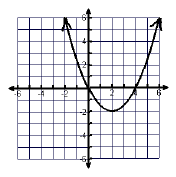
Where is the vertex?

a)

(0, 3)\left(0,\ -3\right)

b)

(1, 4)\left(1,\ -4\right)

c)

(1, 0)\left(-1,\ 0\right)

d)

(3, 0)\left(3,\ 0\right)

e)

(1, 0)\left(1,\ 0\right)

19.

Does the graph have a maximum or a minimum?

a)

Maximum

b)

Minimum

c)

Both

d)

Neither

20.

Does the graph have a maximum or a minimum?

a)

Maximum

b)

Minimum

c)

Both

d)

Neither

21.

Use the graph to determine the X-intercepts

a)

(-1,0) and (-3,0)

b)

(1,0) and (3,0)

c)

(0,1) and (0,3)

d)

(0,-1) and (0,-3)

22.
What is the equation for axis of symmetry?
a)
y=3
b)
x=3
c)
x=5
d)
x=1
23.
What is the vertex of the quadratic function:
y = x2 - 6x + 11?
a)
(3,2)
b)
(-3,-2)
c)
(-3,2)
d)
(3,-2)
24.
Determine the vertex of the parabola:
y = 5x- 20x + 13
a)
(5, -7)
b)
(-2, -7)
c)
(2, -7)
d)
(-7, -2)
25.

What are the x- intercepts?

a)

x=0 and x=-4

b)

x=0 and x=4

c)

x=0

d)

x=2

26.

Which transformation transforms the graph of

f(x) = x2 to the graph of g(x) = (x + 4)2?

a)

shift 4 units up

b)

shift 4 units down

c)

shift 4 units to the left

d)

shift 4 units to the right

27.

What are the transformations?

y=(x-2)2+4 (Choose ALL that apply.)

a)

shift right 2

b)

shift left 2

c)

shift up 4

d)

shift down 4

28.

y= -(x-11)2+6

*Mark all that apply.

a)

right 11

b)

reflection across x-axis

c)

VC

d)

up 6

29.

Write the equation of this transformation: up 8

a)

y=(x+8)2

b)

y= x2+8

c)

y= x2-8

d)

y=8x2

30.

Write the equation of this transformation: reflection across x-axis, left 2, down 5

a)

y= -(x+2)2+5

b)

y= -(x+2)2

c)

y= (x-2)2-5

d)

y= -(x+2)2-5

31.

50\sqrt{50}  

a)

525\sqrt{2}  

b)

5\sqrt{5}   

c)

252\sqrt{5}  

d)

25225\sqrt{2}  

32.

243\sqrt{243}  

a)

333\sqrt{3}  

b)

939\sqrt{3}  

c)

81381\sqrt{3}  

d)

3813\sqrt{81}  

33.

112\sqrt{112}  

a)

474\sqrt{7}  

b)

16316\sqrt{3}  

c)

16716\sqrt{7}  

d)

434\sqrt{3}  

34.

√169 =

a)

3√7

b)

13

c)

7√3

d)

7√7

35.
3x2 = 12
a)
± 2
b)
2
c)
± √12
d)
± 4
36.
x2 + 4 = 68
a)
± 8
b)
± √8
c)
8
d)
± 64
37.
3x2 - 1 = 14
a)
5
b)
-√5
c)
-√5, √5
d)
√5
38.
x2 + 4 = 68
a)
± 8
b)
± √8
c)
8
d)
± 64
39.

Solve the following equation:

x2+8=13x^2+8=13

a)

x=±5x=\pm5  

b)

x=±5x=\pm\sqrt{5}  

c)

x=±212x=\pm21^2  

40.

Simplify using the 9 Laws of Exponents:

a)
b)
c)
d)
41.

Simplify using the 9 Laws of Exponents:

a)
b)
c)
d)
42.
(2x3y)6
a)
2x18y6
b)
64x18y6
c)
64x3y6
d)
2x3y6
43.
40
a)
0
b)
1
c)
4
d)
-4
44.
Simplify the exponential expression:
a)
10x-2
b)
2x2
c)
2x12
d)
10x12
45.
Simplify the exponential expression.
a)
2x6y12
b)
2x5y7
c)
8x6y12
d)
8x5y7
46.
(3y⁴)²
a)
9y⁸
b)
9y⁶
c)
6y⁸
d)
6y⁶
47.
n²⋅n⁴⋅n⁵
a)
n¹¹
b)
n⁴⁰
c)
n¹³
d)
n²²
48.
According to exponent rules, when we multiply the same base we _______ the exponents.
a)
Multiply
b)
Add
c)
Divide
d)
Subtract
49.
According to exponent rules, when we divide the same base we _______ the exponents.
a)
Multiply
b)
Add
c)
Divide
d)
Subtract
50.
Simplify:
(x5)4
a)
x9
b)
x20
c)
x
d)
x54
51.
According to exponent rules, when we raise the power to a power we _______ the exponents.
a)
add
b)
subtract
c)
multiply
d)
divide
52.
Anything raised to a power of zero is always: 
a)
0
b)
1
c)
itself
d)
negative
53.
Simplify
(-7y2)(5y4)
a)
-35y6
b)
-2y6
c)
-35y8
d)
-2y8
54.
Simplify (-4r5)(2r8)
a)
-8r13
b)
-2r13
c)
-8r40
d)
-2y40
55.
6v(2v + 3) 
a)
12v+18
b)
15v2 + 8v
c)
12v2 + 18v
d)
12v2 + 18v2
56.
(x+10)(x-10)
a)
x2  - 100
b)
x2 + 100
c)
x2 + 20x - 100
d)
x2 -20x + 100
57.
(x + 7)(x + 9)
a)
x2 + 63x + 16
b)
x2 + 16x + 63
c)
x2 + 79
d)
x2 + 16x + 2
58.
(x + 7)(x - 2)
a)
x2 - 5x + 5
b)
x2 - 9x - 14
c)
x2 - 5x - 14
d)
x2 + 5x - 14
59.
Multiply
x2(2x+3)
a)
x2+2x+3
b)
2x+3
c)
2x2+3x
d)
2x3+3x2
60.
 2x3(x2−2x − 3)
a)
2x6- 4x3 - 6x3
b)
2x5−4x4 − 6x3
c)
-2x5−4x4 − 6x3
d)
-2x6−4x3 − 6x3