
 Worksheets
Spring Semester REVIEW
Total questions: 50
Worksheet time: 2hrs 40mins

Acceleration is
the rate at which velocity changes.
the change in velocity
the rate of change
when you speed up only
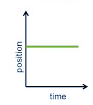
Describe the motion of the object in the graph
Moving with constant speed
Speeding up
Not moving

What is occurring on this graph?
Negative acceleration
moving at a constant speed in the positive direction
positive acceleration
negative net force
Newton's 1st Law is also called the Law of ...
Friction
Inertia
Unbalanced forces
Newtons

If the net force on an object is zero, the object will:
start moving
stop moving
change direction
there will be no change in the object's motion
Which of the following correctly summarizes Newton’s 1st law of motion?
Objects tend to randomly stop what they are doing
An object at rest stays at rest and an object in motion stays in motion.
All Objects tend to have an equal and opposite force.
. All Objects mass determines its force.
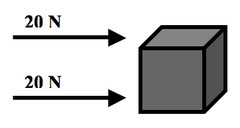

What are the units to measure mass?
kilograms
pounds
Newtons
meters per second, squared
Newton's Second Law says that F=m*a.
Therefore, if the force increases, then the acceleration
increases
decreases
stays the same
Newtons law states that for every action, there is an_________ reaction
unequal and opposite
stronger and opposite
equal and similar
equal and opposite
Which of the following examples best represent Newton's 3rd Law?
A large truck takes longer to slow down than a car.
Your stomach jumps when you ride a roller coaster.
Pushing water backward with oars helps paddle a canoe forward.
Energy can not be _______.
transformed
converted/changed
created or destroyed
used
This is energy that is stored for later use.
kinetic energy
potential energy
motion/mechanical energy
radiant energy

At which point does the ball have the least kinetic and the greatest potential energy?
1
2
3
Heat is another name for
thermal energy
electrical energy
mechanical energy
gravitational energy
Movement of electrons to transmit electricity
Thermal Energy
Electrical Energy
Chemical Energy
Elastic Energy
Splitting the nuclei of atoms in a process called fission
Sound Energy
Electrical Energy
Mechanical Energy
Nuclear Energy
If you double the velocity of an object, then its momentum will ______________.
will double
will half
will quadruple (x4)
will be quartered (x 1/4)
Which has more momentum?
A parked semi truck
A moving car
they have the same amount of momentum
The Law of Conservation of Energy states:
Energy can created or destroyed but not transformed
Energy cannot be created or destroyed, it can only transformed
Energy can't be created, destroyed or transformed
Energy cannot be created or destroyed.
What is the correct unit for energy?
meters (m)
kilogram meters per second (kg m/s)
Newtons (N)
Joules (J)
What is the equation for calculating gravitational potential energy
mv
1/2 mv^2
mgh
Ft
What is the equation for calculating kinetic energy?
mv
1/2 mv^2
mgh
Ft
You are in the top bunk of a bunk bed and you want to turn down the air conditioner on while your friend on the bottom bunk is fine is caused by ...
Conduction
Radiation
Convection
What is the formula needed to solve for work?
w = f/d
w = f*d
w = f+d
What is transferred from place to place by waves?
matter
energy
particles
waves
When energy increases, amplitude _______?
increases
decreases
stays the same
Why are Christmas lights wired in parallel?
It is cheaper to make
You can make longer strands
It uses less electricity
If a light breaks, the others keep working
Ashley is classifying some objects as conductors or insulators. What is the difference between conductors and insulators?
A conductor allows electrical current to flow through it easily, while an insulator does not.
An insulator allows electrical current to move through it easily, while a conductor does not.
A conductor has a static charge, while an insulator does not.
An insulator is a metal, while a conductor is not a metal.

