wayground logo

Free Printable Worksheets

Font size

S
M
L
XL
Worksheets

Year 7 end of year revision

Total questions: 37

Worksheet time: 27mins

Name
Class
Date
1.
What does HTML stand for?
a)
Hypertext Making Language
b)
Hyper Transfer Markup Language
c)
Hypertext Markup Language
d)
Hyper Transfer Making Language
2.
HTML Language uses
a)
Tabs
b)
Tags
c)
Punctuation
d)
Quotations
3.
What two HTML <tags> should be at the start and finish of a HTML document?
a)
<head> and </head>
b)
<head> and </body>
c)
<html> and </html>
d)
<start> and </stop>
4.
Which symbol closes an open html <tag>?
a)
/
b)
.
c)
,
d)
*
5.
What <tag> would correctly display the an image of luke skywalker saved as: skywalker.jpg?
a)
<img src="Skywalker.jpg">
b)
<img ="Skywalker.jpg"
c)
<video src="Skywalker.jpg">
d)
<img src="skywalker.jpg">
6.
Spot the syntax error with the code below...
<img srs="last_jedi.png">
a)
tags not opened or closed correctly
b)
not the correct tag 
c)
spelling error
d)
no errors would work.
7.

Which is the correct tag to change the colour of Hello to RED?

a)

<font color="Pink">This is some text!</font>

b)

<font color="red">Hello</font>

c)

<font color="red">hello//</font>

d)

<font colour="red">This is some text!</font>

8.
A properly coded HTML tag will always be found between which two symbols?
a)
( )
b)
{ }
c)
[ ]
d)
< >
9.
What is computational thinking?
a)
It allows you to break down a large / complex problem into smaller parts.
b)
It is thinking like a robot
c)
It is being able to bake a cake.
d)
It is creating a coding solution to a problem.
10.
What is abstraction?
a)
A painting
b)
A programming language
c)
This means focusing on the important details and ignoring the irrelevant information
d)
Abstraction is the breaking down of a big problem into smaller parts.
11.
What does decomposition mean?
a)
focuses on the important information only, ignoring irrelevant detail
b)
Step by step instructions on solving a problem.
c)
Thinking like a computer
d)
This is the breaking down of a complex problem into smaller parts
12.
What is an algorithm?
a)
A sequence of instructions on how to solve a problem.
b)
The breaking down of a problem into smaller parts.
c)
Focusing on important parts and ignoring the irrelevant details
d)
The recipe for a cake
13.
What are the two main ways that we represent an algorithm?
a)
By drawing pictures 
b)
Using flowcharts and pseudo code
c)
Using python and small basic
d)
Using Scratch and python
14.
What is a flowchart?
a)
A visual representation of an algorithm using symbols
b)
Using 'fake code' to plan an algorithm
c)
Using a programming language to show an algorithm
d)
Uisng different types of charts to show an algorithm
15.
What does the following flowchart symbol represent?
a)
A process
b)
An output
c)
A decision (choice)
d)
End
16.
What does the following flowchart symbol represent?
a)
Input / Output
b)
Start of flowchart
c)
A process
d)
End
17.
What does the following flowchart symbol represent?
a)
A process
b)
Input / Output
c)
Start / End
d)

A subroutine

18.
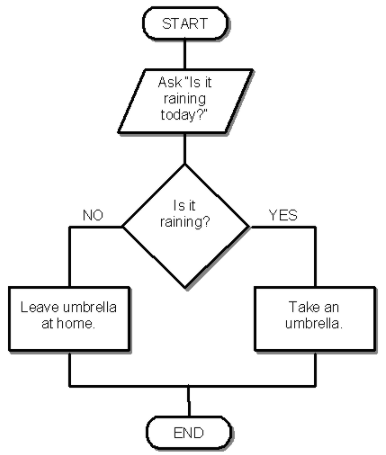
What is the Output if the user enters:
Yes
a)
Leave umbrella at home
b)
Take an umbrella
19.
What is the Output if the temperature is:
19
a)
Below Freezing
b)
Above Freezing
20.
On average, which searching algorithm is more efficient?
a)
Binary Search
b)
Linear Search
21.
How many linear searches will it take to find the value 7 in the list [1,4,8,7,10,28]?
a)
2
b)
3
c)
4
d)
5
22.
A Linear search algorithm requires data to be ordered.
a)
True
b)
False
23.

How does a binary search algorithm works?​

a)

Dividing the list into halves until the item is matched with one in the list.​

b)

Starts with the first element and checks the next element consecutively until a match is found.

c)

​ None of the above​

24.
A computer network is ___ connected together.
a)
One computer
b)
Two or more
c)
Three or more
d)
Four or more
25.

What does WWW stand for?

a)

Wide World Works

b)

World Wide Web

c)

World Web Wide

d)

Web World Wide

26.

What is an email attachment?

a)

A forwarded email

b)

A file sent within an email

c)

A reply to an email

d)

A deleted message

27.

Which is the largest computer network in the world?

a)

Cellular

b)

Airdrop

c)

Bluetooth

d)

The Internet

28.

What goes into the "To" section/box/field?

a)

The name of the person that you are sending the Email to

b)

The Email address of the person that you are writing to

c)

Your name

d)

Your Email address

29.

What goes into the "Subject" box/field/section?

a)

What the Email is about

b)

Your name

30.

What is a Carbon Copy / CC or what does it mean?

a)

An indication that the Email will be auto-deleted

b)

A third person that also receives a copy of the Email

c)

To show that it must not be copied

31.

How do you send a file with your message?

a)

You forward the file.

b)

You reply to the file.

c)

You attach the file.

32.

Match up the security definitions with the correct key term

a)

An individuals identification is measured by a scanner. An example could be finger print or facial recognition

1.

Biometric

b)

is a security system that requires two forms of identification in order to access something. A common method is a text message and a password

2.

Two-Factor-Authentication

c)

A set of characters that are used to access an account. These should only be known by the user

3.

Password

33.

Which of the following is one way to reduce a risk of being online.

a)

Make sure any social media accounts are private

b)

Use a fake name on any account

c)

Only use the internet during the day

34.

Personal information is essentially personal data with meaning. Everything someone does online – searches, location sharing, paying with an e-wallet etc.

a)

True

b)

False

35.

Social Engineering takes advantage of which security flaw in a computer system?

a)

The person

b)

The Network

c)

The Password

36.

How are people targeted through Phishing?

a)

via Email

b)

on Websites

37.

Which of the following is not a social engineering technique?

a)

Blagging

b)

Hacking

c)

Phishing

d)

Pharming