
 Worksheets
Static electrictiy
Total questions: 26
Worksheet time: 23mins
Mrs Brownlee rubbed two balloons with a piece of wool. What will happen when the balloons are brought near each other?
The balloons will repel each other.
The balloons will attract each other.
The balloons will become positively (+) charged.
The balloons will pop.

Bending water with a charged balloon is an example of what type of charging (charging an object without touching)
friction
induction
conduction
The difference between attraction and repulsion is that to attract is to pull something closer and repel is to push something away.
True
False

the positively charged particle in an atom, never leaves the nucleus, determines the element
proton
neutron
electron
During a lab a balloon was rubbed with a wooly fabric. This is an example of which type of charging?
conduction
friction
induction
What is the major difference between static electricity and current electricity?
Current electricity involves a continuous flow of elecrons; static electricity is a sudden transfer of protons
Current electricity can be deadly; static electricity is almost always safe
In current electricity, there's a single transfer of electrons; in static electricity, there's a steady flow of electrons
Current electricity involves a flow of electrons; static electricity involves a single transfer of electrons
What happens when you touch a metal doorknob after rubbing your shoes on the carpet?
The doorknob sends a burst of electric current into your body
Millions of electrons go from your finger into the doorknob
The doorknob sends millions of electrons into your finger
Your finger becomes negatively charged
An object that is neutral contains the same number of electrons and protons.
True
False
the negatively charged particle in an atom, moves freely, can be released, shared, or “stolen” from an atom
proton
neutron
electron
the charging of an object by the contact of a charged object to a neutral object (like touching a door knob)
induction
conduction
friction
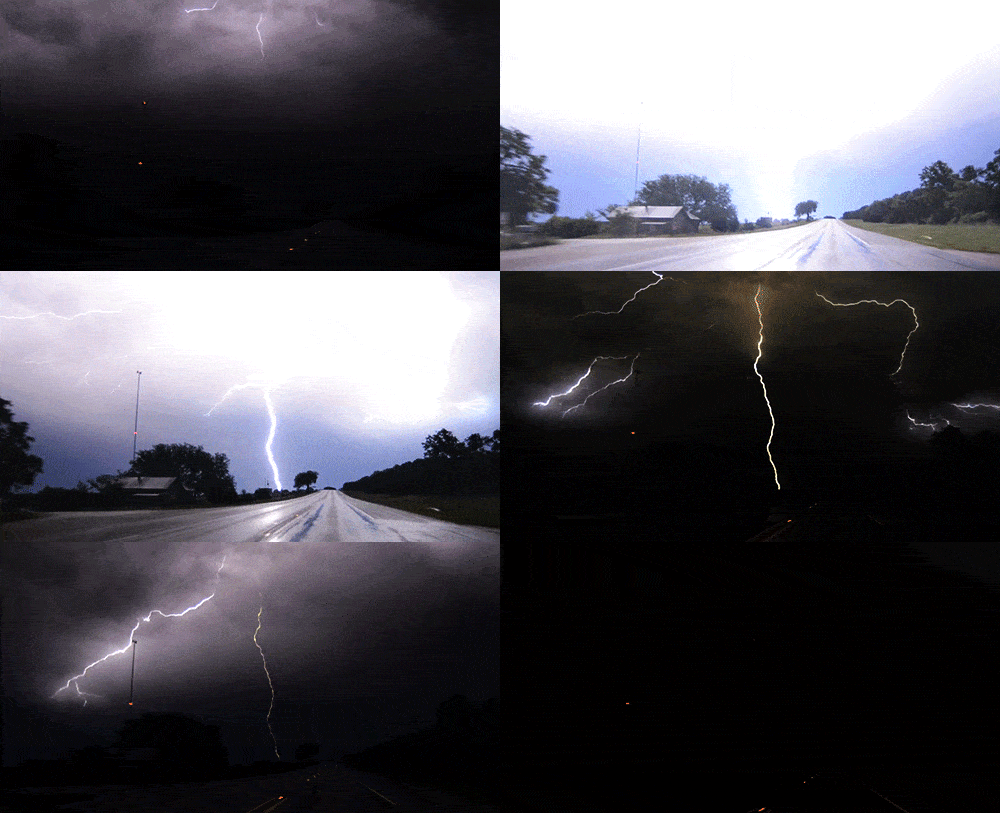
Lightning occurs because ___.
the negative charges at the bottom of clouds are attracted to the positive charges on the ground.
the positive charges at the bottom of clouds are attracted to the negative charges on the ground.
the positive and negative charges inside clouds are attracted to each other
All of these reasons are correct.
Opposite charges
attract
repel
become neutral
do nothing
The accumulation of excess electric charge on an object is called
Static electricity
Electric discharge
Resistance
Current electricity

Electric force is described as
The force between charged objects.
A buildup of charges on an object.
Electric charges flow through a substance
Parts of an atom
An electric FIELD is
The area inside an electric fence
The region around a charged object where the object’s electric force is exerted on other charged objects
The same thing as electric force
The neutral region in an area
Static electricity occurs because...
of thunder
of humid air
of neutral particles adding up
of a buildup of charges on an object.
The loss of static electricity as electric charges transfer from one object to another.
Static Discharge
Negative Charge
Positive Charge
Neutral Charge
Electric charges flow through a substance
Induction
Deduction
Conduction
Insulation


