
 Worksheets
Fluids
Total questions: 22
Worksheet time: 44mins
What is the SI unit use for hydraulic pressure?
Kg/m3
Pa
kg m-3
N m2

The upward force exerted by a fluid is called the...
buoyancy force
density force
fluidity force
normal force
How does an object's density affect the buoyant force acting on it?
The more dense the object, the greater the buoyant force
The less dense the object, the greater the buoyant force
Density is equivalent to buoyant force
Object density has no effect on buoyant force
When force increases...
pressure increases
pressure decreases
pressure stays the same
pressure increases then decreases
When area increases...
pressure increases
pressure decreases
pressure stays the same
pressure increases then decreases
If an object has a density of 3.6 g/mL and you put it into water (density =1.0g/mL,) will it sink or float?
sink
float
partially sink
partially float
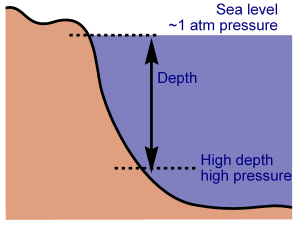
When you increase your depth under water, the water pressure on your body
increases
decreases
stays the same
In a hydraulic machine, a force of 2.25 N is applied on the piston of area 5 cm2. what force is obtained on the bigger pistion of area 100cm2 ?
45 N
225 N
450 N
22.5 N
Calculate the pressure at the bottom of a cylindrical vessel filled with water.Area of cross section is 250 cm2. density of water is 1000 kg m-3. water is filled to a height of 10cm.
g = 10 ms-2
250 Pa
105 Pa
2500 Pa
1000 Pa
What is Archimedes' Principle?
The buoyant force is equal to the weight of the object
The buoyant force is equal to the gravitational force of the fluid
The buoyant force is equal on all sides of a submerged object
The buoyant force is equal to the weight of the fluid displaced
The buoyant force is equal to the mass of the fluid displaced
If the density of sea water is 1150 kgm-3 , calculate the pressure at a point 40m below sea level due to the water alone.
500kPa
460 kPa
320kPa
20kPa
A liquid has a specific gravity of 0.68. What is the density of the liquid (in kg/m^3)?
(a)
A diving bell can withstand a maximum pressure of 2.5×10^6 Pa. What maximum depth (in m) can the bell reach in seawater (density 1025 kg/m3 )?
***Round to the nearest 10th.***
(a)
The small piston of a hydraulic lift has an area of 25 cm^2 and the large piston has an area of 625 cm^2 . What force must be applied to the small piston in order to lift a car weighing 14,000 N?
(a)
A 650 N diver weighs 500 N in sea. What is the buoyant force of the sea water?
(a)
An object has a volume of 3.4 m^3 and a weight of 45,000 N. What will its weight (in N) be in water (density 1000 kg/m^3 )?
(a)
A circular window in a submarine has a diameter of 40 cm. The window can withstand a maximum force of 5.6×10^5 N. What is the maximum depth (in m) in the sea (density 1025 kg/m^3 ) to which the submarine can submerge without breaking the window?
***Round to the nearest 10th.***
(a)

