wayground logo

Free Printable Worksheets

Font size

S
M
L
XL
Worksheets

Review

Total questions: 124

Worksheet time: 4hrs 55mins

Name
Class
Date
1.
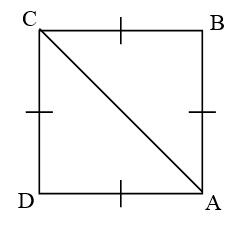
If ABCD is a parallelogram, what is the length of BD? 
a)
10
b)
11
c)
7
d)
5
2.
Which is NOT a property of a parallelogram?
a)
Diagonals bisect each other
b)
Diagonals are congruent
c)
Both pairs of opposite sides are parallel
d)
Both pairs of opposite angles are congruent
3.
The opposite angles of a parallelogram are ...
a)
complementary
b)
congruent
c)
supplementary
d)
perpendicular
4.
In a parallelogram, consecutive angles are __________.
a)
congruent
b)
supplementary
c)
corresponding
d)
parallel
5.
In a parallelogram, diagonals are __________.
a)
perpendicular
b)
bisected
c)
congruent
d)
parallel
6.
Which shape is NOT a type of parallelogram?
a)
trapezoid
b)
rectangle
c)
rhombus
d)
square
7.
The figure is a parallelogram.  
Solve for x.  
a)
1
b)
11
c)
7
d)
6
8.
The figure is a parallelogram.  
Solve for x.  
a)
7
b)
2
c)
0
d)
4
9.

Which measures could be the 4 angles of a NOT REGULAR Pentagon?

a)

180, 70, 30, 120, 140

b)

135, 135, 135, 135, 135

c)

80, 50, 100, 20, 200

d)

30, 20, 50, 90

10.
Parallelograms are ...
a)
triangles
b)
quadrilaterals
c)
pentagons
d)
hexagons
11.
The figure is a parallelogram.  
Solve for x.  
a)
7
b)
1
c)
5
d)
2
12.

What is the sum of the interior angles of a HEXAGON (6 sides)?

a)

1,080*

b)

560*

c)

720*

d)

180*

13.

Which could be the measures of the angles of a regular Octagon?

a)

180, 180, 180, 180, 180, 180, 180, 180

b)

150, 160, 170, 180, 190, 140, 150

c)

22.5, 25.5, 19.5, 14.5, 30.5, 22, 23, 22.5

d)

135, 135, 135, 135, 135, 135, 135, 135

14.

In a parallelogram, opposite sides are always

a)

supplementary

b)

congruent

c)

connected

d)

consecutive

15.

What is the equation to find the sum of the interior angles of any polygon?

a)

(n-2)(180), if n = the number of sides

b)

(n)(180), if n = the number of sides

c)

(n-2)/(180), if n = the number of sides

d)

(n-2)(360), if n = the number of sides

16.
a)

acute

b)

obtuse

c)

right

17.
a)

equilateral

b)

isosceles

c)

scalene

18.
a)

equilateral

b)

isosceles

c)

scalene

19.
a)

equilateral

b)

isosceles

c)

scalene

20.
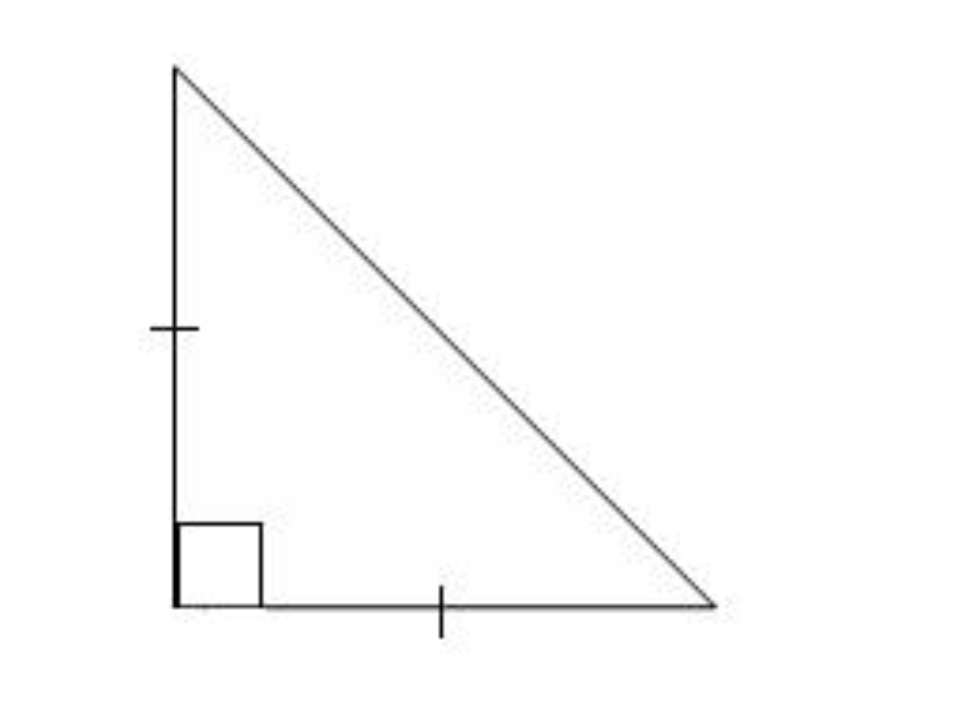
Which type of triangle is pictured?
a)
Equilateral Triangle
b)
Right Isosceles Triangle
c)
Obtuse Scalene Triangle
d)
Obtuse Equilateral Triangle
21.
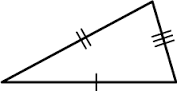
Name this triangle
a)
Acute, Scalene
b)
Obtuse, Scalene
c)
Right, Isosceles
d)
Acute, Equilateral
22.
Classify the following triangle in as many ways as possible. 
a)
Right, Equilateral
b)
Obtuse, Scalene
c)
Obtuse, Equilateral
d)
Right, Scalene
23.
The Triangle Sum Theorem states that the sum of all angles in a triangle is ______. 
a)
45°
b)
90°
c)
180°
d)
360°
24.
Matching sides are called
a)
Corresponding Sides
b)
Corresponding Angles
c)
The Same
d)
Congruent Sides
25.
Matching angles are called
a)
Corresponding Sides
b)
Corresponding Angles
c)
The Same
d)
Congruent Angles
26.
What is congruency?  
a)
Same size and shape 
b)
Same size
c)
segment 
d)
congruent 
27.

If ∆LMK ≅ ∆LMT, then

∠K ≅ ____

a)

MT

b)

∠T

c)

∠M

d)

∠L

28.
∆ABC≅∆XYZ
which is true?
a)
AB≅XY
b)
AB≅YX
c)
AB≅XZ
d)
BC≅CB
29.
PICK THE CORRECT CONGRUENCE STATEMENT
a)
∆TUV ≅ ∆EUV
b)
∆VUT ≅ ∆UVE
c)
∆TUV ≅ ∆UEV
d)
∆UTV ≅ ∆EUV
30.
All corresponding angles in congruent figures are congruent.  
a)
True
b)
False
31.
How can you tell which Angles are congruent from ∆DEF ≅ ∆ZXY?
a)
I can not tell without a diagram.
b)
I can not tell without measurements given.
c)
I looked at the letters in corresponding positions.
d)
The letters closer to the beginning of the alphabet match and the letters closer to the end of the alphabet match.
32.

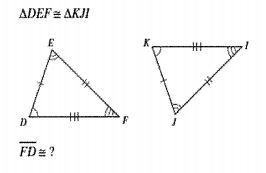
Complete the statement:   FD  \overline{FD}\ \ \cong  _____

a)

IK

b)

KJ

c)

JI

d)

EF

33.

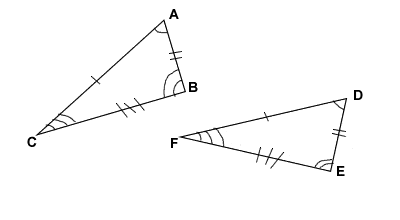
Determine whether the two figures are congruent.

a)

Yes, corresponding sides are congruent.

b)

Yes, corresponding angles are congruent.

c)

Yes, corresponding sides and corresponding angles are congruent.

d)

No, the two figure are not congruent.

34.

Which statement is always true about two congruent polygons?

a)

Corresponding sides are always congruent.

b)

Corresponding angles are always right angles.

c)

Corresponding sides are always parallel.

d)

Corresponding sides are proportional.

35.
Name the transformation.
a)
Translation
b)
Reflection
c)
Rotation
36.
 Describe the Transformation
a)
Translation
b)
Rotation
c)
Reflection
37.
 Describe the Transformation
a)
Translation
b)
Rotation
c)
Reflection
38.
In congruent triangles, corresponding parts are always ______.
a)
opposite
b)
equal
c)
equilateral
d)
acute
39.
If ΔDEF ≅ ΔRST, then we can conclude that ∠R ≅ ____.
a)
∠F
b)
∠E
c)
∠D
d)
DF
40.
ΔEDF ≅ Δ____
a)
ABC
b)
CAB
c)
BAC
41.
What does CPCTC stand for?
a)
Congruent parts of congruent triangles are congruent
b)
Corresponding parts of congruent triangles are congruent
c)
Corresponding parts of corresponding triangles are corresponding
d)
Corresponding parts of congruent triangles are Canadian.
42.

Which two angles are the remote interior angles to Angle W?

a)

Angle X and Angle Y

b)

Angle X and Angle Z

c)

Angle Y and Angle Z

d)

Angle Z and Angle W

43.

Set up an equation to find x.

a)

52 + 5x + 16 + 10x + 8 = 180

b)

52 - 5x + 16

c)

52 + 5x + 16 = 10x + 8

d)

52 + 10x + 8 = 5x +16

44.
Which of the following terms best describes Angle d?
a)
Remote interior angle
b)
Corresponding angle
c)
Exterior angle
d)
Interior angle
45.

All the interior angles of equilateral triangles are (a)   °

46.

The measure of an exterior angle of a triangle is equal to the sum of the measures of the two nonadjacent

interior angles is the ______________ ?

a)

Triangle Sum Theory

b)

Triangle Sum Corollary

c)

Interior Angle Theorem

d)

Exterior Angle Theorem

47.
Name the property of equality or congruence that justifies going from the first statement to the second statement.
a)
Reflexive Property of Equality
b)
Symmetric Property of Equality
c)
Symmetric Property of Congruence
d)
Reflexive Property of Congruence
48.
Name the property of equality or congruence that justifies going from the first statement to the second statement.
a)
Reflexive Property of Congruence
b)
Symmetric Property of Congruence
c)
Distributive Property
d)
Transitive Property of Congruence
49.
Name the property of equality or congruence that justifies going from the first statement to the second statement.
a)
Reflexive Property of Congruence
b)
Symmetric Property of Congruence
c)
Distributive Property
d)
Transitive Property of Congruence
50.
x = x
a)
Transitive Property of Equality
b)
Symmetric Property of Equality
c)
Reflexive Property of Equality
d)
Division Property of Equality
51.
If y/4 = 5, then y = 20
a)
Multiplication Property of Equality
b)
Division Property of Equality
c)
Addition Property of Equality
d)
Subtraction Property of Equality
52.
If AB = CD and CD = EF, then AB = EF
a)
Symmetric Property of Equality
b)
Reflexive Property of Equality
c)
Transitive Property of Equality
d)
CLT or Simplify
53.
Name the property described:
If PQ = RS then RS = PQ
a)
Reflexive
b)
Symmetric
c)
Transitive
d)
Addition
54.
Name the property described:
m∠1=m∠1
a)
Reflexive
b)
Symmetric
c)
Transitive
d)
Addition
55.
Which property is shown below?
__________________________
4(x+6) = 4x + 4(6)
a)
Reflexive
b)
Distributive
c)
Transitive
d)
Substitution
56.

If  mA=mX, m\angle A=m\angle X,\  then  mX = mAm\angle X\ =\ m\angle A  

a)

Reflexive Property of Equality

b)

Addition Property of Equality

c)

Symmetric Property of Equality

d)

Transitive Property of Equality

57.
Which property justifies the work in solving this equation?
a)
Addition Property of Equality
b)
Additive Inverse Property
c)
Identity Property of Addition
d)
Subtraction Property of Equality
58.

Which property of real numbers was used to get from Step 3 to Step 4?

a)

Addition Property of Equality

b)

Subtraction Property of Equality

c)

Symmetric Property

d)

Substitution Property

59.

What property of equality is shown below?
7n=28
7n ÷\div  7 = 28  ÷\div  7

a)

addition property of equality

b)

subtraction property of equality

c)

multiplication property of equality

d)

division property of equality

60.

Use the picture to write the correct Segment Addition statement.

a)

AB + BC = AC

b)

BC + BA = BC

c)

BA + AC = BC

d)

AB + BC = AC

61.
What does the word BISECT mean?
a)
To cut something into more than five pieces.
b)
It is a plane with two sets of wings.
c)
A shape that has three sides. 
d)
To cut something into two congruent pieces or in half.
62.
This point divides a line segment into 2 equal parts.
a)
point
b)
vertex
c)
midpoint
d)
segment
63.
Part of a line. Has a beginning and end. 
a)
Line Segment
b)
Line
c)
Ray
d)
Point
64.

A flat surface is called a...

a)

plane

b)

line

c)

point

d)

ray

65.

Part of a line that has a beginning, but no end is called a...

a)

line segment

b)

ray

c)

angle

d)

plane

66.

A straight path with no beginning or end is a...

a)

ray

b)

line

c)

plane

d)

angle

67.

Part of a line that has a beginning and an end is called a...

a)

ray

b)

plane

c)

angle

d)

line segment

68.

A specific location in space is called a...

a)

line

b)

point

c)

line segment

d)

ray

69.
Name this angle.
a)
acute
b)
right
c)
obtuse
d)
none of the above
70.
Name this angle.
a)
acute
b)
right
c)
obtuse
d)
none of the above
71.
Name this angle.
a)
acute
b)
right
c)
obtuse
d)
none of the above
72.
Find HG
a)
28
b)
14
c)
41
d)
7
73.
Find the length of RT
a)
9
b)
4.5
c)
18
d)
36
74.
Name the parallel segment.
a)
WY
b)
YX
c)
WX
d)
PN
75.

Tell whether the information in the diagram allows you to conclude that point P lies on the perpendicular bisector of LM. Explain your reasoning.

a)

No. You would need to know that LK   MK\overline{LK\ }\ \perp\ \overline{MK} .

b)

No. You would need to know that KP  LM\overline{KP}\ \perp\ \overline{LM} .

c)

Yes. LN\overline{LN}MN\overline{MN} and NK\overrightarrow{NK} \perp LM\overline{LM} , so NK\overrightarrow{NK} is the perpendicular bisector of LM\overline{LM} and P is on NK\overrightarrow{NK} .

d)

Yes. NK\overrightarrow{NK}LM\overline{LM} , so NK\overrightarrow{NK} is the perpendicular bisector of LM\overline{LM} and P is on NK\overrightarrow{NK}

76.
A line, segment, or ray that passes through the midpoint of a side that is creates a 90 degree angle with that side.
a)
Perpendicular bisector
b)
Angle bisector
c)
Median
d)
Altitude
77.
Name the dashed segment:
a)
altitude
b)
angle bisector
c)
perpendicular bisector
d)
median
78.
Name the dashed segment:
a)
altitude
b)
angle bisector
c)
perpendicular bisector
d)
median
79.
x = x
a)
Transitive Property of Equality
b)
Symmetric Property of Equality
c)
Reflexive Property of Equality
d)
Division Property of Equality
80.
Name the angle relationship.
a)
Alternate Interior
b)
Alternate Exterior
c)
Corresponding
d)
Vertical Angles
81.
What is the relationship of the Angles
a)
Alternate Interior
b)
Alternate Exterior
c)
Corresponding
d)
vertical 
82.
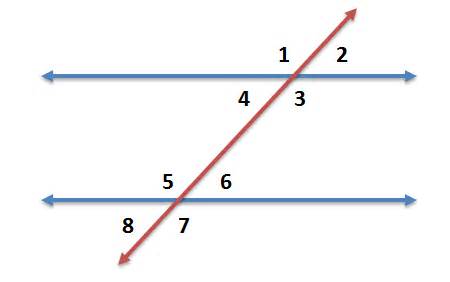
Which pair of angles are alternate exterior angles?
a)
Angle 7 and Angle 4
b)
Angle 2 and Angle 6
c)
Angle 8 and Angle 1
d)
Angle 2 and Angle 8
83.
What are supplementary angles?
a)
Angles that add up to 180°
b)
Angles that add up to 90°
c)
Angles that are equal to each other
d)
Angles that are opposite of each other when lines intersect
84.
Name the angle relationship.
a)
Consecutive Interior
b)
Alternate Interior
c)
Corresponding
d)
Vertical Angles
85.
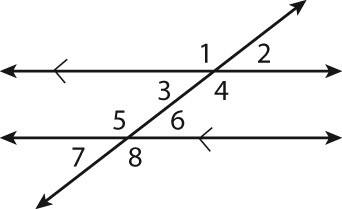
Name the alternate interior angle to angle 3.
a)
4
b)
5
c)
6
d)
8
86.
Name the corresponding angle to angle 4.
a)
angle 8
b)
angle 6
c)
angle 2
d)
angle 5
87.
Name a pair of same side exterior angles.
a)
angle 1 & angle 2
b)
angle 2 & angle 7
c)
angle 1 & angle 7
d)
angle 2 & angle 8
88.
State the angle relationship and find the measure of angle 2
a)
Alternate Exterior
127
b)
Alternate Exterior
52
c)
Alternate Interior
127
d)
Alternate Interior
52
89.
If angle 6 is 25 degrees, how many degrees is angle 7?
a)
25 degrees
b)
50 degrees
c)
90 degrees
d)
155 degrees
90.
If angle 1 is 135 degrees, how many degrees is angle 3?
a)
45 degrees
b)
65 degrees
c)
135 degrees
d)
225 degrees
91.
Find m ∠C.
a)
∠C=116°
b)
∠C=64°
c)
∠C=180°
d)
∠C=26°
92.
Which pair is NOT corresponding?
a)
1 & 8
b)
3 & 7
c)
4 & 8
d)
1 & 5
93.
Which of these angles is NOT congruent to angle 5?
a)
Angle 6
b)
Angle 8
c)
Angle 1
d)
Angle 4
94.
A line that passes through parallel lines is called a ______________.
a)
vertical lines
b)
a passer through line
c)
transversal
d)
perpendicular line
95.

Are the triangles definitely congruent? If so, by what theorem?

a)

SSS

b)

SAS

c)

AAS

d)

Not Possible

96.

Are the triangles definitely congruent? If so, by what theorem?

a)

ASA

b)

AAS

c)

SAS

d)

Cannot be proven congruent

97.

Are the triangles definitely congruent? If so, by what theorem?

a)

ASA

b)

AAS

c)

SAS

d)

Cannot be proven congruent

98.

Are the triangles definitely congruent? If so, by what theorem?

a)

ASA

b)

AAS

c)

SAS

d)

Cannot be proven congruent

99.
What postulate proves these triangles congruent?
a)
SSS
b)
SAS
c)
ASA
d)
AAS
100.

ZY

a)

BC

b)

AC

c)

CA

d)

CB

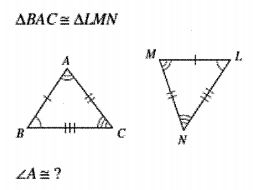
101.
 ∠A = ≅
a)
∠M
b)
∠N
c)
∠L
102.
Name the postulate, if possible, that makes the triangles congruent.
a)
SSS
b)
SAS
c)
ASA
d)
AAS
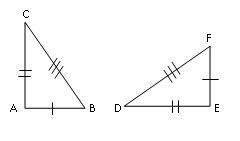
103.
Name the postulate, if possible, that makes the triangles congruent.
a)
SAS
b)
ASA
c)
AAS
d)
Not Possible
104.
Name the postulate, if possible, that makes the triangles congruent.
a)
SSS
b)
SAS
c)
ASA
d)
Not Possible
105.
Solve for x.
a)
5
b)
12
c)
-7
d)
-6
106.

Find the value of x.

a)

80

b)

95

c)

110

d)

145

107.
The dotted line represents a ?...
a)
median
b)
centroid
c)
midsegment
d)
midpoint
108.
The figure is an example of a(n) ...
a)
angle bisector
b)
perpendicular bisector
c)
median
d)
midsegment
109.
The figure is an example of a(n) ...
a)
altitude 
b)
perpendicular bisector
c)
midsegment
d)
angle bisector
110.
Which of the following segments represents an altitude?
a)
BX
b)
AZ
c)
AC
d)
BZ
111.
Which of the following segments represents a median?
a)
BX
b)
AZ
c)
AC
d)
BZ
112.
The smallest angle would be located where in a triangle?
a)
Across from the smallest side.
b)
Across from the largest side
c)
Cannot tell
113.

Where would the largest side of a triangle be located?

a)

Across from the largest angle.

b)

Across from the smallest angle.

c)

Next to the smallest side.

d)

Across the smallest side.

114.
Name the angles from SMALLEST to LARGEST
a)
Q, R, P
b)
P, Q, R
c)
R, P, Q
d)
R, Q, P
115.
Name the sides from SMALLEST to LARGEST
a)
RS, ST, TR
b)
ST, RT, RS
c)
RT, ST, RS
d)
RT, RS, ST
116.
Name the angles from LARGEST to SMALLEST
a)
R, S, T
b)
S, T, R
c)
S, R, T
d)
T, S, R
117.
Name the sides from LARGEST to SMALLEST
a)
KJ, KH, JH
b)
JH, KH, KJ
c)
KH, KJ, JH
d)
KH, JH, KJ
118.
Find the largest angle in Δ PRQ
a)
∠R
b)
∠P
c)
∠Q
d)
∠S
119.
Find the largest side in Δ BCD
a)
Segment BC
b)
Segment DB
c)
Segment DC
d)
Segment AB
120.

Use the figure to determine which of the following angles has the greatest measure:   1,  3, 4\angle\ 1,\ \angle\ 3,\ \angle4  

a)

1\angle1  

b)

3\angle3  

c)

4\angle4  

d)

Not enough information

121.

Use the figure to determine which of the following angles has the greatest measure:   4,  8, 9\angle\ 4,\ \angle\ 8,\ \angle9  

a)

4\angle4  

b)

8\angle8  

c)

9\angle9  

d)

Not enough information

122.

SPORTS The figure shows the position of three trees on one part of a disc golf course. At which tree position is the angle between the trees the greatest?

a)

Tree 1

b)

Tree 2

c)

Tree 3

123.

Use the Exterior Angle Inequality Theorem to list all angles that satisfy the stated condition: measures are less than  1\angle1  

a)

3, 4, 5, 7, 8\angle3,\ \angle4,\ \angle5,\ \angle7,\ \angle8  

b)

3, 4, 5, 6, 8\angle3,\ \angle4,\ \angle5,\ \angle6,\ \angle8  

c)

2, 6, 7, 8\angle2,\ \angle6,\ \angle7,\ \angle8  

d)

2, 6, 8, 9\angle2,\ \angle6,\ \angle8,\ \angle9  

124.

Use the Exterior Angle Inequality Theorem to list all angles that satisfy the stated condition: measures are less than  3\angle3  

a)

2, 6, 8, 9\angle2,\ \angle6,\ \angle8,\ \angle9  

b)

1, 6, 8\angle1,\ \angle6,\ \angle8  

c)

5, 7, 8\angle5,\ \angle7,\ \angle8  

d)

2, 4, 7, 8\angle2,\ \angle4,\ \angle7,\ \angle8