wayground logo

Free Printable Worksheets

NEW

Font size

S
M
L
XL
Worksheets

Chemistry Final Review

Total questions: 75

Worksheet time: 43mins

Name
Class
Date
1.

State of matter with a definite shape and definite volume.

a)

solid

b)

liquid

c)

gas

2.

State of matter with a definite volume, but no definite shape.

a)

solid

b)

liquid

c)

gas

3.

State of matter with no definite shape and no definite volume.

a)

solid

b)

liquid

c)

gas

4.

THE VAPOR AND THE AIR ARE MATTER IN STATE..

a)

Solid

b)

Liquid

c)

Gas

5.

THE ORANGE JUICE AND WATER ARE MATTER IN STATE..

a)

Solid

b)

Liquid

c)

Gas

6.

THE PENCIL AND THE ROCK ARE MATTER IN STATE..

a)

Solid

b)

Liquid

c)

Gas

7.

THE MILK IS MATTER IN STATE..

a)

Solid

b)

Liquid

c)

Gas

8.

AN EXAMPLE OF SOLID IS...

a)

Air

b)

Computer

c)

Water

9.

AN EXAMPLE OF LIQUID IS..

a)

Window

b)

Yogurt

c)

Balloon

10.

100 Celsius is ? Kelvin (K = Celsius + 273)

a)

173 K

b)

373K

c)

273 K

d)

0 K

11.
forms ions in solution
a)
ionic compounds
b)
covalent compounds
12.
electrolytes
a)
ionic compounds
b)
covalent compounds
13.

The following properties are all characteristics of ionic compounds EXCEPT

a)

high melting and boiling points

b)

soft

c)

crystal lattice structure

d)

conduct electricity when dissolved in water

14.

Malleability and ductility are characteristics of compounds with

a)

covalent bonds

b)

metallic bonds

c)

ionic bonds

d)

alloy bonds

15.

What could be a charge on aluminum?

a)

1+

b)

2+

c)

3+

d)

4+

16.

How many atoms of Sulfur are in the following compound:

Al2(SO4)3

a)

12

b)

4

c)

3

d)

1

17.
How would this element be classified?
a)
Metal
b)
Nonmetal
c)
Metalloid
d)
Metamorphic
18.
Molecules have the least kinetic energy in which phase?
a)
solid
b)
liquid
c)
gas
d)
plasma
19.

All of the following are indicators of a chemical reaction except one. Which one is NOT an indicator that a chemical reaction has taken place?

a)

the production of heat or light

b)

a color change

c)

the production of gas bubbles

d)

the dissolving of one substance in another

e)

an odor change

20.
What is the name of CuCl2
a)
copper (II) chloride
b)
copper chloride
c)
copper monochloride
d)
copper (I) chloride
21.
Name the compound S2F8
a)
sulfur (II) fluoride
b)
disulfur octafluoride
c)
sulfur fluorine
d)
sulfur octafluoride
22.

What is Ca3N2 called?

a)

calcium nitride

b)

calcium (II) nitride

c)

calcium nitrogen

d)

tricalcium dinitride

23.
Give the name for the polyatomic ion PO43- 
a)
phosphorous tetraoxide
b)
phosphorous oxide
c)
phosphorous (III) oxygen
d)
phosphate
24.

The chemical bond between a non-metal and another non-metal will be a ________ bond.

a)

metal

b)

ionic

c)

covalent

d)

polar

25.

The chemical bond between a metal and a non-metal will be a _____ bond.

a)

metal

b)

ionic

c)

covalent

d)

polar

26.

Sodium and Bromine will make a _____ bond.

a)

ionic

b)

covalent

c)

metallic

27.

Carbon and Oxygen will make a ___________ bond.

a)

ionic

b)

covalent

c)

metallic

28.

What is the left part of a chemical equation called?

2H2 + O2 ---> 2H2O

a)

Reactants

b)

Yields

c)

Products

d)

Chemical equation

29.

What is the right part of a chemical equation called?

2H2 + O2 ---> 2H2O

a)

Reactants

b)

Yields

c)

Products

d)

Chemical Equation

30.

What is the little number after an element in a chemical equation called?

Example: H2

a)

Coefficient

b)

Atom

c)

Subscript

d)

Equation

31.

What is the number before a chemical formula called?

Example: 2H2 + O2 ---> 2H2O

a)

Coefficient

b)

Atom

c)

Subscript

d)

Equation

32.

Balance this equation

_Al +_HCl --> _H2 +_AlCl3

a)

2,6,3,2

b)

it's already balanced

c)

4,12,3,4

d)

2,1,4,5

33.

What does the Xe represent?

a)

Atomic number

b)

Element Symbol

c)

Atomic Mass

d)

Element Name

34.

What does the 54 represent?

a)

Atomic Number

b)

Element Symbol

c)

Atomic Mass

d)

Element Name

35.

What does the 131.29 represent?

a)

Atomic Number

b)

Element Symbol

c)

Atomic Mass

d)

Element Name

36.

What does Xenon represent?

a)

Atomic number

b)

Element Symbol

c)

Atomic mass

d)

Element Name

37.

Which element has an atomic number of 29?

a)

Iron

b)

Copper

c)

Nickle

d)

Silver

38.

Which element has the atomic number of 14?

a)

Silicon

b)

Nitrogen

c)

Arsenic

d)

Germanium

39.

Subatomic particles with a negative charge

a)

Electrons

b)

Neutrons

c)

Protons

d)

Quarks

40.
subatomic particles found on the outermost shell & responsible for the atom's reactivity
a)
neutrons
b)
valence electrons
c)
isotopes
d)
ions
41.
Measure mainly of the nuclear particles: protons + neutrons
a)
Subatomic Particles
b)
Atomic Number
c)
Atomic Mass
d)
Gluons
42.
Subatomic particles with a positive charge
a)
neutrons
b)
atomic mass
c)
protons
d)
isotopes
43.
Value representing the number of protons in an element
a)
Atomic Mass
b)
Mass Number
c)
Valence Electrons
d)
Atomic Number
44.
Subatomic particles that are neutral in charge
a)
Neutrons
b)
Protons
c)
Nucleus 
d)
Electrons
45.
Atoms of the same element with a different number of neutrons
a)
Ion
b)
Gluons
c)
Isotope
d)
Quarks
46.
A charged atom
a)
Ion
b)
Isotope
c)
Electron Cloud
d)
Quark
47.
Where is the nucleus located in an atom?
a)
Near the electron shells/levels
b)
Near the center of an atom
48.
Which two subatomic particles make up the nucleus of an atom?
a)
Protons and Electrons
b)
Neutrons and Electrons
c)
Electrons and Protons
d)
Protons and Neutrons
49.
What is an atom mostly made up of?
a)
protons
b)
electrons
c)
empty space
d)
neutrons
50.
Can an atom of Hydrogen have 2 protons?
a)
Yes, because it can be an ion
b)
No, because protons identify the atom
c)
Yes, because it can be an isotope
d)
No, because only neutral atoms exist
51.
Valence electrons are: 
a)
Electrons farthest away from the nucleus
b)
Electrons closest to the nucleus
c)
Electrons that just come and go - they don't stay with the atom
52.
What is the number of protons?
a)
34
b)
16
c)
18
d)
S
53.
What is the number of neutrons?
a)
34
b)
79
c)
45
d)
35
54.
What is the name of the pictured isotope?
a)
Chlorine-Schmorine
b)
Chlorine-17
c)
Chlorine-35
d)
Chlorine-18
55.
What atom matches this electron configuration?
1s22s22p63s23p64s23d10
a)
Zinc
b)
Copper
c)
Nickel
d)
Germanium
56.
The electron configuration of an atom is 1s22s22p6.  The number of electrons in the atom is 
a)
3
b)
6
c)
8
d)
10
57.
Which electron configuration belongs to Chlorine (Cl)?
a)
1s2s2p3s3p5
b)
1s2s2p3s3p6
c)
1s2s2p3s3p7
58.
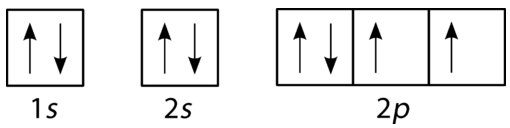
This orbital diagram represents:  
a)
C
b)
B
c)
N
d)
O
59.
This orbital diagram represents:  
a)
C
b)
B
c)
N
d)
O
60.
How many electrons can the d sublevel hold?
a)
14
b)
10
c)
2
d)
6
61.
How many electrons can the s sublevel hold?
a)
14
b)
10
c)
2
d)
6
62.
How many electrons can the p sublevel hold?
a)
14
b)
10
c)
2
d)
6
63.
What is the chemical symbol for the element hydrogen
a)
H
b)
He
c)
h
d)
he
64.
Which of the following is a Halogen? 
a)
Bromine
b)
Rubidium
c)
Argon
d)
Beryllium
65.
How many valence electrons does a halogen have? 
a)
1
b)
2
c)
7
d)
8
66.
How many valence electrons does an alkaline earth metal have? 
a)
1
b)
2
c)
7
d)
8
67.
Which of the following groups is inert? 
a)
Alkali
b)
Transition Metals
c)
Halogens
d)
Noble Gas
68.
Which of the following is the most reactive group of metals? 
a)
Alkali
b)
Alkaline Earth
c)
Halogen
d)
Transition Metals
69.
Which has the greater EN: 
Cl or Al?
a)
Cl
b)
Al
70.
Which of the following will have a larger radius than Zinc?
a)
Gallium
b)
Aluminum
c)
Magnesium
d)
Strontium
71.
Which atom has the largest atomic radius?
a)
potassium
b)
rubidium 
c)
francium
d)
cesium
72.
Ionization energy is...
a)
the energy required to add an electron to a specific atom
b)
how much energy it takes to remove an electron from an atom
c)
the energy required to shield the outer electrons from the nucleus
d)
a measure of the ability of an atom to attract electrons
73.
Electronegativity is...
a)
how good an atom is at attracting electrons
b)
the ability of an atom to lose electrons
c)
the energy required to remove an electron from a specific atom
d)
how easy it is to make friends. 
74.
Which periodic group has the smallest atomic radius?
a)
Alkali metals
b)
Halogens
c)
Noble Gases
d)
Transition metals
75.
Electrons in the outermost orbit or shell
a)
quarks
b)
molecules
c)
valence
d)
compounds