
 Worksheets
Enzymes
Total questions: 15
Worksheet time: 9mins
Name
Class
Date
1.
Enzymes are considered to be
a)
Lipids
b)
Carbohydrate
c)
Protein
d)
Nucleic Acid
2.
What is the purpose of an enzyme?
a)
give permission for the reaction
b)
raise activation energy
c)
speed up reactions
d)
control how many reactions occur
3.
Where do substrates bind on an enzyme?
a)
voltage-gated channels
b)
surface receptor
c)
calcium channels
d)
active site
4.

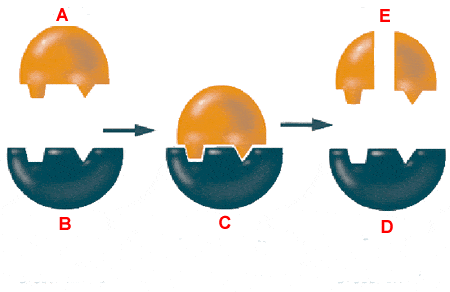
What is structure A?
a)
Substrate
b)
Active site
c)
Enzyme
d)
Products
5.
What 3 letters do enzymes typically end in?
a)
-ose
b)
-ase
c)
-ese
d)
-tic
6.
What is the name for the mechanism of enzyme activity?
a)
Lock and key
b)
jigsaw puzzle
c)
hammer and nail
d)
two hands pattern
7.
At 40 degrees Celsius, your biological enzymes will...
a)
Functional optimally
b)
Denature
c)
Wait until the temp. increases
d)
Wait until the temp. decreases
8.
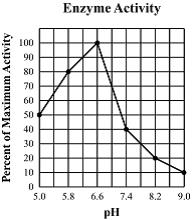
Which of the following conclusions can be drawn from this graph?
a)
The optimum pH of the enzyme is 6.6.
b)
The optimum pH of the enzyme is 5.8
c)
The enzyme’s activity increases as pH increases 5.0 to 9.0
d)
The enzyme’s activity is greater around pH of 8.0 .
9.
What makes an enzyme substrate specific?
a)
Size
b)
Shape
c)
Name
d)
Location it is found in
10.
Enzymes catalyze reactions by ___________ Activation Energy.
a)
Increasing
b)
Decreasing
11.
Which of these is NOT true?
a)
Enzymes can denature (change shape) when the temperature gets too high.
b)
Enzymes can only be used once in a chemical reaction.
c)
Extreme pH can denature enzymes.
d)
Enzymes speed up chemical reactions.
12.
What is the function of amylase?
a)
to break down protein into fatty acids
b)
to break down carbohydrates into amino acids
c)
to break down starch into glucose
d)
to break down protein into glucose
13.
What is the function of protease?
a)
break down starch into amino acids
b)
break down protein into fatty acids
c)
break down protein into amino acids
d)
break down protein into urea
14.
Where do all enzymes work?
a)
small intestine
b)
large intestine
c)
stomach
d)
liver
15.
What is the name of the enzyme found in your saliva?
a)
protease
b)
carbohydrase
c)
lipase
d)
amylase
100 %

