Wayground logo

Free Printable Worksheets

Font size

S
M
L
XL
Worksheets

Water Cycle, Groundwater, Surface Water, & Energy Test

Total questions: 30

Worksheet time: 10mins

Name
Class
Date
1.

What happens once groundwater reaches a layer of rock in the ground that it cannot pass through?

a)

it is soaked up by the impermeable layer

b)

it creates a aquifer

c)

it creates a geyser

d)

it evaporates

2.

What are clouds made of?

a)

dry air

b)

water

3.
When water is heated in the ocean by the sun and turns into water vapor
a)
condensation
b)
evaporation
c)
transpiration
d)
runoff
4.
Water in lakes and rivers that does not contain salt-
a)
recycled water
b)
new water
c)
salt water
d)
fresh water
5.
When water vapor s cooled and forms droplets-
a)
Condensation
b)
Evaportation
c)
Transpiration
d)
Run-off
6.
After condensation, the droplets of water in the clouds fall to the earth in different forms
a)
precipitation 
b)
condensation
c)
evaporation 
d)
ground water
7.
Forms of precipitation are-
a)
only sleet and snow
b)
rain, sleet, hail, and snow
c)
only dew and rain 
d)
only snow and rain
8.

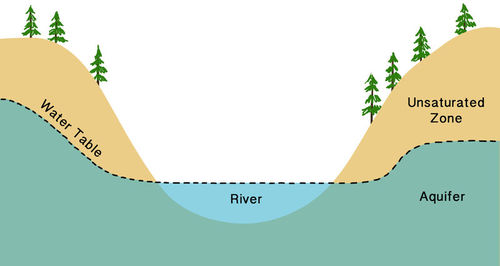
What is the best definition of a water table?

a)

The level to which a river rises when it floods

b)

The boundary between the land and the ocean

c)

The top of the saturated zone in an aquifer

d)

The top of the unsaturated zone in an aquifer

9.

What would cause the water table to lower?

a)

Periods of low precipitation

b)

Low rates of evaporation and transpiration

c)

Increasing amounts of runoff

d)

A heavy rainstorm with a lot of precipitation

10.

What is infiltration?

a)

The process by which water sinks into the ground

b)

The zone where there are still air spaces left between the particles.

c)

The process by which water vapor turns into liquid water and forms fog or clouds.

d)

The process by which water does not sink into the ground, but rather travels along the surface.

11.

Which surface would have the most runoff from it after a rainstorm?

a)
b)
c)
d)
12.

Water is able to flow more easily through the aquifer because its material has a ___________.

a)

low permeability

b)

low porosity

c)

high impermeability

d)

high permeability

13.

In the diagram, the area labeled A is called the __________.

a)

zone of infiltration

b)

recharge zone

c)

zone of saturation

d)

zone of permeability

14.

A cavern is a feature associated with

a)

Volcanoes

b)

Mountainous topography

c)

Karst topography

15.

Though it occurs naturally, human activities can increase

a)

tributaries

b)

eutrophication

c)

watersheds

16.
An area of land in which all of the water falling or flowing over it drains to the same location is a/an…
a)
watershed
b)
watertable
c)
river
d)
aquifer
17.
How do people extract groundwater?
a)
groundwater cannot be extracted
b)
by drilling wells and pumping water out of the ground
c)
mining water from the Earth
d)
answer not shown
18.

Materials carried by a stream are called its ________________

a)

Gradient

b)

Flow

c)

Stream load

d)

Watershed

19.
As the velocity of a stream decreases, what happens to the size particles that it is able to carry?
a)
It's only able to carry larger particles
b)
It's only able to carry smaller particles
c)
It can carry any size particles
20.

The landscape feature labeled X is best described as

a)

Floodplain

b)

Delta

c)

Sandbar

d)

Escarpment

21.

Which letter has a higher velocity?

a)

A

b)

B

22.

Which letter is there more deposition occurring?

a)

A

b)

B

23.
Fossil fuels are classified as nonrenewable because they.......
a)
require expensive equipment
b)
take millions of years to replace
c)
can be found all over 
d)
provide all the energy we use
24.
Which of the following is not a type of fossil fuel? 
a)
Coal
b)
Light
c)
Petroleum
d)
Natural Gas
25.
What are fossil fuels?
a)
Dinosaur bones
b)
Resources made from once living organisms 
c)
Combination of different rocks
d)
Gas Stations
26.
Energy sources that cannot be replaced once they are used up
a)
Renewable Energy Sources
b)
Non Renewable Energy Sources
27.
Which of the following sources of energy is classified as an alternative energy source?
a)
Mined coal
b)
Geothermal heat
c)
Crude oil
d)
Natural gas
28.
All of the following are considered alternative energy sources EXCEPT –
a)
Wind
b)
Coal
c)
Biofuel
d)
Solar
29.

Solar energy is power obtained by harnessing the energy of _________.

a)

the sun's rays

b)

the water currents

c)

the wind

d)

the heat from the ground

30.
One problem with ____ energy is that it produces radioactive waste. 
a)
nuclear
b)
solar
c)
tidal
d)
geothermal