

wayground logo

Free Printable Worksheets

NEW

Font size

S
M
L
XL
Worksheets

Series vs. Parallel Circuits

Total questions: 20

Worksheet time: 13mins
Name
Class
Date
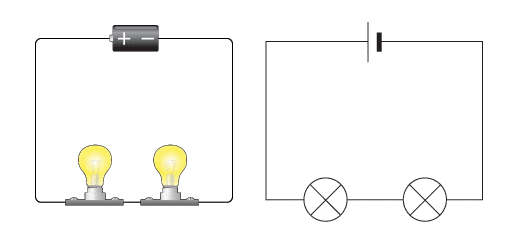
1.
What kind of circuit is this?
a)
Series
b)
Consecutive
c)
Parallel
d)
Training
2.
What kind of circuit is this?
a)
series
b)
parallel
3.
This circuit has more than one loop. When one light goes out, the others stay on. 
a)
closed circuit
b)
series circuit
c)
parallel circuit
d)
open circuit
4.
A series circuit has how many pathways for the electrons to flow?
a)
Two
b)
One
c)
Many
d)
Zero
5.
In a series circuit, if one receiver is disconnected, nothing will work.
a)
true
b)
false
6.
The picture shows an electrical circuit. This circuit is a series circuit because: 
a)
It has 3 light bulbs.
b)
The same current flows through all three light bulbs.
c)
It uses a single battery.
d)
The electrical current is divided between the three light bulbs.
7.

This circuit is easy to repair and less likely to overheat

a)

open circuit

b)

closed circuit

c)

parallel

d)

series

8.

One of the advantages of _________ circuits is that they ensure all components in the circuit have the same voltage

as the source.For instance, all bulbs in a string of lights have the same brightness.

a)

open

b)

multiple

c)

series

d)

parallel

9.

In a parallel circuit if one of the light bulbs burns out the rest _________.

a)

stop the flow of electricity

b)

will go out

c)

can still light up

10.

This is an example of a _______ circuit

a)

close

b)

parallel

c)

series

11.

A series circuit has ____ path(s) that the electric current can take.

a)

one

b)

two

c)

three

12.

This is needed in a circuit to start the electrons moving.

a)

battery

b)

switch

c)

wire

13.

What type of circuit is this picture?

a)

parallel

b)

series

c)

open

14.

How many path(s) does the parallel have?

a)

has only one path for current to travel

b)

does not allow electricity to travel through it

c)

has more than one path for current to travel

15.
The flow/movement of electric charges 
a)
Voltage
b)
Resistance 
c)
Current 
d)
Circuit 
16.
The tendency for a material to oppose the flow of electrons, changing electrical energy into thermal energy and light.
a)
Voltage
b)
Current
c)
Resistance
d)
Circuit 
17.
According to this law, the current in a circuit equals the voltage difference divided by the resistance. 
a)
Law of Conservation of Energy 
b)
Ohm's Law 
c)
Law of Conservation of Charges
d)
Newton's First Law 
18.

SI unit of current is

a)

ampere

b)

metre

c)

ohm

d)

volt

19.

SI unit of voltage is

a)

ampere

b)

metre

c)

ohm

d)

volt

20.

SI unit of resistance is

a)

ampere

b)

metre

c)

ohm

d)

volt
