
 Worksheets
Test 2 Part 1 Review
Total questions: 36
Worksheet time: 23mins
A wave is a disturbance that transfers ________ from one place to another.
Matter
Mass
Energy
The number of waves passing a given point each second is:
Frequency
Wave speed
Wavelength
Amplitude
As wavelength decreases, the crests of the wave:
become wider
become shorter
get closer together
get farther apart
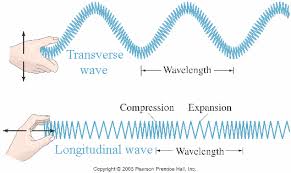
When frequency increases
diffraction increases.
amplitude increases
wavelength decrease
wavelength increases

The lowest point of a transverse wave is the
trough
crest
amplitude
rest
_______ refers to the highest point or peak of a wave.
Crest
Trough
Wavelength
Amplitude

A push or a pull that starts, stops or changes the direction of an object
force
energy
gravity
motion
The pressed together regions of particles in a sound wave are called ____.
rarefactions
compressions
frequencies
wavelengths
An area that is more separate...
compression
expansion
rarefaction
reflection
Plucking a guitar string creates a wave whose motion is perpendicular to the downward force on the strings. This is an example of a _____.
Transverse
Logitudinal
microwave
Light Wave
An ocean wave crashes when its height (also called its _____________) is more than seven times greater than its wavelength.
Crest
Trough
Frequency
Amplitude
A guitar produces sound waves when a string is plucked and it vibrates. The measure of the number of the string's vibrations in 1 second is called ____________.
Wave length
Amplitude
Frequency
Speed


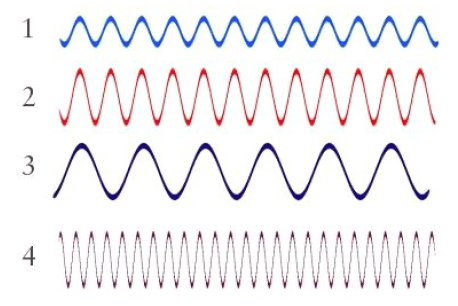
A wave with a large wavelength will have a ______ frequency and _____ energy
high, low
high, high
low, high
low, low

High frequency waves have _________ wavelength.
varying
long
the same
short
In order to calculate speed of a wave that is traveling, you multiply...
wavelength x frequency
frequency x amplitude
amplitude x wavelength

What is the relation between the frequency of electromagnetic waves and their wavelength?
Higher frequency= Higher wavelength
Higher frequency= Lower wavelength
Lower frequency = Lower wavelength

What numbers should be labeled rarefaction in the longitudinal wave?
1 and 3
2 and 4
1 and 2
3 and 4
Sound waves can travel through all of the following EXCEPT
a vacuum (empty space)
air
water
steel



