
 Worksheets
Reflection- Physics Mastery Check
Total questions: 13
Worksheet time: 7mins
Law of reflection state that - The angle of incidence is .................. to the angle of reflection.
(La ley de reflexión establece que - El ángulo de incidencia es .................. al ángulo de reflexión.)
equal (igual)
half (mitad)
double (doble)
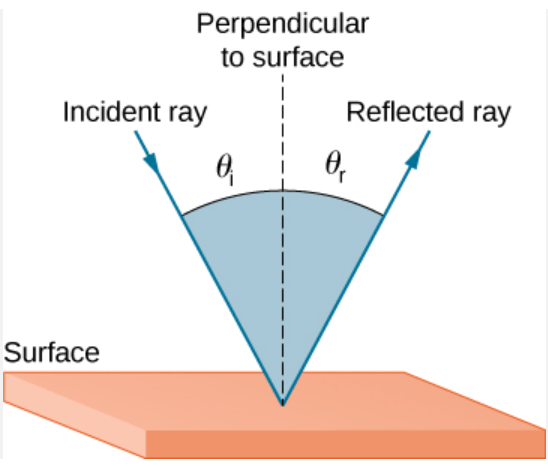
If the angle of incidence is 20 degrees, what will be the value of the angle of reflection?
(Si el ángulo de incidencia es de 20 grados, ¿cuál será el valor del ángulo de reflexión?)
0
10
20
30
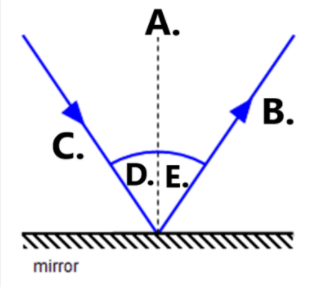
In the diagram, which letter represents the angle of incidence?
(En el diagrama, ¿qué letra representa el ángulo de incidencia?)
B
C
D
E
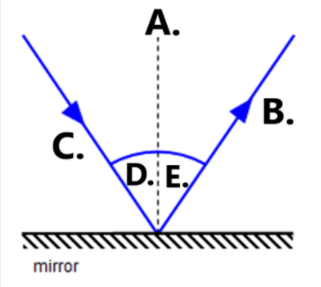
In the diagram, which letter represents the angle of reflection?
(En el diagrama, ¿qué letra representa el ángulo de reflexión?)
B
C
D
E
What is reflection?
(¿Qué es la reflexión?)
Reflection is the absorbing of light off the surface that it strikes on. (La reflexión es la absorción de la luz de la superficie sobre la que incide.)
Reflection is the bouncing of light off the surface that it strikes on.(La reflexión es el rebote de la luz en la superficie sobre la que incide.)
Reflection is the bending of light off the surface that it strikes on.(La reflexión es la desviación de la luz de la superficie sobre la que incide.)
Reflection is the scattering of light off the surface that it strikes on. (La reflexión es la dispersión de la luz de la superficie sobre la que incide.)
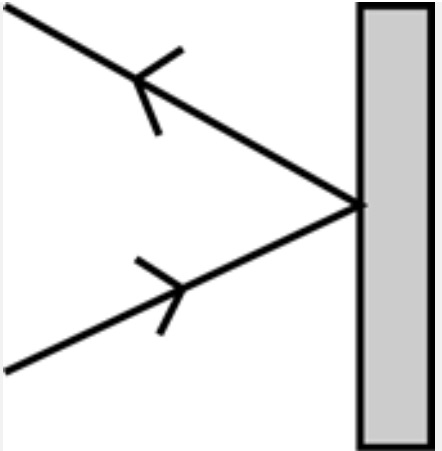
The illustration shows a light ray striking an object.
In the illustration, the light ray striking the object is-
(La ilustración muestra un rayo de luz que golpea un objeto. En la ilustración, el rayo de luz que golpea el objeto es:)
absorbed (absorbido)
stopped (detenido)
reflected (reflejado)
refracted (refractado)
The ray of light that strikes a reflecting surface is called ________.
(El rayo de luz que incide en una superficie reflectante se llama ________.)
incident ray (rayo incidente)
reflected ray (rayo reflejado)
normal line (normal line)
The angle produced as a source of light bounces off a reflecting surface is called ______.
(El ángulo producido cuando una fuente de luz rebota en una superficie reflectante se llama ______.)
angle of incidence (ángulo de incidencia)
angle of reflection (angulo de reflexion)
obtuse angle (angulo obtuso)
straight angle (angulo tecto)
Why can you see most objects?
(¿Por qué puedes ver la mayoría de los objetos?)
They emit light. (Ellos emiten luz.)
Light refracts through them. (La luz se refracta a través de ellos.)
Light reflects off them. (La luz se refleja en ellos)
They absorb light. (Ellos absorben la luz.)
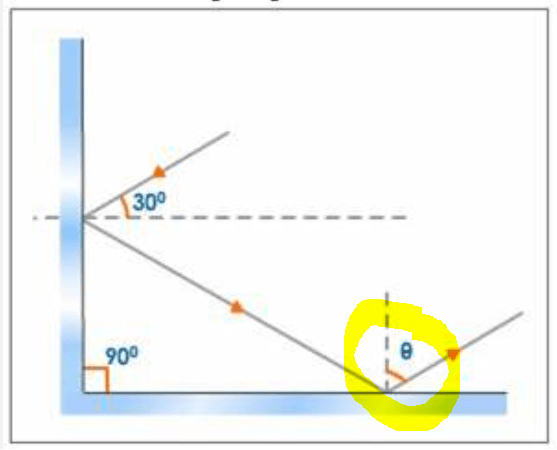
What is the value of the unknown angle (theta) in the following diagram?
(¿Cuál es el valor del ángulo desconocido (theta) en el siguiente diagrama?)
60 degrees
30 degrees
90 degrees
45 degrees

