
NEW
Font size
 Worksheets
Recount Text
Total questions: 30
Worksheet time: 17mins
Kang Chol Hwan was born into a loyal family that had once lived in the large Korean community of Japan. In Kyoto, his grandfather had been supporter of Kim II Sung, North Korean’s Great Leader since 1945. In 1961 the grandfather returned with his family to North Korea and had important government post.
Within months, however, he was complaining to friends that North Korea was not the country he had expected. He was shocked to see so much poverty, which he eventually came to blame on the government’s stifl ing left for work and never returned. One morning in July 1977, when Kang was nine, his grandfather left for work and never returned.
A few weeks later, seven plain clothes security guard stormed into Kang’s house “Your grandfather betrayed the fatherland,” one of them stated” You must be punished.”
Kang’s parents and grandmother sobbed as they forced to pack their belongings into two army trucks. The family was driven off, but Kang’s mother was left behind, “spared” because her own father was regarded as a revolutationary hero. That was the last Kang ever saw her.
- What was a reason for Kang’s grandfather never returned to Kang’s house?
A supporter of Kim II Sung
Accused of betraying North Korea
Regarded as a hero
As an important person in Korea
Force Kang’s family to leave their homeland
Kang Chol Hwan was born into a loyal family that had once lived in the large Korean community of Japan. In Kyoto, his grandfather had been supporter of Kim II Sung, North Korean’s Great Leader since 1945. In 1961 the grandfather returned with his family to North Korea and had important government post.
Within months, however, he was complaining to friends that North Korea was not the country he had expected. He was shocked to see so much poverty, which he eventually came to blame on the government’s stifl ing left for work and never returned. One morning in July 1977, when Kang was nine, his grandfather left for work and never returned.
A few weeks later, seven plain clothes security guard stormed into Kang’s house “Your grandfather betrayed the fatherland,” one of them stated” You must be punished.”
Kang’s parents and grandmother sobbed as they forced to pack their belongings into two army trucks. The family was driven off, but Kang’s mother was left behind, “spared” because her own father was regarded as a revolutationary hero. That was the last Kang ever saw her.
What is mainly discussed in the last paragraph?
The last minutes Kang gathered together with his mother
The day Kang ever saw his grandma and grandpa
The moment Kang’s father was regarded as a hero
The last day Kang’s parents and his grandma sobbed
The sad moment when Kang’s parents meet grandma
Kang Chol Hwan was born into a loyal family that had once lived in the large Korean community of Japan. In Kyoto, his grandfather had been supporter of Kim II Sung, North Korean’s Great Leader since 1945. In 1961 the grandfather returned with his family to North Korea and had important government post.
Within months, however, he was complaining to friends that North Korea was not the country he had expected. He was shocked to see so much poverty, which he eventually came to blame on the government’s stifl ing left for work and never returned. One morning in July 1977, when Kang was nine, his grandfather left for work and never returned.
A few weeks later, seven plain clothes security guard stormed into Kang’s house “Your grandfather betrayed the fatherland,” one of them stated” You must be punished.”
Kang’s parents and grandmother sobbed as they forced to pack their belongings into two army trucks. The family was driven off, but Kang’s mother was left behind, “spared” because her own father was regarded as a revolutationary hero. That was the last Kang ever saw her.
Why did Kang’s grandfather disappear?
He left for work and went somewhere else
He returned to North Korea
He was supporter of Kim II Sung
He went to the government’s office
He was kidnapped and punished by the security guards
Kang Chol Hwan was born into a loyal family that had once lived in the large Korean community of Japan. In Kyoto, his grandfather had been supporter of Kim II Sung, North Korean’s Great Leader since 1945. In 1961 the grandfather returned with his family to North Korea and had important government post.
Within months, however, he was complaining to friends that North Korea was not the country he had expected. He was shocked to see so much poverty, which he eventually came to blame on the government’s stifl ing left for work and never returned. One morning in July 1977, when Kang was nine, his grandfather left for work and never returned.
A few weeks later, seven plain clothes security guard stormed into Kang’s house “Your grandfather betrayed the fatherland,” one of them stated” You must be punished.”
Kang’s parents and grandmother sobbed as they forced to pack their belongings into two army trucks. The family was driven off, but Kang’s mother was left behind, “spared” because her own father was regarded as a revolutationary hero. That was the last Kang ever saw her.
A few weeks later, seven plain clothes security guards stormed into Kang’s house.
The underlined word has the same meaning as ....
Destroyed
Attacked
Knocked
Involved
Knotted
Galileo Galilei (1564-1642) — Astronomer and Scientist. Galileo developed a superior telescope and made many significant discoveries in astronomy. He was sentenced to life imprisonment by the inquisition for his support for the Copernican theory that the sun was at the centre of the solar system.
Galileo was born in Florence, Italy in 1564 to a poor but noble family His parents recognized their child's innate intelligence and talents and so made sacrifices to have him educated. At his father's insistence, Galileo studied the profitable career of medicine. But, at the University of Pisa, Galileo became fascinated in a wide range of subjects. He was also critical of many of Aristotle's teaching which had dominated education for the past 2,000 years.
Galileo was appointed to be a mathematics professor at the University of Pisa, but his strident criticisms of Aristotle left him isolated among his contemporaries. After three years of persecution, he resigned and went to the University of Padua, where he taught maths. His entertaining lectures attracted a large following and he was able to spend the next 18 years pursuing his interests in astronomy and mechanics.
Something that we can learn from Galileo Galilei's biography is ...
We must always believe whatever the society believes to avoid getting persecuted.
We must never go against the believe of the society to avoid getting imprisoned.
We should believe in something and stay faithful to it no matter how hard.
We must sacrifice everything to get ourselves educated.
We should spend 18 years to pursue our interests.
Galileo Galilei (1564-1642) — Astronomer and Scientist. Galileo developed a superior telescope and made many significant discoveries in astronomy. He was sentenced to life imprisonment by the inquisition for his support for the Copernican theory that the sun was at the centre of the solar system.
Galileo was born in Florence, Italy in 1564 to a poor but noble family His parents recognized their child's innate intelligence and talents and so made sacrifices to have him educated. At his father's insistence, Galileo studied the profitable career of medicine. But, at the University of Pisa, Galileo became fascinated in a wide range of subjects. He was also critical of many of Aristotle's teaching which had dominated education for the past 2,000 years.
Galileo was appointed to be a mathematics professor at the University of Pisa, but his strident criticisms of Aristotle left him isolated among his contemporaries. After three years of persecution, he resigned and went to the University of Padua, where he taught maths. His entertaining lectures attracted a large following and he was able to spend the next 18 years pursuing his interests in astronomy and mechanics.
From the fact that Galileo Galilei was imprisoned for supporting the Copernican theory, which later was proven to be true, we know that Galileo Galilei was ...
Reckless
Stubborn
Tenacious
Arrogant
Foolish
Galileo Galilei (1564-1642) — Astronomer and Scientist. Galileo developed a superior telescope and made many significant discoveries in astronomy. He was sentenced to life imprisonment by the inquisition for his support for the Copernican theory that the sun was at the centre of the solar system.
Galileo was born in Florence, Italy in 1564 to a poor but noble family His parents recognized their child's innate intelligence and talents and so made sacrifices to have him educated. At his father's insistence, Galileo studied the profitable career of medicine. But, at the University of Pisa, Galileo became fascinated in a wide range of subjects. He was also critical of many of Aristotle's teaching which had dominated education for the past 2,000 years.
Galileo was appointed to be a mathematics professor at the University of Pisa, but his strident criticisms of Aristotle left him isolated among his contemporaries. After three years of persecution, he resigned and went to the University of Padua, where he taught maths. His entertaining lectures attracted a large following and he was able to spend the next 18 years pursuing his interests in astronomy and mechanics.
According to the biography, why did Galileo Galilei resign from his teaching job at the University of Pisa?
He had attracted many followers.
He was persecuted for three years.
He was appointed as a mathematics professor.
He had a better offer from the University of Padua.
He wanted to pursue his interests in astronomy and mechanics.
Galileo Galilei (1564-1642) — Astronomer and Scientist. Galileo developed a superior telescope and made many significant discoveries in astronomy. He was sentenced to life imprisonment by the inquisition for his support for the Copernican theory that the sun was at the centre of the solar system.
Galileo was born in Florence, Italy in 1564 to a poor but noble family His parents recognized their child's innate intelligence and talents and so made sacrifices to have him educated. At his father's insistence, Galileo studied the profitable career of medicine. But, at the University of Pisa, Galileo became fascinated in a wide range of subjects. He was also critical of many of Aristotle's teaching which had dominated education for the past 2,000 years.
Galileo was appointed to be a mathematics professor at the University of Pisa, but his strident criticisms of Aristotle left him isolated among his contemporaries. After three years of persecution, he resigned and went to the University of Padua, where he taught maths. His entertaining lectures attracted a large following and he was able to spend the next 18 years pursuing his interests in astronomy and mechanics.
"His parents recognized their child's innate intelligence and talents and so made sacrifices to have him educated." (Paragraph 2) The underlined word is closest in meaning to ...
Acquired
Ingenious
Multiple
Inborn
Strident
Here is my unforgettable experience. One day I joined a story telling contest. Two of my friends and I had been chosen to take a part in the final round at the district level. I was very happy and eager to win the competition.
For preparation, I had to memorize and understand the story well.My teacher guided and taught me pronunciation, facial expression and gestures. One day, before performing, my friends and I were busy to prepare the props and costumes for the competition. Thing that me sad was my teacher rented the props and costumes for my friends but not for me. My two friends had beautiful costumes and luxurious props. Although I just wore the simple ones, I performed my best to win the competition.
The competition started. I got number 29 and my friends got number 5 and 10. I was nervous but I showed my best performance on stage. Lots of people took photos and videos of me. Finally, anxiety was gone after I had finished performing. And then, the announcement came which made three of us very uneasy. Luckily I was chosen as the first winner. I went to the stage and all the judges congratulated me and gave a plague, trophy, and money. I was very happy.
What is the writer’s intention to write the text?
To tell his achievement
To win the competition
To describe his feeling to the teacher
To show his disappointment to teacher.
To tell his expectation to be the winner.
Here is my unforgettable experience. One day I joined a story telling contest. Two of my friends and I had been chosen to take a part in the final round at the district level. I was very happy and eager to win the competition.
For preparation, I had to memorize and understand the story well.My teacher guided and taught me pronunciation, facial expression and gestures. One day, before performing, my friends and I were busy to prepare the props and costumes for the competition. Thing that me sad was my teacher rented the props and costumes for my friends but not for me. My two friends had beautiful costumes and luxurious props. Although I just wore the simple ones, I performed my best to win the competition.
The competition started. I got number 29 and my friends got number 5 and 10. I was nervous but I showed my best performance on stage. Lots of people took photos and videos of me. Finally, anxiety was gone after I had finished performing. And then, the announcement came which made three of us very uneasy. Luckily I was chosen as the first winner. I went to the stage and all the judges congratulated me and gave a plague, trophy, and money. I was very happy.
Why did the writer feel sad before the competition?
She had no luxurious gown.
Her teacher really cares about her.
Her teacher was not fair to her.
Her friends did not support her.
She only had a very simple dress
Here is my unforgettable experience. One day I joined a story telling contest. Two of my friends and I had been chosen to take a part in the final round at the district level. I was very happy and eager to win the competition.
For preparation, I had to memorize and understand the story well.My teacher guided and taught me pronunciation, facial expression and gestures. One day, before performing, my friends and I were busy to prepare the props and costumes for the competition. Thing that me sad was my teacher rented the props and costumes for my friends but not for me. My two friends had beautiful costumes and luxurious props. Although I just wore the simple ones, I performed my best to win the competition.
The competition started. I got number 29 and my friends got number 5 and 10. I was nervous but I showed my best performance on stage. Lots of people took photos and videos of me. Finally, anxiety was gone after I had finished performing. And then, the announcement came which made three of us very uneasy. Luckily I was chosen as the first winner. I went to the stage and all the judges congratulated me and gave a plague, trophy, and money. I was very happy.
From the text it can be concluded that ….
Practice makes performance go well.
Being nervous helps perform well on the stage.
Wearing simple clothes can help win the competition.
It is necessary to wear beautiful costumes for the competition
Beautiful costumes and luxurious props are the requirements for the competition.
Here is my unforgettable experience. One day I joined a story telling contest. Two of my friends and I had been chosen to take a part in the final round at the district level. I was very happy and eager to win the competition.
For preparation, I had to memorize and understand the story well.My teacher guided and taught me pronunciation, facial expression and gestures. One day, before performing, my friends and I were busy to prepare the props and costumes for the competition. Thing that me sad was my teacher rented the props and costumes for my friends but not for me. My two friends had beautiful costumes and luxurious props. Although I just wore the simple ones, I performed my best to win the competition.
The competition started. I got number 29 and my friends got number 5 and 10. I was nervous but I showed my best performance on stage. Lots of people took photos and videos of me. Finally, anxiety was gone after I had finished performing. And then, the announcement came which made three of us very uneasy. Luckily I was chosen as the first winner. I went to the stage and all the judges congratulated me and gave a plague, trophy, and money. I was very happy.
"…..I was nervous, I showed my best performances on the stage."
The sentences can be connected by which of the following words?
However
Although
Because
But
If
Luis Lionel Andres Messi, born June 24, 1987, is an Argentina football player for F.0 Barcelona. He is not very tall, mainly, due to the a g problem he had when he was younger. His eyes are brown. He never has short hair.
Lionel Messi started playing football at a very early age in his hometown's Newell's Old Boys. From the age of 11, he suffered from a hormone deficiency and as Lionel's parents were unable to pay for the treatment in Argentina, they decided to move to Barcelona, Spain.
In the 2003-2004 season, When he was still only 16 years old, Messi made his first team debut in a friendly with Porto marked the opening of the new Dragao stadium. The following championship-winning season, Messi made his first appearance in an official match on October 16, 2004, in Barcelona's derby win against at the Olympic Stadium (0-1). And now, in 2010, 2011, and 2012 he are best player in the world with collect 3 Ballon D'Or.
According to the text, Messi's parents moved to Barcelona ...
Because they were very poor in Argentina
Because they wanted Messi to be successful in soccer
So that Messi could learn in the best soccer club
To get Messi's health problem cured
To find the best treatment to cure Messi's health problem
Luis Lionel Andres Messi, born June 24, 1987, is an Argentina football player for F.0 Barcelona. He is not very tall, mainly, due to the a g problem he had when he was younger. His eyes are brown. He never has short hair.
Lionel Messi started playing football at a very early age in his hometown's Newell's Old Boys. From the age of 11, he suffered from a hormone deficiency and as Lionel's parents were unable to pay for the treatment in Argentina, they decided to move to Barcelona, Spain.
In the 2003-2004 season, When he was still only 16 years old, Messi made his first team debut in a friendly with Porto marked the opening of the new Dragao stadium. The following championship-winning season, Messi made his first appearance in an official match on October 16, 2004, in Barcelona's derby win against at the Olympic Stadium (0-1). And now, in 2010, 2011, and 2012 he are best player in the world with collect 3 Ballon D'Or.
What is the main idea of the third paragraph?
He hasn't really attractive face, but he's a very good football player.
Lionel Messi is a good player for FC. Barcelona.
His best characteristics are on the foot has competitiveness.
He appears to be a quite good and modest person.
He has long black hair and brown eyes.
I’ll never forget May 3, 1990, the date Tien- Tien came into our lives. Ahong , the wife of my youngest brother Ajiang, gave birth after a very difficult labour of five hours. We already had a name for the baby before she was born. She would be called Tien-Tien which meant ‘sweetness’.
As we waited at the hospital, our joy quickly turned to grief when the attending physician announced that he could detect no signs of life in Tien-Tien. There was no breathing, no heartbeat, so he finally declared the baby dead.
Ajiang decide to lay the body next to the Taizi River. To outsiders, this might be strange: to us, a Chinese family with almost no money or resources, the prospect of encouraging the baby’s spirit slip away to a better world in a beautiful setting made a great deal of sense. We planned to return later to bury Tien-Tien’s remains and pay honour to her.
Ajiang wrapped his child in a red fl oral quilt and set off for the river. He gently laid his baby in a patch of grass along the bank of the river.
A week later, while I was walking home from work, I overheard several women talking about one of her friends. They said their friend heard a baby crying and the sound came from a patch of grass along the river bank. They further explained that the baby had been placed in a local orphanage.
Something inside me said it must have been Tien-Tien. Without waiting any longer, I ran to the orphanage. In the room I saw Tien-Tien in a crib covered in dirt but very much alive.
What is the best title for the text?
The dead baby
The baby in a crib
The poor crying baby
The baby by the river
The newborn baby
I’ll never forget May 3, 1990, the date Tien- Tien came into our lives. Ahong , the wife of my youngest brother Ajiang, gave birth after a very difficult labour of five hours. We already had a name for the baby before she was born. She would be called Tien-Tien which meant ‘sweetness’.
As we waited at the hospital, our joy quickly turned to grief when the attending physician announced that he could detect no signs of life in Tien-Tien. There was no breathing, no heartbeat, so he finally declared the baby dead.
Ajiang decide to lay the body next to the Taizi River. To outsiders, this might be strange: to us, a Chinese family with almost no money or resources, the prospect of encouraging the baby’s spirit slip away to a better world in a beautiful setting made a great deal of sense. We planned to return later to bury Tien-Tien’s remains and pay honour to her.
Ajiang wrapped his child in a red fl oral quilt and set off for the river. He gently laid his baby in a patch of grass along the bank of the river.
A week later, while I was walking home from work, I overheard several women talking about one of her friends. They said their friend heard a baby crying and the sound came from a patch of grass along the river bank. They further explained that the baby had been placed in a local orphanage.
Something inside me said it must have been Tien-Tien. Without waiting any longer, I ran to the orphanage. In the room I saw Tien-Tien in a crib covered in dirt but very much alive.
Why did they suddenly become unhappy?
The baby was heartless
The baby was already dead
The baby was declared alive
The baby could not be detected
The baby had no sign of life
I’ll never forget May 3, 1990, the date Tien- Tien came into our lives. Ahong , the wife of my youngest brother Ajiang, gave birth after a very difficult labour of five hours. We already had a name for the baby before she was born. She would be called Tien-Tien which meant ‘sweetness’.
As we waited at the hospital, our joy quickly turned to grief when the attending physician announced that he could detect no signs of life in Tien-Tien. There was no breathing, no heartbeat, so he finally declared the baby dead.
Ajiang decide to lay the body next to the Taizi River. To outsiders, this might be strange: to us, a Chinese family with almost no money or resources, the prospect of encouraging the baby’s spirit slip away to a better world in a beautiful setting made a great deal of sense. We planned to return later to bury Tien-Tien’s remains and pay honour to her.
Ajiang wrapped his child in a red fl oral quilt and set off for the river. He gently laid his baby in a patch of grass along the bank of the river.
A week later, while I was walking home from work, I overheard several women talking about one of her friends. They said their friend heard a baby crying and the sound came from a patch of grass along the river bank. They further explained that the baby had been placed in a local orphanage.
Something inside me said it must have been Tien-Tien. Without waiting any longer, I ran to the orphanage. In the room I saw Tien-Tien in a crib covered in dirt but very much alive.
From paragraph 3, we can conclude that ….
Ajiang came from a poor family
The baby was buried by the river
Ajiang’s family lived by Taizi River
The baby’s spirit would go to a better life
Tien-tien’s remains had been buried in the river bank
The Proclamation of Indonesian Independence was read at 10.00 a.m. on Friday, 17 August 1945. The document was signed by Sukarno and Mohammad Hatta, who were appointed president and vice-president respectively the following day. The draft was prepared only a few hours earlier on the night of 16 August 1945 by Sukarno, Hatta, and Soebardjo, at the house of Rear-Admiral Tadashi Maeda.
The wording of the proclamation had been discussed at length and had to balance both conflicting internal Indonesian and Japanese interests. Sukarno drafted the final proclamation which balanced the interests of both the members of the youth movement and the Japanese. The term ‘TRANSFER OF POWER’ was used in Indonesian to satisfy Japanese interests to appear that it was an administrative transfer of power, although the term used ‘pemindahan kekuasaan’ could be perceived to mean political power. The wording ‘BY CAREFUL MEANS’ related to preventing conflict with members of the youth movement. The wording ‘IN THE SHORTEST POSSIBLE TIME’ was used to meet the needs of all Indonesians for independence.
Initially the proclamation was to be announced at Djakarta central square, but the military had been sent to monitor the area, so the venue was changed to Sukarno's house at Pegangsaan Timur 56. The proclamation was heard throughout the country because the text was secretly broadcast by Indonesian radio personnel using the transmitters of the Jakarta Broadcasting Station.
What is the main idea of the second paragraph?
The location of the proclamation.
The night before the proclamation.
The term ‘TRANSFER OF POWER’.
The preparation of Indonesian independence.
Word choice in the text of proclamation.
The Proclamation of Indonesian Independence was read at 10.00 a.m. on Friday, 17 August 1945. The document was signed by Sukarno and Mohammad Hatta, who were appointed president and vice-president respectively the following day. The draft was prepared only a few hours earlier on the night of 16 August 1945 by Sukarno, Hatta, and Soebardjo, at the house of Rear-Admiral Tadashi Maeda.
The wording of the proclamation had been discussed at length and had to balance both conflicting internal Indonesian and Japanese interests. Sukarno drafted the final proclamation which balanced the interests of both the members of the youth movement and the Japanese. The term ‘TRANSFER OF POWER’ was used in Indonesian to satisfy Japanese interests to appear that it was an administrative transfer of power, although the term used ‘pemindahan kekuasaan’ could be perceived to mean political power. The wording ‘BY CAREFUL MEANS’ related to preventing conflict with members of the youth movement. The wording ‘IN THE SHORTEST POSSIBLE TIME’ was used to meet the needs of all Indonesians for independence.
Initially the proclamation was to be announced at Djakarta central square, but the military had been sent to monitor the area, so the venue was changed to Sukarno's house at Pegangsaan Timur 56. The proclamation was heard throughout the country because the text was secretly broadcast by Indonesian radio personnel using the transmitters of the Jakarta Broadcasting Station.
What is the main idea of the second paragraph?
The location of the proclamation. The night before the proclamation. The term ‘TRANSFER OF POWER’. Word choice in the text of proclamation. The preparation of Indonesian independence.
The location of the proclamation. The night before the proclamation. The term ‘TRANSFER OF POWER’. Word choice in the text of proclamation. The preparation of Indonesian independence.
The location of the proclamation. The night before the proclamation. The term ‘TRANSFER OF POWER’. Word choice in the text of proclamation. The preparation of Indonesian independence.
The location of the proclamation. The night before the proclamation. The term ‘TRANSFER OF POWER’. Word choice in the text of proclamation. The preparation of Indonesian independence.
“the text was secretly broadcast” (Par. 3). The underlined word has similar meaning to ….
continuously
formally
openly
publicly
quietly
Thomas Matulessy, also known as Kapitan Pattimura or Ahmad Lussy or simply Pattimura, was an Ambonese soldier and National Hero of Indonesia. Born on the island of Saparua, Pattimura joined the British army after they took the Maluku islands from the Dutch colonials. When the islands were returned to the Dutch in 1816, he was dismissed. Concerned that the Dutch would implement programs that limited his people, Pattimura led an armed rebellion that captured Fort Duurstede on 16 May 1817. Killing the inhabitants of the fortress and fighting off Dutch reinforcements, on 29 May he was declared the leader of the Maluku people. After being betrayed by the King of Booi Pati Akoon, he was captured by Dutch forces on 11 November and hanged the next month.
Pattimura has become a symbol of both Maluku and Indonesian independence, praised by President Sukarno and declared a national hero by President Suharto. He has several namesakes both in the capital of Maluku, Ambon, and in the rest of the Indonesian archipelago.
What can we infer from the text?
The Dutch took Maluku from the British.
Pattimura was born in a nationalist family.
Thomas Matulessy joined the British army to fight the Dutch.
Pattimura was executed to stop the rebellion.
Pattimura was declared the leader of the Maluku people by Suharto.
Last holiday I went to Paris. I visited museums and sat in public gardens. A friendly waiter taught me a few words of French. Then he lent me a book. I read a few lines, but I did not understand a word. Every day, I thought about postcards. My holidays passed quickly, but I did not send any cards to my friends. On the last day I made a big decision, I got up early and bought thirty seven cards. I spent the whole day in my room, but I did not write a single card!
The text is telling about?
My holiday
Holiday in Paris
Last holiday
Last holiday I went to Paris. I visited museums and sat in public gardens. A friendly waiter taught me a few words of French. Then he lent me a book. I read a few lines, but I did not understand a word. Every day, I thought about postcards. My holidays passed quickly, but I did not send any cards to my friends. On the last day I made a big decision, I got up early and bought thirty seven cards. I spent the whole day in my room, but I did not write a single card!
Whom did the writer meet in Paris?
A man that take him to French
A man that gave him thirty seven cards
A man that lent him a book
On Saturday night, we went to the Town Hall. It was the last day of the year and a large crowd of people had gathered under the Town Hall clock. It would strike twelve in twenty minutes’ time. Fifteen minutes passed and then, at five to twelve, the clock stopped. The big minute hand did not move. We waited and waited, but nothing happened. Suddenly someone shouted,”It’s two minutes past twelve! The clock has stopped!”
I looked at my watch. It was true. The big clock refused to welcome the New Year. At that moment, everybody began to laugh and sing.
Based on the text, where was the writer?
At the center of the town
At home
At the market
Social function of recount text is...
To give an information
To telling about the story
To retell past experiences
What is the tense used in recount text?
Simple Present Tense
Present Continuous Tense
Simple Past Tense
What is Recount Text ?
is a story with complication or problematic events and it tries to find the resolutions to solve the problems
is a text which retells events or experiences in the past
is a text which informs readers about events of the day

The event of the text is.....
Last Monday was a busy day for me. I spent my time to do a lot of activities from college to my home.
First, at the morning, I did my presentation assignment with my partner, she was Nurhidayah.
Those activities made my day busy.
What are generic structure of the text ?
Description, Identification
Orientation, Steps, Reorientation
Reorientation, thesis, Description
Orientation, Events, Reorientation

What is the main idea of the paragraph?
Invitation of writer’s International Day
Invitation of Grandparents’ International Day
Celebration of Sue’s International Day
Celebration of Grandparents’ International Day
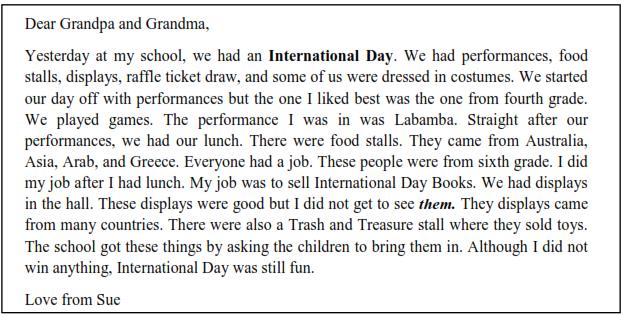
What is the purpose of the text?
To describe The International Day
To announce The International Day
To report The International Day
To retell The International Day

