
 Worksheets
Primary 4 Science Semester Test review
Total questions: 179
Worksheet time: 2hrs 8mins
What has a definite shape and volume?
Gas
Liquid
Solid
A state in which matter has no definite shape and no definite volume is ________.
Liquid
Solid
Gas
What state of matter has a definite volume, but no definite shape?
Gas
Solid
Liquid
Milk is a example of which state of matter?
Solid
Liquid
Gas
A pencil is a __________.
Solid
Liquid
Gas
Plasma
When you heat water, it turns into a _________.
Gas
Liquid
Solid
What is an example of a solid turning into another state of matter?
Breaking a chair into pieces
Snow becoming a puddle
Tearing a piece of paper
Water freezing
When an ice cube melts, it changes from...
A solid to a liquid.
A liquid to a gas.
A solid to a gas.
A gas to a solid.
Which would cause liquid water to change to a solid?
Warming
Heating
Freezing
Dripping
Shauna placed a cup of water in a warm place. One week later, no water was left in the cup. What probably happened?
The liquid water changed to a gas.
The liquid water changed to a solid.
The water leaked out of the cup.
The water spilled from the cup.
Any substance that has mass and occupies space is called____________________
atom
matter
volume
Which state of matter has a definite shape and volume?
solid
liquid
gas
Molecules in _______________are very loosely packed.
solids
liquids
gases
The air you breathe is in which state?
gas
liquid
solid

These particles are representing which state of matter?
gas
solid
liquid

These particles are representing which state of matter?
liquid
solid
gas
Matter exist in _________________states.
Two
Three
Four
Five

Magnetism is a type of ____________
force
book
plant
animal

What do magnets stick to?
copper
wood
iron
plastic

When two magnets attract, they ______________
push apart
change color
get colder
pull together

When two magnets repel, they ________________
change color
pull together
push apart
get colder

Materials with _______________ surfaces have less friction.
smooth
rough
both

A puck slides along an icy surface. What makes it slow down?
It runs out of push
It rubs against the ice
It runs out of electricity

A boy sits halfway down a grassy slope. What force stops him sliding down?
Weight
Gravity
Friction
Magnetism

On which surface will a toy car travel the furthest?
Carpet
Polished Wood
Ice
Grassy field

Rougher surfaces have ...
greater friction
less friction
the same level of friction
no friction
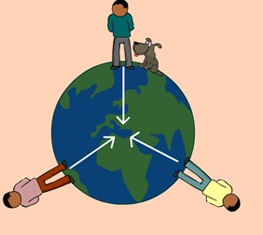
What is gravity?
A force that pulls
A force that pushes
energy
friction

A _____ is a pull or a push.
force
friction
gravity
speed

A _____ moves an object closer to you.
push
pull
friction
magnetism

One way that a force can cause the change in an object's motion is to...
do nothing.
eat ice cream.
start the object moving.
shine on the object.

_____ is the force that slows and stops motion between touching objects.
Friction
Gravity
Pull
Push

What science tool is used to measure mass?
ruler
pan balance
circuit
graduated cylinder

What science tool is used to measure distance?
graduated cylinder
ruler or meter stick
thermometer
magnet

Which force causes an object to move away from you?
magnetism
push
pull
gravity

The toy car and ramp seen above might be used to answer which testable question?
A. What material is the ramp made of?
B. Which toy car looks the best?
C What effect does gravity have on a toy car?
D. What metal makes the best toy cars?

2. By changing the surface over which the car rolls from sandpaper to wax paper, you might be able to test the effect of what force?
A. Magnetism
B. Wind
C. Wind
D. Friction
3. Which two tools below would be most useful in testing how the mass of an object can affect the distance it moves with a push?
A. Spring scale and hot plate
B. Balance and meter stick
C. Graduated Cylinder and beaker
D. Magnet and thermometer
How might you test the strength of several different types of magnets?
F. Submerge each magnet in water
F. Submerge each magnet in acid
H. Find the mass of each magnet
J. Measure the attraction force of each magnet

5. An experiment is conducted to measure the amount of force required to push a square cardboard box from one side of the room to the other side. What variable is likely to lessen the force required?
A. Adding several heavy weights to the box
B. Tipping the box onto its side
C. Adding another box on top
D. Placing the box onto a wheeled cart
6. Some students were investigating if the height that a ball was dropped would affect its bounce. The ball was dropped at 60 cm and at 80 cm. What statement is true of the results for each of the heights that the balls were dropped?
F. There was no difference in the results.
G. The ball dropped from 60 cm bounced 20 cm higher than
the ball dropped from 80 cm.
H. The ball dropped from 80 cm bounced higher than the ball dropped from 60 cm.
J. The ball dropped from 60 cm bounced higher than the ball dropped from 80 cm.

7. A ball is sitting loose in the moving wagon pictured below. If the wagon stops suddenly, the ball will
A. stop immediately with the wagon
B. roll forward in the wagon and fall off
C. both the wagon and the ball will crash
D. stay exactly where it is

During an experiment, students applied an equal force to push each box pictured below. If they pushed all of the boxes on the same surface for same amount of time, which box will MOST LIKELY move the greatest distance?
F. 30 kg
G. 15 kg
H. 150 kg
J. 40 kg

9. Some students were testing the effects of force on the motion of a water bottle. They set up the experiment picture above and rolled the full water bottle down both ramps. What question were the students most likely trying to answer?
A. How does mass affect the distance a full water bottle will roll?
B. How does friction affect the distance a full water bottle will roll?
C. How does the size of the water bottle affect the distance it rolls?
D. How does ramp height affect the distance a full water bottle will roll?

10. A student investigating the effects of forces, measures the distance a ball can be pushed by air from a small fan. What is the variable (change) in this investigation?
F. The mass of the balls being pushed by air.
G. The length of the surface on which the balls roll.
H. The amount of wind pushing the balls.
J. The type of surface the balls are rolling on.
Which of the following is correct about coal?
solid fossil fuel
liquid fossil fuel
gaseous fossil fuel
plasma fossil fuel
Which of the following is correct about oil?
solid fossil fuel
liquid fossil fuel
gaseous fossil fuel
plasma fossil fuel

Look at the electrical appliance shown. The form of energy produced when it is being used is...
sound, light and heat
light and heat
sound and light
sound and heat

The alternative energy used as shown in the picture is?
geothermal
tides
wind
wind and water

Look at the electrical appliances given. The electrical appliances that undergo the same energy transformation when in use are...
1 and 2
1 and 4
2 and 3
2 and 4

Look at the electrical appliances given. The electrical appliances that undergo the same energy transformation when in use are...
1 and 2
1 and 4
1, 2 and 4
1, 2, 3 and 4

Look at the picture shown.
The energy transformation that takes place in this electrical appliance is from.... energy to .... energy.
electrical, heat
electrical, sound
sound, electrical
electrical, chemical

Look at these electrical appliances.
The appliances that undergo the same energy transformation when in use are....
1 and 2
2 and 3
1, 2 and 3
1, 2, 3 and 4

The alternative energy as shown in the picture is...... energy.
geothermal
tide
wind
solar
Mention 3 ways to conserve energy.
Turn off the electronics when they are not in use
Use energy-saving lamps
Shut your computer down when you are done with it
Leaving the Lights On
Leaving the fridge open
What is energy?
moving energy
stored energy
renewable energy
The ability to do work.
What is NOT a renewable energy source?
Coal
Wind
Solar
Water
__________ is a substance from plants or animal faeces used to produce fuels and generate electricity.
Fossil Fuel
Nuclear
Uranium
Biomass
Sun is a need for plants to carry out?
defecation
excretion
photosynthesis
digestion
Blowing wind rotates the __________ to generate electricity.
dam
windmill
hydroelectric dam
nuclear power station
The main source of energy is
Geothermal
Sun
Wind
Nuclear
The energy from the Sun is used to generate electricity with the use of ________________?
Wave turbine
Windmill
Power station
Solar Panel
_____________ is the energy produced by vibrating objects.
Heat energy
Kinetic Energy
Potential Energy
Sound Energy
Which of renewable energy come from deep within the Earth?
Wind
Hydro
Biomass
Geothermal
Which of following non-renewable energy produce less pollutant?
Coal
Oil
Natural Gas
Nuclear
A solid fossil fuel that is formed from the concentrated remains of plants over very long periods of time
coal
oil
uranium
solar
Burning of fossil fuels has a direct effect on the environment. The greatest direct effect is–
animals being driven from their homes.
pollution being added to the air.
plants in nearby ponds being killed.
powerful winds being created.
All of the following are considered alternative energy sources EXCEPT –
Wind
Coal
Biofuel
Solar

The picture shows what type of transformation
Electrical to mechanical
light to electric
electrical to light
light to light
What is energy transformation?
a change of energy from one form to another
when energy gets more energy added to it
when energy gets destroyed
a change in intensity
Which of following is NOT the component of simple circuit?
Bulb
Switch
Valve
Cell

What do we call the part of bulb which labelled number 1?
Glass cover
Metal filament
Metal wires
Metal casing
What is the unit to measure voltage?
Ampere
Ohm
Volt
Mole
What makes a short circuit ?
When wire is short
When wire heats up
When battery has finished
When bulb blown up

What can we do to make the bulbs brighter?
Add more wire
Add more switch
Add more bulb
Add more battery

Which variable is changed from the circuits?
Number of bulb
Number of batteries
Arrangement of bulb
Arrangement of battery

What can we do to make the bulb dimmer?
Shorten the wire
Take the switch
Add more battery
Reduce battery

Which of following will NOT make the bulb dimmer?
Use old battery
Add more bulb
Use longer wire
Change bulb position
How do we control the flow of the electricity?
By using bulb
By using battery
By using buzzer
By using switch
What an electrical technician wear when fixing electrical appliances?
Wear a googles
Wear gloves
Wear mask
Wear boots
Which of following activity is allowed when we are using main electricity?


Which of following is battery symbol?


Which of following circuit will NOT light up?


How do you identify a faulty component in a series circuit?
When we add more bulb
When we add more battery
When the bulb does not light up
When the wire is longer

What makes the bulb does not light up?
Because there is no switch
Because there is only 1 battery
Because there is only 1 bulb
Because the wire is not connected well
Which of the following are the electric components of a simple circuit?
Motor, bulb, wire, buzzer
Switch, battery, cell, wire
Battery, main, switch, wire
Switch, wire, battery, motor
Ani wants to set up an electric circuit with these loads : 1 bulb, and 1 buzzer. A bulb needs 1.5 volts and a buzzer needs 3 volts. How many 1.5 V batteries does she need to make the loads work?
She needs 2 batteries.
She needs 3 batteries.
She needs 6 batteries.
She needs 8 batteries.

Look at the picture shown.
Which part of the bulb should connect to the battery?
1 and 2
1 and 3
3 and 4
2 and 4

Look at the picture shown.
Which set-up(s) will light the bulb?
I only
I and II
III and IV
III and V
A battery produces 1.5 volts. How many total voltages would 10 batteries (arranged in series) produce?
7.5 Volts
15 Volts
21.5 Volts
30 Volts

Look at the electric circuit shown.
Which diagram is correct to represent the circuit?


This happens when the current flows through a path which has little or even zero load. What this picture shown?
It's open circuit
It's parallel circuit
It's short circuit
It's not a circuit
The pressure from an electrical circuit's power source that pushes electric current through a loop is called _________.
transformation
voltage
volt
switch
___________ is electrical component of a circuit that consumes electric energy, such as bulb, motor and buzzer.
load
wire
switch
electricity

Look at the picture shown.
Which light will be brighter? Explain your answer.
A, because it has less voltage than B.
B, because it has less voltage than A.
A, because it has more voltage than B.
B, because it has more voltage than A.

Sean builds a circuit below. The cell and light bulb work. If Sean connects all materials like the picture shown, will the bulb light up? Explain your answer.
Yes, the bulb will light up because the key is a conductor.
Yes, the bulb will light up because the key is an insulator.
No, the bulb will not light up because the key is a conductor.
No, the bulb will not light up because the key is an insulator.

Andy builds the circuit below. The bulbs do light up. Andy wants to change his circuit so that the two bulbs are brighter (He can use any other equipment). Suggest a way so Andy can make his two bulbs dimmer.
Andy should put more batteries.
Andy should remove a bulb.
Andy should remove a battery.
Andy should put a switch.
Jill wants to do an investigation to see whether the voltage of a battery will affect the electric circuit.
What variable She needs to change?
the lengths of wire
the number of bulbs
the voltage of the battery
the brand of the battery
(Select more than one answer)
Jill wants to do an investigation to see whether the voltage of a battery will affect the electric circuit.
Mention 3 variables that need to keep the same?
the type of circuit
the number of bulbs
the voltage of the battery
the brand of batteries

Look at the picture shown.
We can model the flow of electricity using a central heating system. Which components of an electric circuit do the parts of the central heating system represent. Label A, B, C and D in order.
A=Load ; B=Cell ; C=Wire ; D=Electric current
A=Bulb ; B=Switch ; C=Wire ; D=Electric current
A=Load ; B=Cell ; C=Switch ; D=Electric current
A=Bulb ; B=Battery ; C=Switch ; D=Electric current
Electric current flows from the _________ terminal to the __________ terminal of a battery.
positive ; negative
negative ; positive
open ; closed
south ; north
(True or False)
An electrical technician need to wear gloves when fixing electrical appliances.
True
False
(True or False)
Different electrical components need same amounts of energy to work.
True
False
(True or False)
A 3-Volt battery has less potential energy than a 6-Volt battery.
True
False
(True or False)
When there is a break in a circuit, the components will not work.
True
False


ear canal
eardrum
pinna
hammer
ear canal
eardrum
pinna
hammer

What is this?
eardrum
ear canal
pinna
hammer

What is this?
eardrum
ear canal
hammer
anvil

What is this?
eardrum
cochlea
hammer
auditory nerve

pinna
stirrup
eardrum
cochlea

What is this?
anvil
cochlea
ear canal
auditory nerve
Sound occurs when particles in the air
vibrate
heat up
slow down
change shape
The unit for measuring sound is
metres (m)
decibels (db)
litres (L)
grams (g)
Which state of matter is the best conductor of sound (hear sounds the loudest)?
solid
liquid
gas
they are all the same
How can a person prevent hearing damage?
Avoid sticking objects into your ears.
Don't listen to loud music for long periods of time.
Wear ear protection when on a construction site.
All of the above
A dolphin hears using its
tailbone
jawbone
fin
pinna

Which wave is the loudest sound?
1
2
3
4

Which wave has the highest pitch
1
2
3
4

Which wave has the lowest pitch?
1
2
3
4
What does the word vibration mean?
moving very fast up and down or side to side
the loudness or softness of a sound
the bones in your ear that help you hear
the ripples in water
What is the best soundproofing material?
aluminum foil
newspaper
a towel
bubble wrap
To help the people at the back of the concert hall hear better, the singer needs to use a sound-amplifying device (device to make sound louder) such as a:
a telephone
a microphone
a telescope
a microscope

Look at the picture. What is one safe sound to hear?
fireworks
dishwasher
rock concert
shotgun
Sounds from 100-140 db are dangerous. What may happen if you hear sounds in this range for a long period of time or very close to your ear?
You may have hearing loss or go deaf.
Nothing will happen
You will go blind.
Check all of the pleasant sounds
birds singing
a jackhammer
loud screaming
soft music
Check all of the unpleasant sounds
nails on a chalkboard
banging a pot with a spoon
your mom yelling at you
calm ocean waves
Check all of the ways humans can make sounds.
thinking
talking
clapping
playing the piano
The frequency of infrasonic sound is below 20 Hz. The following animal that can hear infrasonic sound is ....


Musical instruments above that can produce sound from vibrating strings are shown by ...


Read the statements below.
I. Sound can be absorbed.
II. Sound cannot be reflected
III. Sound travel faster in solids than in gas
IV. Sound is a longitudinal waves
V. Sound cannot travel through gas
The correct properties of sound are shown by number...
I, II, and III
I, III and V
I, III, and IV
I, II and V
The following statement is correct about the use of ultrasonic sound is...
To measure the blood pressure
To check the internal human organs like the use of Ultrasonography (USG).
To check body temperature
To measure the speed of water
The frequency of ultrasonic sound is...
Above 20.000 Hz
Between 20 – 20.000 Hz
Below 20 Hz
Below 20.000 Hz

The part of the ear that is pointed by number 2 is used to...
collect the soundwave
connect the outer and middle parts or the ear
connect the middle and inner parts
keep the body balancear
The items that can reflect sound are...
Ceramic
Sponge
Carpets
Glass
Read the sentences below.
1. Sound enter the ear from the air.
2. The auditory nerves transmit the sound to the brain so thatwe can perceive sound.
3. The sound vibrate the ear drum
4. The sound vibrations are transmitted to the earbones and cochlea, until they reach
auditory nerves.
The correct way of how our ear works is shown by ...
1-2-3 and 4
1-2-4 and 3
1-3-4 and 2
1-4-3 and 2
The outer part of the ears are ...
Ear canal
Ear bones
Earlobes
Auditory nerve
The correct ways to care of ears are...
Cleaning our ears using wet cotton buds.
Cleaning ears everyday.
Seeing the doctor to check if the ears are healthy.
Using headset frequently
Deafness is ear disorders caused by ....
Damage of the ear drums and hearing nerves.
an infection in the middle part of ear
cleaning the ear using sharp materials
clean the outer part of the ears using rough and hard materials
Read the characteristics below.
- The frequency of this sound is between 20Hz-20.000 Hz.
- This frequency can be detected by the human ear.
The type of sound based on the characteristics above is ....
ultrasonic sound
infrasonic sound
audiosonic sound
supersonic sound

The correct way to keep our ears healthy based on the picture above is . . .
Cover the ears if you hear sudden loud noises
Do not clean the ears oft en as it will take away the serumen or earwax
Clean the outer part of the ears using soft materials, such as cotton
Avoid using headsets often
The part of ear that has the function to deliver the stimulus of sound to the brain is ....
Pinna
Auditory nerve
Ear drum
Ear bones

Based on the picture, sound can travel through....
air
solid
liquid
gas

