wayground logo

Free Printable Worksheets

Font size

S
M
L
XL
Worksheets

4th 9 Week Review

Total questions: 43

Worksheet time: 1hrs 7mins

Name
Class
Date
1.

What is a limiting factor?

a)

Factors that always increase a population

b)

Factors that always decrease a population

c)

Resources that are unlimited

d)

Factors/resources that limit how many organisms can live in an area at the same time

2.

Choose the 4 limiting factors.

a)

Food

b)

Water

c)

Time

d)

Space

e)

Shelter

3.
If there is more food than usual in an ecosystem, then...
a)
Populations will stay the same
b)
Populations will decrease
c)
Populations will increase
4.

Abiotic factors are...

a)

living things

b)

non-living things

c)

undead things

5.

Which of these is NOT an abiotic factor?

a)

water

b)

temperature

c)

grass

d)

soil

6.

Biotic factors are...

a)

living things

b)

non-living things

c)

undead things

7.

Natural disasters can be considered limiting factors.

a)

true: density independent limiting factors

b)

false; natural disasters are not limiting factors

c)

true: density dependent limiting factors

d)

false: because Mrs. Schaffer said

8.
Limiting factors which impact the size of a population no matter how large that population is.
a)
Density Independent Limiting Factors
b)
Density Dependent Limiting Factors
c)
Carrying Capacity
d)
Exponential Growth
9.

Which factor might not contribute to an exponential growth rate in a given population?

a)

lower death rates

b)

higher birth rates

c)

less competition

d)

reduced resources

10.
Food, water, sunlight, shelter, and space are resources that are  __________.
a)
limiting factors
b)
wet
c)
messy
d)
found in rocks
11.
Kudzu has overgrown many parts of southern Missouri and native ground plants have disappeared from the area. This is an example of:
a)
Parasitism between kudzu and the native plants
b)
A predator prey relationship between ground plants and kudzu
c)
Competition occurring between the native and invasive species
d)
Commesalism occurring between the kudzo and native plants
12.
1. What makes a species invasive?
a)
Moving to a new ecosystem and taking resources from natives 
b)
Not having papers
c)
Species that can't adapt
d)
Plants that take up too much space
13.
What is a native specie?
a)
A specie that is local and has lived in the same place
b)
A specie who has come from another state or country
c)
A specie that has no "home" and travels for its whole life
d)
None of the above
14.

What does Acid Rain do?

a)

It turns you into the Joker

b)

It burns your face off

c)

It deteriorates the ecosystem and buildings

d)

It... idek

15.

What is a habitat destruction?

a)

cities getting bigger

b)

the improvement of an ecosystem

c)

a reduction of the area in which a population lives in

d)

a type of land

16.

Reducing the quality of habitat through pollution or invasive species is called ___________.

a)

degradation

b)

destruction

c)

fragmentation

d)

mitigation

17.

What is the main (and direct) reason for habitat destruction caused by humans?

a)

Global warming

b)

Research

c)

Technological Development

d)

Rising Population

18.
In the energy pyramid here, how much of the energy in each level gets lost as heat or used by the organism for survival?
a)
80%
b)
90%
c)
10%
d)
20%
19.

If only 10% of an organism's energy is available for the next trophic level, what happens with the other 90% of the energy?

a)

It is destroyed after it is used up

b)

It is used for life processes like movement, creating offspring producing waste or lost as body heat

c)

It is used to grow plants

d)

It is lost completely as body heat

20.

The approximate amount of energy that is transferred between each trophic level is:

a)

10%

b)

0.1%

c)

90%

d)

It totally depends on the ecosystem.

21.
Organisms that break down dead plants & animals and release nitrogen back into atmosphere...
a)
bacteria
b)
plants
c)
animals
d)
producers
22.
How nitrogen is "fixed" into useable form for plants...
a)
through action of bacteria only
b)
through lightning only
c)
through action of bacteria & lightning
d)
through photosynthesis
23.

Look carefully at the image. If energy is lost as it moves up the food chain, what trophic level has the most amount of energy?

a)

1st level - producers

b)

2nd level - primary consumers

c)

3rd level - secondary consumers

d)

4th level - tertiary consumers

24.
What would happen to the ecosystem if the biomass of 1st level consumers was higher than the biomass of producers? 
a)
The primary consumers will eat all of the producers...
b)
The primary consumers will become the producers and perform photosynthesis 
c)
The producers will become primary consumers
d)
This is DEFINITELY not the right answer.
25.

Why are energy pyramids never inverted?

a)

because energy is always lost from one trophic level to the next

b)

because energy is always gained from one trophic level to the next

c)

because energy cannot be measured as it transfers from one trophic level to the next

d)

because it just never is

26.
What would happen to the ecosystem if the biomass of 1st level consumers was higher than the biomass of producers? 
a)
The primary consumers will eat all of the producers...
b)
The primary consumers will become the producers and perform photosynthesis 
c)
The producers will become primary consumers
d)
This is DEFINITELY not the right answer.
27.
Which of the following is the correct equation for PHOTOSYNTHESIS?
a)
CO+ light + H2O --> O+ Sugar
b)
CO+ sugar + H2O --> O+ light
c)
O2 + light + H2O --> CO+ Sugar
d)
CO+ O2 + H2O --> Light+ Sugar
28.
What are the products of photosynthesis?
a)
water and carbon dioxide
b)
oxygen and glucose
c)
oxygen and carbon dioxide
d)
oxygen and water
29.
Which of the following removes carbon from the atmosphere?
a)
Combustion
b)
Respiration
c)
Photosynthesis
d)
Death
30.

C6H12O6 is also known as glucose (sugar). Where is it found?

a)

Plants

b)

Animals

c)

Both plants and animals

d)

Neither plants or animals

31.
How do living organisms return carbon to the atmosphere in the carbon cycle?
a)
respiration and photosynthesis
b)
 decomposition and respiration
32.

Deforestation causes an increase in atmospheric carbon dioxide

a)

true

b)

false

33.
Does deforestation contribute to global warming?
a)
No, trees aren't that important
b)
Sometimes because only the cutting down of Maple trees contributes to global warming
c)

No, deforestation makes the Earth cooler

d)
Yes; less trees means less CO2 is turned into oxygen.
34.

How do plants affect the air that animals and people breathe?

a)

Plants use oxygen from the air to make their own food

b)

Plants release pollution into the air

c)

Plants take in carbon dioxide and release oxygen

d)

Plants take in oxygen and release carbon dioxide

35.
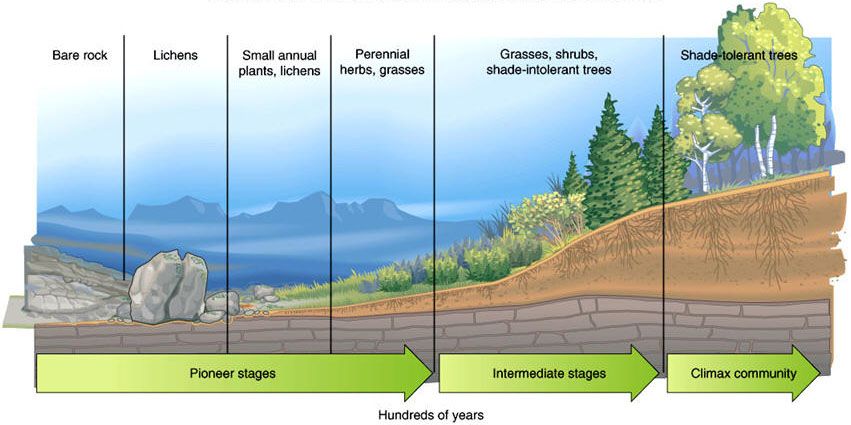
What is formed during primary succession that doesn't need to be formed during secondary succession?
a)
pioneer species
b)
soil
c)
climax community
d)
lichens
36.
What type of succession is shown going from figure A to figure B?
a)
primary succession
b)
eutrophication
c)
secondary succession
d)
intermediate
37.
succession that occurs in an area with no soil
a)
ecological succession 
b)
primary succession 
c)
secondary succession
d)
pioneer speciles
38.
starts with bare rock followed by lichen
a)
primary succession 
b)
secondary succession
c)
both types of succession
39.
this type of succession occurs after a forest fire
a)
primary succession
b)
secondary succession
c)
both
40.
Which catastrophic event will most likely have the effect of returning an ecosystem to primary succession?
a)
A tornado
b)
A volcanic eruption
c)
A flood
d)
A drought
41.

The picture shows what type of succession?

a)

primary

b)

secondary

c)

tertiary

d)

quadanary

42.

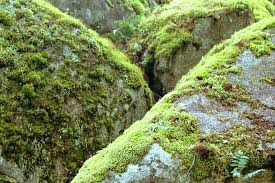
What are examples of pioneer species in a primary succession?

a)

Bushes and Shrubs

b)

Oak trees

c)

Mossess and Lichens

d)

A rose Bush

43.

After a volcanic eruption, lava covers the land. What is the order that plants grow to repopulate the area?

a)

Lichens → Shrubs → Grasses → Trees

b)

Lichens → tree → shrubs→Grasses

c)

Grasses → Lichens → Shrubs → Trees

d)

Lichens → Grasses → Shrubs → Trees